
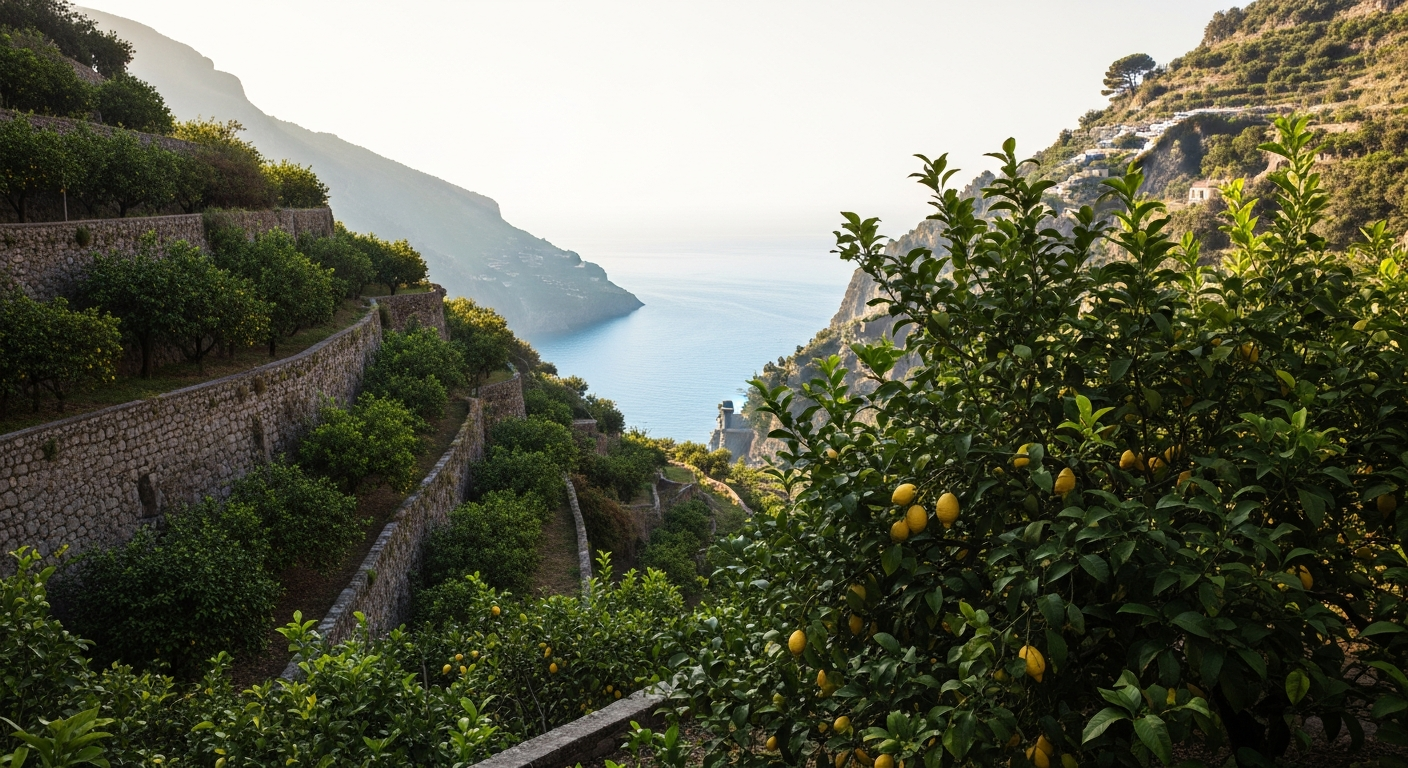
The Amalfi Coast is best understood as a series of vertical problems solved by human persistence. The cliff face drops four hundred metres into the Tyrrhenian Sea and the towns cling to it at angles that should not support permanent habitation. The roads are too narrow for two buses to pass. The steps are everywhere. The lemons grow on terraces carved into the rock over a thousand years, tended by families who have been doing this longer than the Italian state has existed. You arrive thinking it is a landscape. Within a day you understand it is an argument for a particular way of living. The steps are everywhere, steep enough to rule out anything underneath but a slip dress and a pair of silicone covers.
The Sfusato Lemon
The lemon specific to this coast is the sfusato amalfitano, a variety shaped like a spindle at both ends rather than the rounded form you know from everywhere else. Arab merchants introduced the first citrus to the coast during the early Middle Ages. The local growers crossbred these with bitter oranges, and by the eleventh century the sfusato had settled into its current form. For four centuries, between 1400 and 1800, the primary market was northern European navies who needed it for the vitamin C to prevent scurvy. The terraces you walk through now were built to supply those ships.
The fruit has twice the concentration of essential oils as common varieties. Peel a sfusato in warm air and the citrus notes cut through everything else in the vicinity. The limoncello made from the sfusato peel is not the sweet yellow liqueur sold in tourist bottles. The correct version is bitter, cold, and brief. It arrives after dinner at the better restaurants without being ordered. It is assumed you want it.
Ravello Above the Coast
Ravello sits 365 metres above the sea, accessible from Amalfi by a road that climbs through lemon groves with the valley opening below at each hairpin. The town is small, with two central piazzas and a population that has been declining since the thirteenth century when the Rufolo merchant family built their villa on the ridge overlooking the coastline they were financing with trade.
Villa Rufolo was constructed around 1270 by that same family, at the height of Ravello's maritime commercial power. The architecture reflects the Rufolo reach: Arab-Norman in structure, with a Moorish cloister of intertwined columns, twin towers, and terraced gardens over the sea that Richard Wagner described in his diary as the garden of Klingsor after visiting in 1880. The Villa Cimbrone, a kilometre's walk through the town, has a belvedere at the edge of the cliff where the view extends, on a clear day, past Capri to the horizon. Both gardens open to visitors. Both require flat shoes and patience with uneven stone paths.
Positano and the Descent
Positano is the most vertical town on the coast. The main road runs along the top, and everything else descends from it: steps, lanes, more steps, smaller lanes, until the beach arrives at the bottom and the boats wait in the shallows. The walk from the road to the beach takes fifteen minutes downward and twenty-five minutes back. In July, at noon, the return climb is not comfortable in any fabric heavier than linen.
La Sponda at the Sirenuse hotel has been setting the standard for Positano evenings for decades. The restaurant runs along a terrace with vines overhead and lemon trees at the edge, white linens, and a view of the illuminated cliff face after dark. The kitchen sources from the coastal farms above the town, working with whatever the morning brought in. Dress for this table the way you would dress for a theatre performance where you are also part of the production. The terrace is a social event. The food is remarkable. Both things require attention.
Moving Along the Coast
The SS163 coastal road is not for the impatient. It was carved into the cliff face in the 1850s and has not been made easier since. Bus or boat are the correct modes. The ferry that runs between Positano, Amalfi, and Salerno takes the cliff from the water and shows you what you are actually dealing with: a series of towns pressed into crevices above a sea that is, on certain afternoons, impossibly blue. From the water, the terraced lemon groves are visible as a green geometry against pale stone, with the occasional flash of yellow fruit.
Amalfi town itself, population five thousand, was for two centuries one of the great maritime powers of the Mediterranean. The Amalfi Tables, a maritime code written in the eleventh century, governed trade across the Mediterranean until the sixteenth century. Da Gemma restaurant has been operating since 1872 on a terrace overlooking the Cathedral of Sant'Andrea, which contains the relics of the apostle Andrew and whose facade is a striped Norman-Arab confection that looks like something from Palermo relocated to a cliff above the sea. Lunch there, in the shade of the terrace, with the square below and the cathedral stairs ascending into the heat: this is what the Amalfi Coast is actually for.
What the Coast Demands
The Amalfi Coast demands upward movement and warm evenings in equal measure. The days are physical: stone steps, boat transfers, the descent to a beach that requires a return climb. The evenings are theatrical: lit terraces, sea views, the social pressure of a setting that expects something considered.
The dresses that work here are light in fabric, clear in line, and structured enough to hold a shape through an evening. The backless silhouette and the plunging neckline read correctly in a setting this old and this confident. What is needed beneath them for the long terrace dinners, the boat crossing back at midnight, the unexpected climb: covers that go on before the dress and are forgotten. Ultra-thin at the edge, less than half a millimetre, good for fifteen or more wears, the adhesive releases cleanly when the evening is done. They are what the terrace evenings require and what you will not think about once they are on.
For navigating backless cuts along a coast where every restaurant faces the sea, the backless dress guide covers the variables by cut and occasion. For how another city handles the evening dress question with similar seriousness, Lima offers a useful contrast.
Packing the Coast
The coast rewards restraint in luggage and boldness in individual pieces. Two or three dresses that work from afternoon to late evening. One set of linen separates for the daytime movement. Flat shoes that handle uneven stone and wet boat decks without complaint. A single light layer for the evenings when the sea breeze comes in off the Tyrrhenian after dinner. The sfusato terrace above Amalfi, the Villa Rufolo at golden hour, the table at La Sponda where the vine overhead makes patterns on the white cloth: these moments do not need more than this.
The coast has been receiving visitors for a thousand years. It knows what it offers and it offers it without apology. The only question is whether you arrive prepared to receive it properly.
Packed beside the linen. Designed to disappear.


