
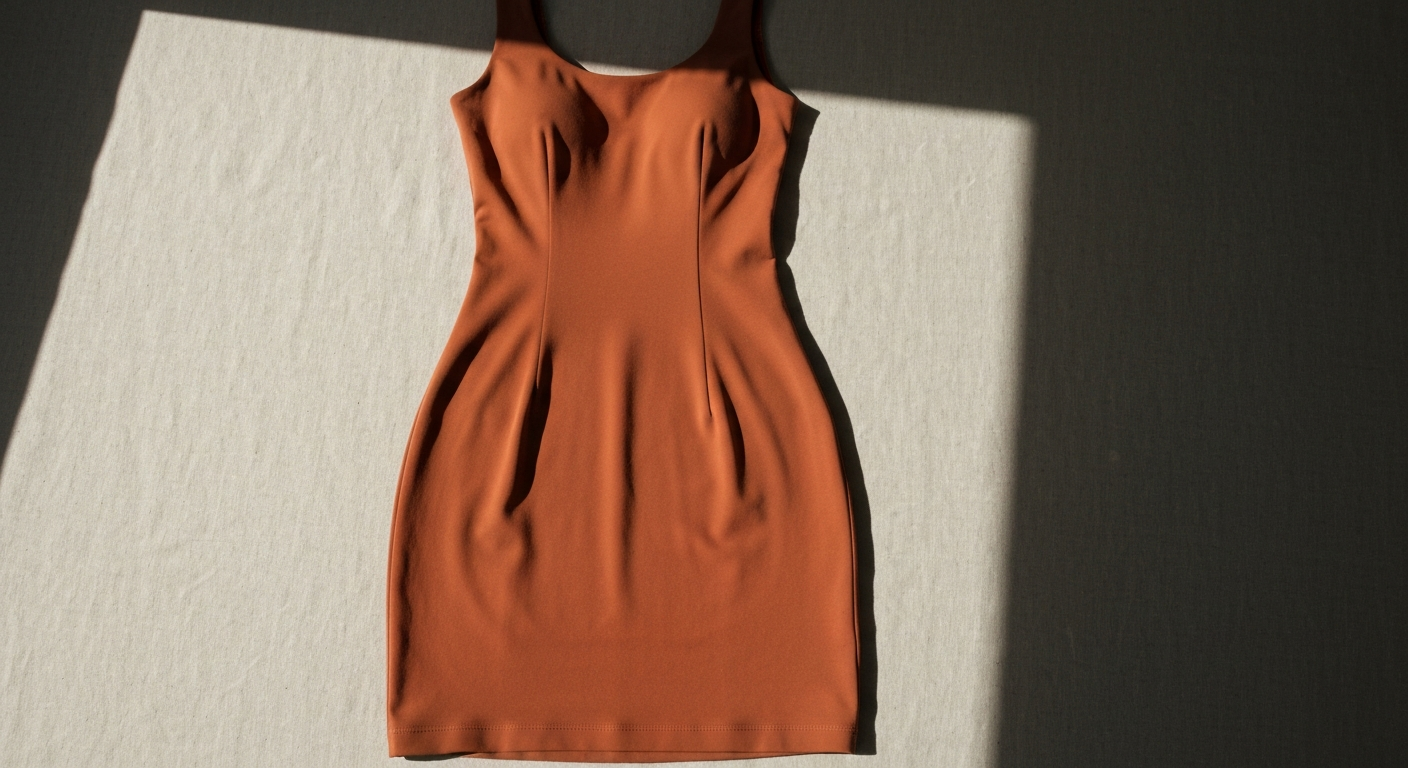
Compression fabric surfaces every edge, seam, and thickness differential underneath it. The line visible through a bodycon dress is not the dress failing. It is the underlayer revealing itself. Silicone covers have no edge, no seam, and no transition zone to read through stretch fabric.
The short answer: nothing with a seam, a hem, or a band. A bodycon dress is compression fabric stretched over whatever is underneath it. Any edge reads as a ridge on the outside. The Confidence Set has no band to show and no elastic edge to print through the fabric. It holds by adhesion, not elastic, so there is no line left to eliminate. Everything below is the longer answer: the three sources of visible line, and which one is yours.
Herve Leger had been working for Karl Lagerfeld at Fendi, then at Chanel, before he launched his own brand in 1985 and began working on the garment that would define him. He was thinking about bandaging, about the structural logic of compression, about what a dress would look like if it held the body the way athletic tape holds a joint: firm, precise, load-bearing at every point. In 1993 his house released the first commercial version of the bandage dress, constructed from dozens of elasticised strips of knitted viscose, rayon, and Lycra woven together into a compression garment of singular sculptural intent. It sold immediately. By 1998 the house was generating over ten million dollars annually from the format alone.
What Leger had understood, and what every designer working in compression fabrics since has had to reckon with, is that a garment this close to the body surfaces everything. The bodycon dress is not forgiving of layers. It is a document of what lies beneath it. The question of what to wear underneath a bodycon dress is not a matter of personal preference or comfort tolerance. It is a structural problem with a specific solution, and the solution depends on what kind of line is creating the problem.
What Creates a Line
Visible lines in a bodycon dress come from three different sources, and they behave differently. Understanding which is present determines what eliminates it.
The first source is edge. Any underwear with a seam, a hem, an elastic waistband, or a leg opening creates a physical edge against the skin. When a compression fabric is stretched over that edge, the edge reads on the outside of the dress as a depression, a shadow, a ridge. The fabric on either side of the edge sits at different heights relative to the skin surface, and the compression magnifies this difference rather than smoothing it. This is the problem that seamless and laser-cut underwear address: they eliminate the edge by removing the seam. Laser-cut underwear is cut rather than hemmed. The edge is a single thickness of fabric rather than a folded seam. The compression of the dress meets a uniform surface.
The second source is thickness differential. Even without seams, if an underlayer is present at some parts of the body and absent at others, the bodycon dress will show the transition zone. The fabric-covered area sits fractionally higher than the uncovered area, and in compression fabric that fraction is enough to show as a line. A high-cut brief that ends mid-hip, for instance, creates a line at the leg opening even if the opening is entirely seamless, because the thickness of the fabric itself creates a step at the transition zone.
The third source is texture transfer. Compression fabrics, particularly the rayon-viscose-Lycra blends used in bandage dress construction, can transmit surface texture from the skin through to the exterior in certain light conditions. A textured bra cup, with any foam or lace pattern in the fabric, shows not as an edge but as a subtle embossing through the dress surface in raking light. This is the most difficult line to see in a domestic mirror but the most reliably captured in photography.
Viscose and What It Reads
The rayon-viscose base of bandage construction is a yarn spun from regenerated cellulose, dissolved wood pulp processed through spinnerets and stretched into fibre. The result is a textile with a silk-like hand and a higher density than either natural silk or polyester of the same denier. It is also hydrophilic: viscose absorbs moisture readily, which is relevant to performance in warm conditions. In a Mediterranean-temperature room, a tight viscose dress will warm and soften slightly over the course of an evening. The compression changes marginally, not enough to alter the silhouette, but enough to alter how the fabric reads on the surface.
This means that a line that was invisible at the beginning of the evening may become marginally visible later, when the fabric has relaxed. The inverse is also true: on a cool evening, viscose compression remains at its most rigid and surface-reading, and a line that disappears in summer heat remains visible through winter.
Contemporary bodycon dresses in scuba fabric, a double-knit polyester-spandex construction without the compression of bandage, are more forgiving. The double-knit structure creates a thicker fabric with more inherent smoothing. Scuba is the bodycon fabric that tolerates more beneath it, though it sacrifices the precise sculptural quality of bandage construction for that tolerance.
The Chest Problem
The chest in a bodycon dress presents a problem distinct from the waist and hip. The torso below the bust is cylindrical, and compression fabrics work well on cylinders: they stretch uniformly and read uniformly. The bust is not cylindrical. It is a complex three-dimensional form, and a bra cup applied to that form adds an additional layer that sits at a different angle to the fabric surface in different zones. The lower cup sits closer to the body; the upper cup sits further. The compression fabric tries to span this difference and reads the attempt as a line, sometimes as an edge, sometimes as a crease.
A t-shirt bra with moulded foam cups performs worst in this context. The foam is a fixed three-dimensional shape, and it adds uniform thickness across the cup surface. The line at the cup edge, where the foam ends and the unpadded zone begins, shows clearly through compression fabric. The thinner the foam, the less visible the edge; but moulded cups thin enough to not show tend to be thin enough to not provide meaningful support.
The solution for the chest in a bodycon dress depends on the dress's own construction. If the dress includes shelf cups or built-in compression panels at the bust, the exterior is already a shaped surface and the problem is different: the question is whether the built-in structure is adequate. If the dress has no internal bust structure, the coverage question is entirely about what adds the least visible surface.
What the Situation Requires
The event is a dinner. The dress is fitted across every zone from the upper chest to the knee, and it is behaving correctly except at the top, where the narrow margin between the neckline and the natural position of the body reads as a zone that requires attention. The compression is honest: what is present is visible, and what is visible should be what was chosen, not what was incidentally captured by the fabric.
Adhesive silicone covers, placed before dressing, have no seam, no edge, no foam, no texture to transfer. The surface of medical-grade silicone is flat and uniform, designed to conform to the skin surface and sit at skin height rather than above it. The cover is there; the compression fabric covers it; the exterior of the dress reads as smooth, because the surface beneath it is smooth. The transition from uncovered skin to covered zone happens at less than half a millimetre of thickness at the perimeter. The fabric cannot find the edge.
Good for fifteen or more wears. The adhesive releases cleanly. The product is at ultra-thin silicone covers.
On Colour
The colour of a bodycon dress changes the severity of the line problem. Dark colours, black in particular, obscure shadow and edge in ways that light colours cannot. A black compression dress with a medium-quality underlayer at waist and hip will show almost nothing in room lighting. A cream or nude-tone compression dress will show the shadow of any edge present, because the light-coloured fabric has nowhere to hide a depression in its surface.
White bodycon dresses compound the problem twice: the colour is unforgiving, and white fabric at direct compression against any coloured underlayer will show that colour through the weave. The industry rule, nude underwear under white fabric, applies equally to compression construction. The nuance is that the specific nude that reads as invisible varies by skin tone: a neutral that disappears on one skin reads as a separate layer on another. The objective is not nude-coloured fabric but skin-matched fabric, which is a different standard.
The Fit Variable
Line visibility is not only a product of what is worn underneath. It is also a product of how well the dress fits the specific body wearing it. A bodycon dress sized correctly for the wearer compresses uniformly at every zone. A dress that is too large at one zone and correct at another will have areas of excess fabric that pool and fold, and folds in compression fabric create their own lines independent of any underlayer.
The classic version of this problem is a dress sized for the hips that is therefore too large at the waist. The waist compression is insufficient and the fabric puckers slightly, creating horizontal lines across the smallest part of the torso where the silhouette should be at its narrowest. The solution is fit, not underlayer management.
A bodycon dress that fits correctly on a given body and is worn with an underlayer of uniform thickness and no seams at the transition zones has no visible lines. The construction of the garment ensures this. Leger understood that the bandage format only worked if the measurements were exact: the dress as a second skin requires that the distance between the first and second skin be zero. The complete framework for what specific garments require is at what to wear under a backless dress, and the bridal bodycon question is in the wedding day lingerie guide.
The Morning Test
Compression fabrics reveal themselves in motion as much as at rest. The morning test for a bodycon dress is standing in bright, raking light, angled from the side rather than from the front. Raking light finds edges that frontal light hides. If an edge is present, it will be visible in this light before you leave the house rather than in a photograph afterwards.
A compression dress that passes the raking-light test has no visible lines. The surface reads as one uninterrupted plane from neckline to hem, shaped only by the body beneath it. The architecture is there, in the tension of the fabric and the precision of the construction. Everything else has been made to disappear. That was Leger's objective in 1993. The objective has not changed.
The dress decides what shows. The covers decide what does not.


