
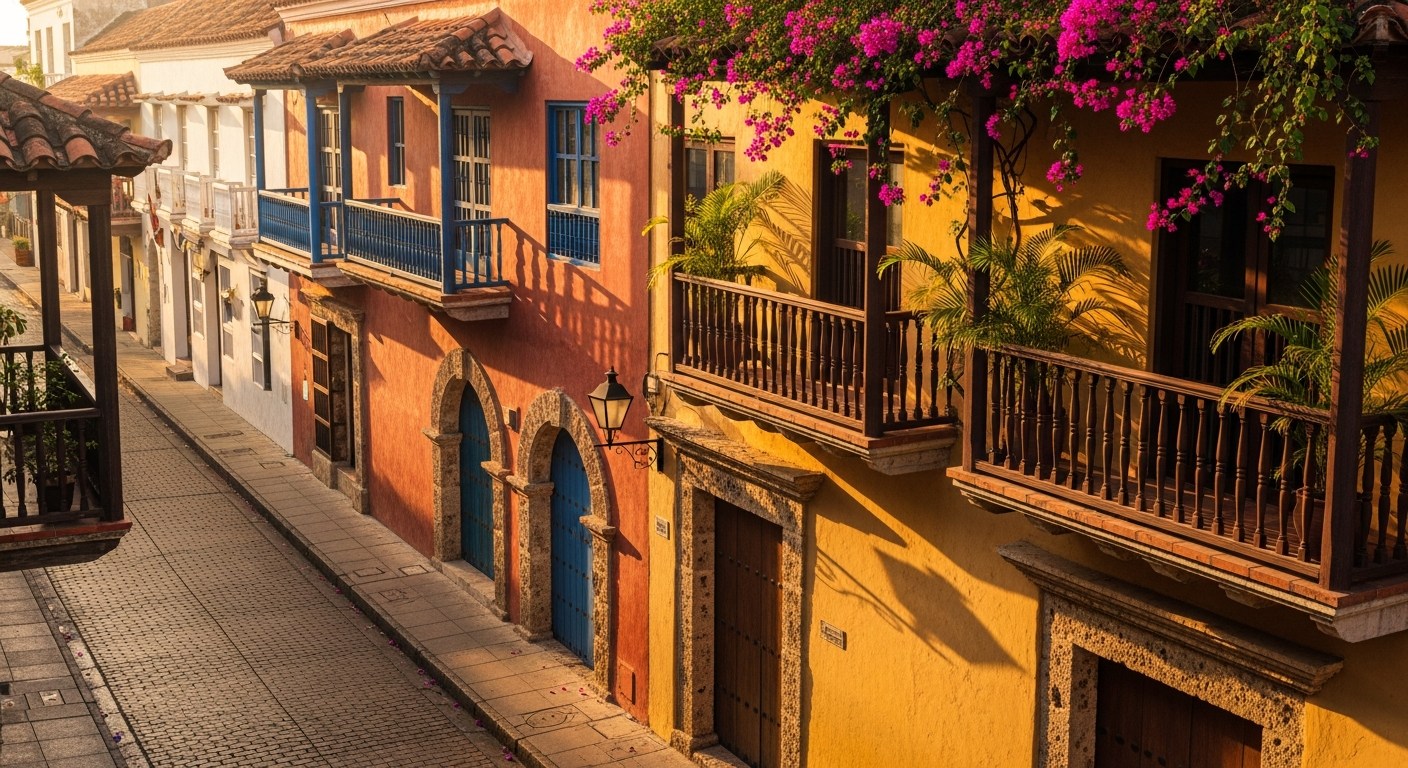
Cartagena is always warm. Not seasonally warm, not warm for part of the day and cooler in the evening. Warm always, the kind of warm that is in the air at seven in the morning before the sun is fully up, still there at midnight when you walk back through the walled city under the street lamps. The temperature ranges from around 28 degrees at night to 33 in the afternoon, and the humidity sits at 80 to 85 percent year-round. You are not going to be comfortable in the textiles sense of that word. You are going to be comfortable in every other sense, because the old city is beautiful enough to make you stop noticing what the air feels like, the same way you stop noticing a pair of silicone covers under a cotton dress by midmorning.
The Walled City in the Morning
The Ciudad Amurallada, the walled colonial centre, is a UNESCO World Heritage site and also a functioning neighbourhood. Inside the walls, the streets are narrow and the buildings are painted in the warm colours that are specific to Caribbean colonial architecture: terracotta, pale yellow, deep blue, washed pink. Bougainvillea in coral and fuchsia spills over iron balconies. The streets smell like coffee and diesel and salt from the sea, which is never far away.
In the morning, before nine, the old city belongs to its residents. Street vendors push carts with fresh fruit already sliced. The churches open for early mass. This is the best time to walk the city and also the coolest. It is still very warm. A loose cotton dress, flat sandals, a lightweight tote: this is the register. Nothing that traps heat, nothing synthetic. The streets are cobblestone throughout the historic centre. Rough, uneven, some stones missing, the gaps filled with grit and rain run-off. Any heel higher than two centimetres is a liability on these streets in this heat.
Getsemaní and the Other City
Getsemaní, the neighbourhood just outside the historic walls, was for a long time Cartagena's overlooked quarter. In the last decade it has become what it is now: the most interesting neighbourhood in the city, with street art covering entire building facades, independent bars and restaurants in converted colonial houses, an evening energy that is local rather than tourist-facing. The neighbourhood still has rough edges. The streets are wider than inside the walled city. The air, marginally, moves more freely. It also has better food than anywhere inside the walls.
Celele, on Calle del Arsenal, was named one of Latin America's 50 Best Restaurants. Chefs Jaime Rodriguez and Sebastian Pinzon spent years travelling Colombia, talking to indigenous communities, recovering flavours that had been absent from restaurant kitchens for generations. The result is not fusion. It is archaeology at the table. Book several days in advance.
On Calle de la Sierpe and the streets around the Parque del Centenario, the bars open in the late afternoon and run until two in the morning. Dress accordingly: casual enough to move easily, considered enough to look like you chose it. The heat in Getsemaní is the same heat as everywhere else in Cartagena. There is no shade in the open streets and no air conditioning in most bars. Wear the minimum amount of fabric you can justify.
The Rooftop Bars
The rooftop bars of Cartagena are the best argument for the city's social life. Above the level of the streets, with the old city spread out in every direction and the Caribbean just visible over the walls, the heat becomes an asset rather than a problem. The breeze at rooftop level is real. The light at sunset makes the colonial architecture look like it was designed to be seen exactly at this hour.
The Sofitel Legend Santa Clara, the former Convent of Santa Clara on Calle del Torno, has the most reliably good terrace. The hotel is the seventeenth-century convent transformed into a walled garden with a pool, and the rooftop terrace looks out over the tiles and campaniles of the old city. Casa San Agustin, quieter and smaller, has a rooftop pool on the edge of the walls with the Caribbean visible from the water. Different hours, different registers. The first is social. The second is not. For either location, you want something that functions in 30-degree warmth with irregular breeze. A backless top with wide trousers in a lightweight fabric, or a silk dress that moves. The base layer has to work in Cartagena's humidity without adding bulk. Medical-grade silicone covers, good for fifteen or more wears, solve this without adding a single additional layer, which in this climate is the only kind of solution worth using.
What Cartagena Asks of You
There is a specific challenge Cartagena poses that other warm-weather cities do not. The old city is genuinely beautiful, beautiful enough that you want to look right for it. The bougainvillea against the yellow walls, the arched doorways, the evening light on the stone. You want to look like you are part of the city, not just passing through it damp.
This means fabric choices matter more in Cartagena than almost anywhere. Natural fibres that breathe: linen, light cotton, silk. Nothing with polyester. The women who look best in Cartagena's evening are usually wearing very little, chosen very well. One piece. Flat sandals. No bag that competes. The rest is edited out.
Gabriel Garcia Marquez set parts of Love in the Time of Cholera here, and walking through the old city in the afternoon heat you understand the logic: the light, the physical warmth, the bougainvillea, the sense that time moves differently inside the walls. The city is the history of the entire Atlantic trade compressed into a few square kilometres of colonial stone. You will sweat through your clothes by noon. You will not want to leave.
For how to build a warm-weather wardrobe that travels the full range from market morning to rooftop evening, read how Lima approaches the same problem from the other direction. The cities are nothing alike. The dressing logic is the same.
Packed beside the linen. Designed to disappear.


