
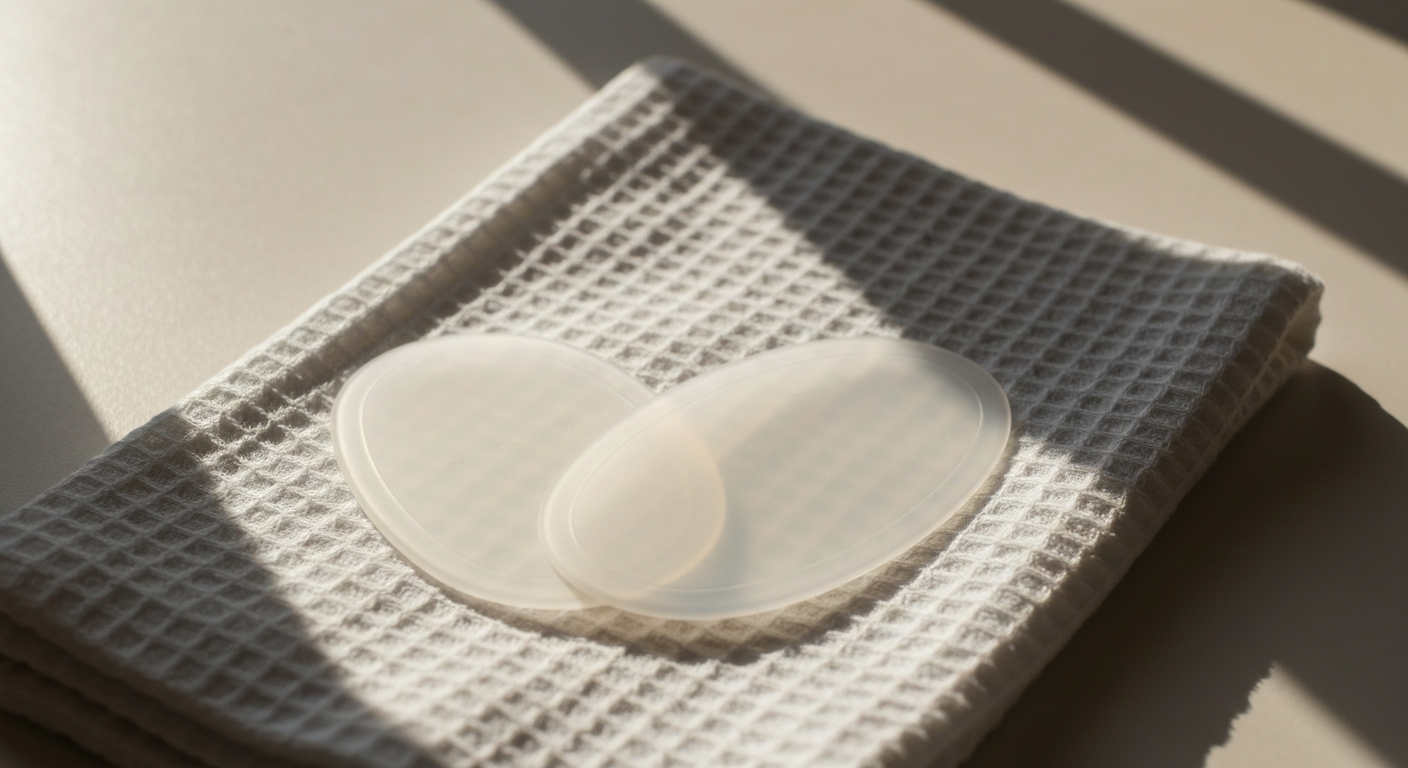
The short answer: rinse after every wear, and the fifteen-wear count is real. What ends a cover early is never the material itself. It is what gets left on it: body oil, sunscreen, a trace of foundation. A cover washed after each wear keeps its grip through the full fifteen wears these medical-grade silicone covers are built for. Skip the rinse a few times and the same cover is done in three. Everything below is the longer answer: the exact wash, the drying, and the one soap that ruins the adhesive.
A new pair of silicone covers, taken out of the packaging for the first time, looks like it should last approximately forever. The material is smooth, the adhesive side feels alive, the edge is so thin it disappears against a fingertip. The first impression is accurate. The product was built to last. Whether it lasts depends on what happens after the first wear.
A silicone cover does not fail from use. It fails from what is left on it. Skin oils, sunscreen, makeup, fabric dust, body lotion. Every wear adds a small amount of something to the adhesive surface, and every unwashed wear makes the next wear a little worse. The woman who never washes her covers will get two or three wears and assume the product is not worth buying again. The woman who washes them after every wear will get fifteen.
The washing
Run lukewarm water over the adhesive side of the cover. Warm, not hot. Hot water is not better than warm for this — it does not clean faster and it stresses the material over time. A steady stream of warm water from a household tap is exactly right.
Put one small drop of mild, unscented soap on the adhesive side. A baby soap works. A gentle hand soap without moisturiser added works. What does not work is dish soap, which is built to strip grease and is too aggressive for this, or a foaming hand wash with moisturiser, which leaves a film that is the entire thing you are trying to remove.
Rub the soap across the surface with one fingertip in a slow circle. No scrubbing, no brushes, no cloths. Thirty seconds is enough. Then rinse until the surface stops feeling slippery from soap and starts feeling tacky again. If it still feels slippery, rinse more. If it feels tacky, it is clean.
The drying
Place the cover adhesive side up on a clean, smooth surface. A clean ceramic plate is perfect. A clean glass surface is perfect. A piece of smooth paper also works if nothing else is to hand.
What does not work is a cotton towel. Towels leave fibres on the adhesive, and fibres on the adhesive are contamination, which is the exact thing the washing was for. If you only have a towel, put the cover on top of a glass or plate on top of the towel, not directly on the cloth.
Leave the cover to air-dry at room temperature. Fifteen to thirty minutes, depending on how humid the room is. Do not use a hair dryer. Heat from a hair dryer at close range is much stronger than the warmth of a body and will change the adhesive in a way that cannot be undone. The drying only needs patience, not help.
Storage between wears
Return the cover to the protective film it came with, adhesive side down. The film is the storage case. It is not packaging to be thrown away after the first use. If the film is lost, a clean glass surface or the rigid case the product shipped in is the next best option.
Keep the covers in a drawer or a closed pouch, at room temperature, away from direct sunlight. A window ledge in a sunny room is not the right place. A bathroom countertop in a house with a hot shower twice a day is also not ideal — the combination of heat and humidity over weeks is harder on the adhesive than a single night of dancing in August.
Before the next wear
The next wear starts before the cover goes on. The skin needs to be clean and dry, with no moisturiser, sunscreen, or body lotion on the area. The adhesive bonds to skin. If the skin is coated in a product, the adhesive is bonding to the product, and the bond will hold less well than it should.
If morning skincare has already gone on that area, the fix is a damp cloth wipe followed by a minute to dry. Not a full shower, not a skincare skip. Just clean skin on the specific area the cover will sit on.
When the cover has reached the end
A well-cared-for pair will reach fifteen or more wears in the same shape as wear one. The real end comes when the adhesive no longer feels tacky after a correct wash. At that point, it is not a care failure, it is the material reaching the end of what it was designed to do. This is the expected and honest finish of the product.
A cover that feels degraded at wear six has usually been washed wrong, or not washed at all. The first step is not to replace it. The first step is to wash it correctly and see if the tack returns. Most of the time it does.
The whole protocol, in five lines
Wash after every wear. Warm water, one drop of mild soap, fingertip, thirty seconds. Rinse until tacky. Air dry adhesive side up on a clean smooth surface. Store in the protective film in a drawer.
That is the full routine. Two minutes of effort and a half hour of patience between wears, in exchange for a product that does what it is meant to do from the first wear to the fifteenth. The material it is made of was built to last that long. The care is what lets it.
Related: How they hold up. Care decides how many wears a pair gives you.
The covers. Designed to disappear under everything.

Matte and invisible under sheer.
€29,90€5,98 a pair
Korean silicone · 15+ wears per pair
“Skin did not pull so it did not hurt.”
Catarina B.

