
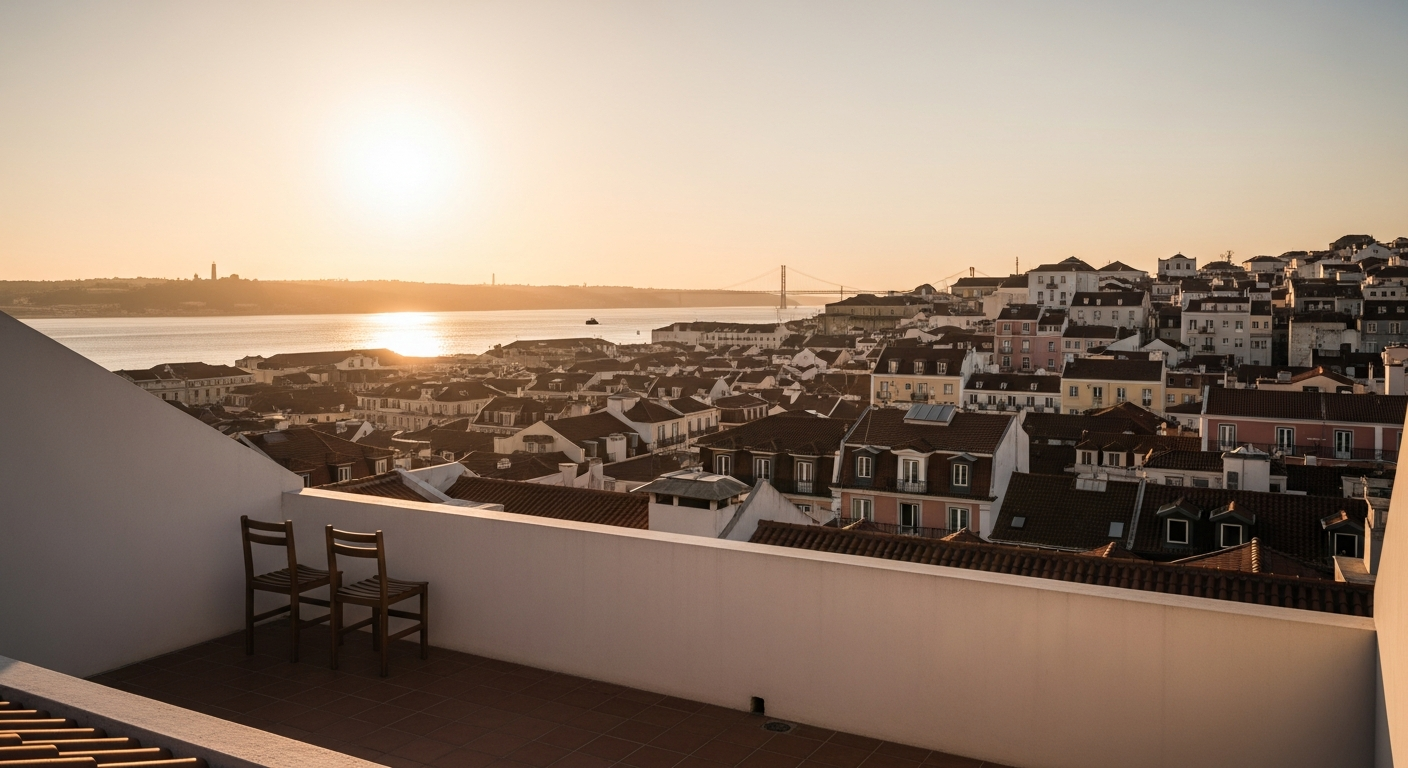
Lisbon is the European capital that survived an earthquake, a tsunami, and a fire on the same morning, the first of November 1755, and rebuilt itself within three years under the direction of one minister: Sebastiao Jose de Carvalho e Melo, the Marquess of Pombal. The lower city, the Baixa, is his work: a grid of straight streets on filled rubble, the buildings constructed with an internal wooden cage, the gaiola pombalina, engineered to flex rather than collapse in the next tremor. The upper neighbourhoods, Alfama and Mouraria, survived because their irregular medieval lanes provided enough structural redundancy that the earthquake could not bring them down at once.
The city that exists now is the product of that division: orderly where it was rebuilt, labyrinthine where it predates the disaster. Both versions are navigable. They require different shoes.
Alfama at Night
Alfama is Lisbon's oldest district, a Moorish-period quarter built on the eastern hill above the Tagus, the streets too narrow for the tram that climbs from the Baixa toward the castle. The neighbourhood survived 1755 and survived the twentieth century and has been the geographic centre of fado since fado became a fixed institution rather than a tavern entertainment. The music appears in the historical record in the 1820s, originating in the waterfront neighbourhoods of Alfama and Mouraria among the sailors, dockworkers, and their communities. The word comes from the Latin fatum: fate, or that which is appointed.
Mesa de Frades, on the Rua dos Remedios, occupies a converted eighteenth-century chapel. The original azulejos, the blue-and-white tin-glazed ceramic tiles that cover the interior walls, date to the chapel's construction and survived the earthquake intact. The fado here is not scheduled or announced in advance; the singers appear when the evening moves toward them. A Baiuca, six tables, no reservations taken by phone, is the format at the other end of the scale: the smallest viable fado house, the one that requires the most advance planning and delivers the experience most directly.
Amalia Rodrigues, who was born in Alfama in 1920 and died in Lisbon in 1999, is the singer who moved fado from a local tradition to an international art form. Her recordings from the 1940s and 1950s, available on any streaming platform, are the correct preparation for a fado evening in the district. She incorporated poets, Spanish rhythms, and a vocal range that the traditional fadista form had not previously demanded. UNESCO added fado to its list of intangible cultural heritage in 2011.
The Azulejos
The tiles on Lisbon's facades are a Portuguese tradition that absorbed Moorish, Dutch, and Italian influences over five centuries. The word azulejo derives from the Arabic al-zillij, polished stone, and the tiles entered Iberian architecture through the Moorish presence. The Pombaline reconstruction used them systematically: the new buildings of the Baixa and later the Chiado received blue-and-white rococo and baroque-pattern tiles as a standard exterior finish, which is why the uniform tiled facades of certain Lisbon streets belong to a single period of construction rather than an accretion of individual decisions.
The best single concentration of narrative azulejo panels is at the Igreja de Sao Vicente de Fora in Alfama: the cloister walls are covered with scenes from Lafontaine's fables rendered in blue and white at approximately three metres of height, painted in the eighteenth century and running continuously around four sides of the cloister. They are among the most ambitious tile installations in the city and are not mentioned as frequently as they should be.
Bairro Alto and the Rooftop Logic
Bairro Alto, the upper western neighbourhood, is the bar district in the plain sense: the streets from about nine at night until two in the morning are dense with movement, every door open, the bars small and the street the social space between them. The neighbourhood was built in the sixteenth century as the city expanded beyond the medieval walls, and the buildings retain the original scale: five storeys, narrow facades, ground floors that have housed bars and workshops and printing houses since the eighteenth century.
Park, on the roof of a multi-storey car park on the edge of Bairro Alto, is the most consistently cited rooftop bar in the city for a specific reason: the view west toward the Tagus and the Alcantara bridge is the view that communicates Lisbon's position on the river most directly. The bar does not take reservations. Arrive before sunset, which in summer arrives after nine, to hold a position at the rail. The Memmo Alfama terrace, further east above the fado district, has the south and east view: the Tagus wide, the rooftops of Alfama below, the bridge of Vasco da Gama visible on clear days fifteen kilometres upriver.
What the Evening Requires
Lisbon's evening dress code is not the same as Madrid's or Paris's. The city runs younger, more casual, more mixed in its registers. A rooftop bar in Bairro Alto has a dress code that a Parisian bar of equivalent reputation would not permit. But the fine dining table, at Belcanto in the Chiado or at a fado restaurant in Alfama, requires something considered, and the streets of both neighbourhoods are cobblestone, which is the constraint that overrides every other packing decision.
The stone surface of the Alfama lanes is not the smooth cobblestone of the Baixa's eighteenth-century reconstruction. It is medieval granite, irregular, polished by centuries of foot traffic, sloped toward a gutter that runs down the centre of the lane. Flat shoes or a block heel with adequate surface area. Nothing that requires confident footing on a smooth surface.
For a backless dress or a scooped neckline at a rooftop table or a fado dinner, the solution needs to be permanent for an evening that begins at eight and does not end before midnight. Medical-grade silicone covers, good for fifteen or more wears, hold correctly through a Lisbon evening that moves between the warm outdoor air and the cooler interiors of a stone-walled eighteenth-century building. The adhesive releases cleanly. Nothing about the foundation should interrupt a neckline that was designed to be seen in the amber light of a fado house or the long blue light of a Tagus sunset from a rooftop.
Tram 28
The Eléctrico 28, operating since the 1930s in its current rolling stock, connects Graça in the east to Estrela in the west, threading through Alfama, the Baixa, the Chiado, and Bairro Alto in a route that covers the city's historic quarters in forty-five minutes. The practical value as a visitor is genuine: the route passes the major architectural reference points of the eastern city, and the tram moves at a pace that makes the azulejo facades visible rather than a blur. The reason it appears in every guidebook is also the reason it is crowded from nine in the morning. Take it in the late evening, when the tourist traffic has dispersed and the remaining passengers are residents heading home.
The Tagus at the End of the Day
The river is the fact about Lisbon that everything else organizes around. The Tagus at this point is eleven kilometres wide, the estuary that made the city a port of consequence for five hundred years of Atlantic trade. The light on the water in the late afternoon comes from the west and reflects off a surface wide enough to behave like a sea. Standing on the Alfama terraces at five o'clock, with the river below and the city behind, is the moment the city gives its visitors that requires nothing to be explained or provided. It simply arrives, as it does every evening, and lasts for about thirty minutes before the light changes and becomes something else.
Read about another city that dresses its evenings with similar specificity in Lima: the city that dresses for dinner in the fog.
Heading somewhere this summer? We will send you the packing checklist.


