
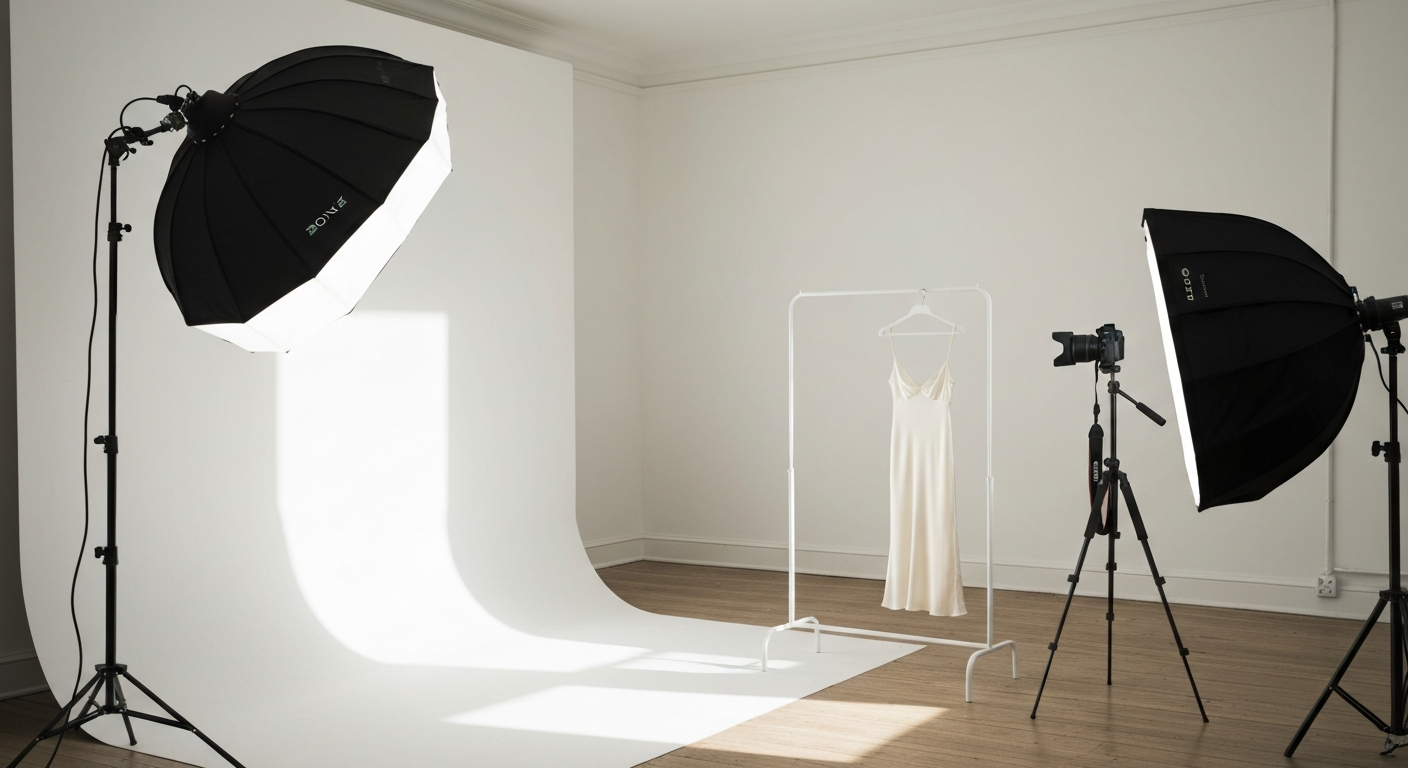
The short answer: silicone covers under anything the camera will read closely, silk included. A mirror forgives what a high-resolution camera does not: a strap that looked invisible in the changing room, a seam pressed flat by a structured bra, an outline the eye corrected for and the lens did not. Silicone covers sit flat under silk or a fitted blouse with nothing to print through at full resolution, no band, no strap, no seam for the camera to find. Everything below is the longer answer: what a camera actually sees that a mirror does not, and where that gap shows up first.
The photographer arrives at ten. By the time she has set up the light stand in the corner of the studio, you have already changed twice. The shoot brief is professional portraits: headshots for the new website, one or two environmental shots, possibly something outside if the afternoon light cooperates. Six hours. Three looks. The first is fine. The second is the one you have been worrying about since Monday.
The second look is the one with the silk. The cream bias-cut slip that photographs like nothing else you own but requires a precision in what goes underneath it that the first look, a structured blazer and trouser, does not. The photographer is professional. The camera is a Sony A7R V. Both see everything.
What the Camera Actually Sees
The gap between how a garment appears in a mirror and how it appears in a photograph is something fashion photographers understand and most subjects discover for the first time on the day. A good mirror flatters by offering a continuous moving image that the eye corrects for in real time. A photograph freezes a single moment and has no interest in flattering corrections.
High-resolution digital cameras capture fabric texture, construction quality, and the engineering of the layers underneath with a fidelity that the eye in ordinary light does not. A barely-visible bra strap that reads as negligible in the changing room reads as a styling decision in a photograph, and not always the right one. The outline of a structured undergarment through a silk blouse is visible in a way that the wearer, who last saw herself in a bathroom mirror, may not have anticipated. A gap in a buttonhole. A seam showing through a light fabric. These are the realities that a professional shoot makes visible.
The Light Problem
Photography is a light problem. The kind of light determines what the camera sees, which determines what the garment looks like in the image. Studio light with a large softbox is flattering to fabric: it wraps around curves and reduces harsh shadow. Direct natural light from a window is less forgiving and more beautiful. Outdoor light in mid-afternoon is the most revealing light that exists: it comes from directly above, creates downward shadows, and shows the three-dimensional character of the fabric in full.
For outdoor photography in natural light, fabric weight matters more than it does in studio conditions. A lightweight chiffon in outdoor afternoon light moves in every air current and catches light on its surface in a way that can be extraordinary or difficult depending on the photographer's speed and the wind. A heavier crepe or matte silk does not perform in the same way: it holds its shape, absorbs the light rather than reflecting it, and gives the camera a consistent surface to work with across multiple frames. The outdoor shoot that requires a specific silhouette to hold is the shoot that needs fabric weight, not fabric beauty.
Colour Under Different Light
Colour behaves differently under different light conditions, and the variation is larger than most subjects expect. Cool colours, blues and grey-greens and certain lavenders, respond to the colour temperature of natural daylight and hold their depth. The same colours under the warm tungsten studio light that many photographers still use for portraits can shift toward brown or green in a way that the photograph records and the eye corrects for on the day.
The reliable photography colours are the ones that hold across colour temperature variations: a true black is a true black in any light. A warm ivory reads as cream under cool light and as warm white under warm light, both of which are correct. A saturated yellow or red behaves well in most photography conditions because the saturation holds through light changes. The difficult colours are the ones that sit close to neutral: the greige that can read as grey or beige or taupe depending on the light, the dusty blue that loses its specificity in strong daylight.
The ivory silk slip for the second look is correct. Ivory photographs beautifully in natural light, holds its luminance in studio conditions, and has a surface quality that the camera reads as deliberate rather than accidental. The question is only what is underneath it.
The Construction Question
Bias-cut silk has no internal structure. The fabric falls along the natural curves of the body, which is the whole argument for it. It also transmits light through it, which is the reason that what is underneath the fabric is, in high-resolution outdoor photography, essentially visible. A structured undergarment under a bias-cut silk creates a visual architecture under the fabric that reads in the photograph. The construction of the undergarment becomes part of the image.
For a photography day where the silk slip is one of the key looks, the base layer that disappears entirely is not a preference: it is the technical requirement that makes the look what it is supposed to be. Medical-grade silicone covers from Korea, ultra-thin at the edge, the width of a human hair, are invisible under bias-cut silk in outdoor afternoon light. The camera cannot see them. The fabric falls as designed. The look in the photograph is the look that was intended at the rack, not a compromise with the engineering of what went underneath it. For the backless component of the shoot, the specific considerations of what the back of a garment reveals are the foundation of getting that frame right.
The Fitting Before the Day
Professional photographers and stylists build fitting time into shoot days because the decisions about what the camera will see need to be made before the camera is pointed at anything. A fitting the day before a professional shoot is standard practice. The garment is tried on, photographed on a phone in natural light, and the photograph is examined: not how you feel in the mirror, but what the camera shows.
This practice reveals things. The blouse that looked opaque in the showroom is somewhat transparent in natural light from a large window. The trouser that appeared well-proportioned in the mirror lengthens or shortens strangely in a full-length photograph. The heel height that felt correct while standing feels wrong in profile. The fitting before the day is the dress rehearsal that prevents the discoveries from happening in front of the photographer, the camera, and the six-hour clock.
What Holds Across Six Hours
A full photography day is physically more demanding than it appears from outside. Standing, moving between setups, changing looks, standing again. The garment is performing for six hours in conditions, studio heat and outdoor temperature and movement, that the garment was not designed to be tested by.
Fabric that holds its character across this kind of sustained use is the fabric that photographs consistently from the first frame to the last. A linen that starts the day fresh and structured will be visibly different by frame six hundred in the afternoon outdoor sequence. The silk, which recovers better from compression than most fabrics, will look as good at four in the afternoon as it did at ten in the morning if the conditions have been reasonably gentle.
The Leica, the Sony, the Hasselblad: the camera is indifferent to the effort involved in looking this way. It captures what is there. The six-hour shoot produces two hundred images and, if the preparation was right, twenty that are exactly what was intended. Those twenty are the reason for the preparation. They hold the version of the day that was planned rather than the version that happened.
The Stylist's Checklist
Professional fashion stylists working editorial shoots use a kit that addresses the gap between the garment's intended appearance and its actual behaviour on a body in front of a camera. Double-sided fashion tape is the most common tool. Alligator clips to gather excess fabric at the back. Small weights sewn into hems to prevent lift in wind. A lint roller for every texture that shows contact. The stylist's kit exists because garments on bodies in real light do not automatically perform the way garments on hangers in showrooms perform.
For the portrait shoot where the subject is their own stylist, the equivalent preparation is the same logic applied independently: the fitting before the day, the phone photograph in natural light, the decision about what goes underneath each look before the photographer arrives. The subject who arrives having resolved the engineering questions allows the photographer to focus on the frame. The subject who is still resolving them at ten in the morning gives the photographer a different kind of problem to manage.
Richard Avedon's fashion subjects, photographed for Vogue and Harper's Bazaar from the 1950s through the 1990s, were prepared by a team whose work was entirely invisible in the final image. The ease that the photographs show is the product of preparation whose traces were removed before the shutter opened. That is the model.
The Image That Remains
The photographer sends through the selects on Thursday. The cream silk slip on the third outdoor frame, the afternoon light coming from behind and to the left, the fabric moving slightly in the late breeze: this is the one. The one that looks like it was easy. The one where the construction of the morning, the choices made at seven before the photographer arrived, are completely invisible.
That invisibility is not an accident. It is the point.
The hours are long. The covers outlast them.

Matte and invisible under sheer.
€29,90€5,98 a pair
Korean silicone · 15+ wears per pair
“I carry them with me everywhere.”
Carol M.

