
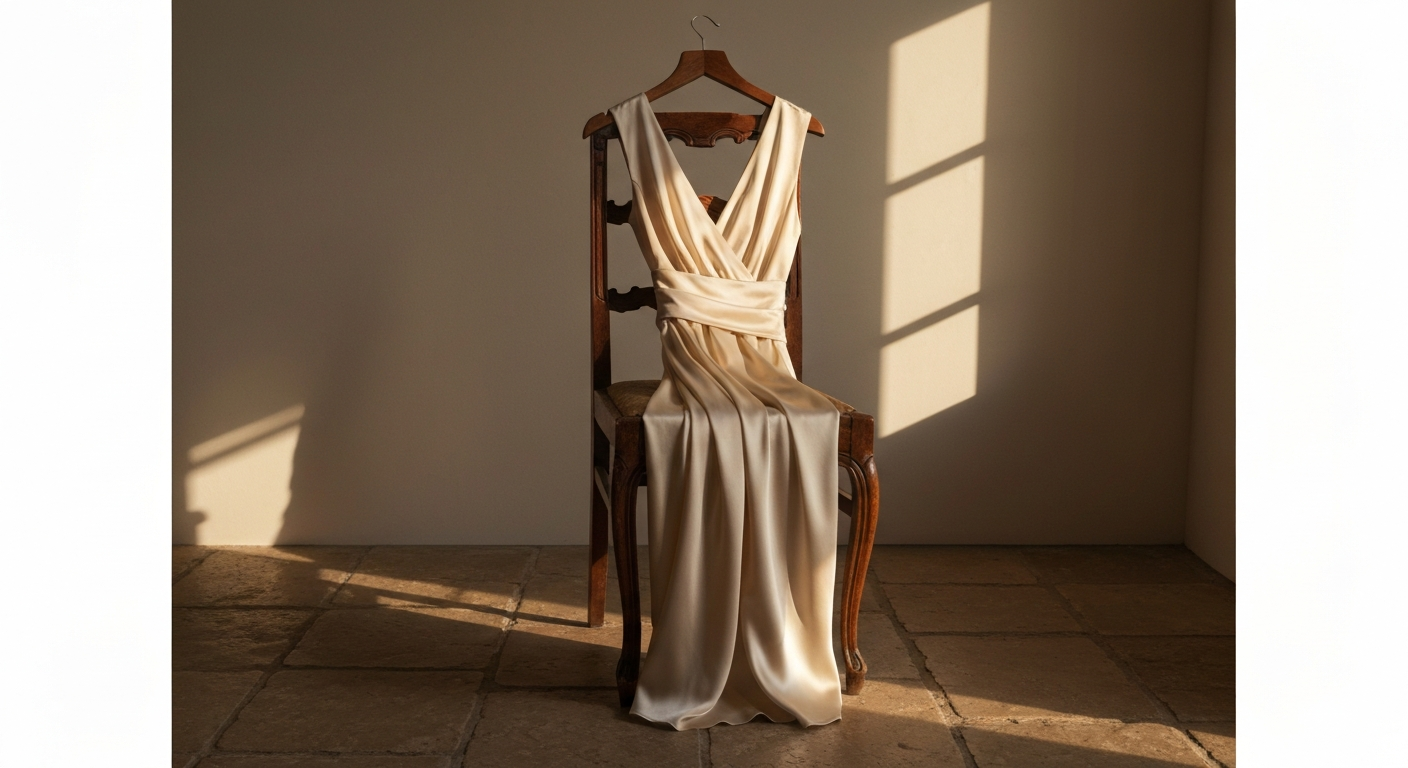
The short answer: the Bridal Kit. A first wedding gown usually arrives with its own boning and a built-in foundation. A second wedding dress, chosen in champagne or sage or midnight because you could actually wear it again, rarely has either. The covers handle the coverage a soft, unstructured cut leaves open; the adhesive bra supplies the lift the dress no longer builds in. Everything below is the longer answer: the colour question, and everything else about dressing differently the second time.
The first wedding dress was chosen at twenty-eight. The sample size fitted and the silhouette was the one from every magazine she had read for the previous six months. The cathedral train required four people to manage at the reception. The structure inside the bodice held everything in place without input from the body wearing it. The dress was a project.
The second wedding is at forty-two. The guest list is forty people. The venue is a restaurant in the country that closes for the evening. The dress will be something she could theoretically wear again: something real, in a colour that is not white, and it will not require a dedicated transportation case or a team of assistants to function properly.
This is the difference between a first and second wedding that no one explicitly names but everyone who has lived both immediately recognises. The second wedding is dressed by a different woman.
The Colour Question
The convention that second brides do not wear white has been quietly dissolving for the better part of twenty years. It was always a social norm rather than a rule, and social norms surrounding second marriages have shifted substantially since the generation that enforced them was making the decisions. White and ivory are still available. Most women planning second weddings choose not to use them, not because they cannot but because the choice no longer interests them.
What replaces white in the second wedding wardrobe is a different category of colour thinking. Champagne, which reads as warm ivory in certain lights but has a depth that flat white does not. Dusty blush, which photographs differently across the day and ages differently across a decade of looking at the photographs. Sage and pale olive for women who want to anchor the dress to a landscape rather than to a bridal convention. Deep midnight for an evening-only wedding where the setting is a room with candlelight and no daylight involved. Navy and forest green are increasingly present in second wedding archives in a way that would have been unusual fifteen years ago.
The colour choice also changes the photography calculation. Against a natural outdoor setting, a white dress reads as the subject. A champagne or sage dress reads as part of the environment, which produces a different kind of image. Photographers who work second weddings regularly note that the colour latitude of the commission changes their approach to the shoot from the first image.
The Cut Question
The first wedding silhouette is often about volume. Ball gown, princess line, the shapes that read as ceremonial from a distance and produce their effect through scale. The second wedding silhouette is almost always about fit. Column cuts, bias-cut silk, the wrap dress in a fine fabric, the midi-length suit with a jacket. The scale is reduced. The tailoring is the content.
Cuts that work at forty-two are not categorically different from cuts that work at twenty-eight. The underlying principles of proportion and structure are the same. What changes is what a specific woman with a specific body in a specific decade values. A woman at forty-two has usually developed a precise understanding of which cuts serve her body and which do not. The bridalwear market, which has historically defaulted to a narrow range of silhouettes for all age groups, is less useful to her than a well-edited ready-to-wear designer working in occasion dressing.
Roland Mouret's spiral cut dresses, designed to follow the specific curve mathematics of a woman's body rather than average it out. Narciso Rodriguez's seam lines, which place the structural work of the dress on the body's natural architecture. These are not bridal references. They are second wedding references, because second wedding dressing draws from a different vocabulary than first wedding dressing.
Where the Budget Goes Differently
A first wedding dress budget operates under the pressure of a social event with two hundred observers, a photographer covering every angle, and the accumulated expectation of the people present. The dress is asked to perform for all of them. The sample sale, the bridal boutique, the designer trunk show: the search is driven by what the dress communicates to the room.
A second wedding dress budget is spent differently. The guest list is smaller. The event is quieter. The dress is for the forty people who already know her, not the two hundred who are being introduced to the marriage. The proportion shifts from display toward quality. A smaller number of guests means a dress that does not need to read from thirty metres. It needs to read from three. At that distance, the fabric is the argument. A silk with a liquid finish at three metres is a different object from polyester at thirty. The budget that at twenty-eight went toward silhouette goes at forty-two toward construction and material.
The same logic applies to everything underneath. A dress bought for its fabric quality requires a foundation that matches that standard. Nothing that transfers, marks, or compromises the material over twelve hours. The investment in the dress is also an investment in what protects it.
The Body Change Question
The body at forty is not the body at twenty-eight. This is not a problem. It is simply a different brief for the dress and for everything underneath it. The specific changes that matter to lingerie and underpinning decisions involve the way weight redistributes across the decade: away from the extremities, toward the centre. The waist and midriff carry more weight at forty than they did at twenty-eight for most women, which affects how fitted dresses behave and what they reveal.
The boning and structure that worked inside a first wedding dress, holding everything in a fixed position relative to a fixed set of measurements taken in a shop at twenty-seven, does not work on the same terms inside a bias-cut silk at forty-two. Bias cut moves with the body. Structure that prevents movement produces tension in the fabric rather than smoothness. The lingerie solution for a second wedding dress is therefore typically less structural than the first wedding solution, not more.
What a column dress or bias-cut silk requires underneath it is coverage without construction. Smooth at every seam line, invisible at every edge, holding without gripping. Medical-grade silicone covers from Korea, ultra-thin at the edge, less than half a millimetre. They provide coverage without adding any structure of their own. The dress moves as the fabric intends rather than against internal resistance. The adhesive releases cleanly after twelve hours. Nothing transfers to silk. Nothing leaves a mark on bias-cut crepe.
The Timeline Difference
A first wedding runs to a specific choreography: arrival, ceremony, photographs, cocktail hour, dinner, dancing, exit. The schedule is built months in advance. Every transition is managed. The second wedding at a country restaurant for forty people runs differently. The timeline is shorter, more informal, less managed. The dress wears through fewer formal transitions and more unstructured time.
This is, in practice, harder on the dress and everything underneath it. An unstructured evening of moving between rooms, sitting for long meals, standing for conversation, and eventually dancing in a small space with friends who have known her for twenty years requires more from the dress than a choreographed sequence of formal events. The Bridal Kit is designed for the full duration rather than the formal sequence. Good for fifteen or more wears and consistent adhesion from morning application to evening removal.
The Second-Time Knowledge
The most consistent report from women dressing for second weddings is that they solved the practical problems faster than the first time. Not because the problems are easier, but because they have lived through the consequences of the solutions they chose the first time. The bra that shifted at the altar. The product that required a bathroom break at six in the evening. The structured piece that left a mark visible in the photographs taken at the end of the night.
The testing protocol is shorter the second time because the information is already present. She knows her body. She knows her dress. She knows the environment the ceremony will take place in. The question is whether the product she tests in the week before the wedding matches what she needs for the day itself. The trial does not take a month. It takes one afternoon.
After the Reception
The forty-person dinner ends at midnight. The guests are people who were present for the first wedding and the years between. The photographs from the evening, when they arrive, will be different from the first wedding archive. The scale is smaller. The faces are closer. The background is a room rather than a venue.
In those photographs, the dress is visible from every angle and in every quality of light the restaurant produces. What the dress contains determines what the photographs keep. The second wedding, unlike the first, was not an event arranged around the dress. The dress was arranged around the evening. That is a distinction that shows.
The woman who made different choices this time did so because she had the information she did not have the first time. The colour works in this light. The cut works on this body. The morning is easy. The twelve hours between are accounted for.
The back is open. What holds her disappears.


