
The short answer: matte silicone covers. A summer wedding guest dress runs from a stone courtyard in mid-afternoon to a dance floor at midnight. Whatever holds underneath has to survive both. A visible band photographs worse than the sun does. Ultra-thin silicone covers sit flat under the fabric, hold through the full day’s heat, and disappear under harsh flash the way a strap cannot. Everything below is the longer answer: which fabric manages that same heat, and which length photographs best on pale stone.
A summer wedding in the south of Portugal takes place in a landscape that is not interested in the contents of your suitcase. The Alentejo in July is forty degrees by three in the afternoon, and the light is direct and merciless from ten in the morning onwards. The ceremony is in a chapel that is cooler than the courtyard outside, and the courtyard is where the drinks happen immediately after, and the drinks are where the photographs happen, and the photographs are in full afternoon sun on pale stone that reflects heat upward as efficiently as it absorbs it.
The dress that works in this context is not the dress that looked best on a hanger in a boutique in London in March. It is the dress that manages the temperature, holds its structure through the heat, photographs well in harsh light, and is still presentable at midnight when the dancing finishes. These are four separate requirements. The dress that satisfies all four is worth finding.
The Temperature Requirement
Fabric behaviour changes with heat. A fluid silk that falls elegantly on a September evening in Tuscany becomes a damp, clinging problem on an August afternoon in the Alentejo. Loosely woven fabrics with air movement through the weave manage heat better than any tightly woven silk. Natural linen, despite its reputation for wrinkling, is among the most heat-compatible formal fabrics available: it wicks moisture, it moves air, and it recovers from sitting far better than any synthetic alternative.
Dress length matters for heat differently than most women expect. A floor-length gown in a breathable, loosely woven fabric handles heat better than a knee-length dress in a structured cotton blend, because the long fabric creates a column of slightly cooler air around the legs. This is counterintuitive. The tailoring advice from every Portuguese seamstress who has worked summer events is: longer and lighter, not shorter and heavier.
The Church Problem
Most summer weddings in Catholic Portugal and Spain include a ceremony in a church. The requirement, covered shoulders and covered knees, is enforced differently by different churches. In older rural churches the enforcement is at the door. In more urban churches it may be advisory rather than absolute, but the custom is observed regardless.
The most practical solution is a second piece: a lightweight scarf in a fabric that does not add significant heat, covering the shoulders during the ceremony and removed for the aperitivo. The scarf needs to be compatible with the dress in colour and weight. A heavy embroidered shawl over a lightweight dress is a textural mismatch that reads badly in photographs, particularly from the back. The second piece chosen to work with the dress, rather than against it, appears in the photographs as intention rather than improvisation.
Photography in Harsh Light
The summer wedding in the south presents specific photographic challenges. Direct afternoon light creates hard shadows and washes out pale tones. White and ivory read as overexposed in midday direct sun. Pale blush, pale yellow, very pale greens all become difficult to resolve in harsh light without losing detail.
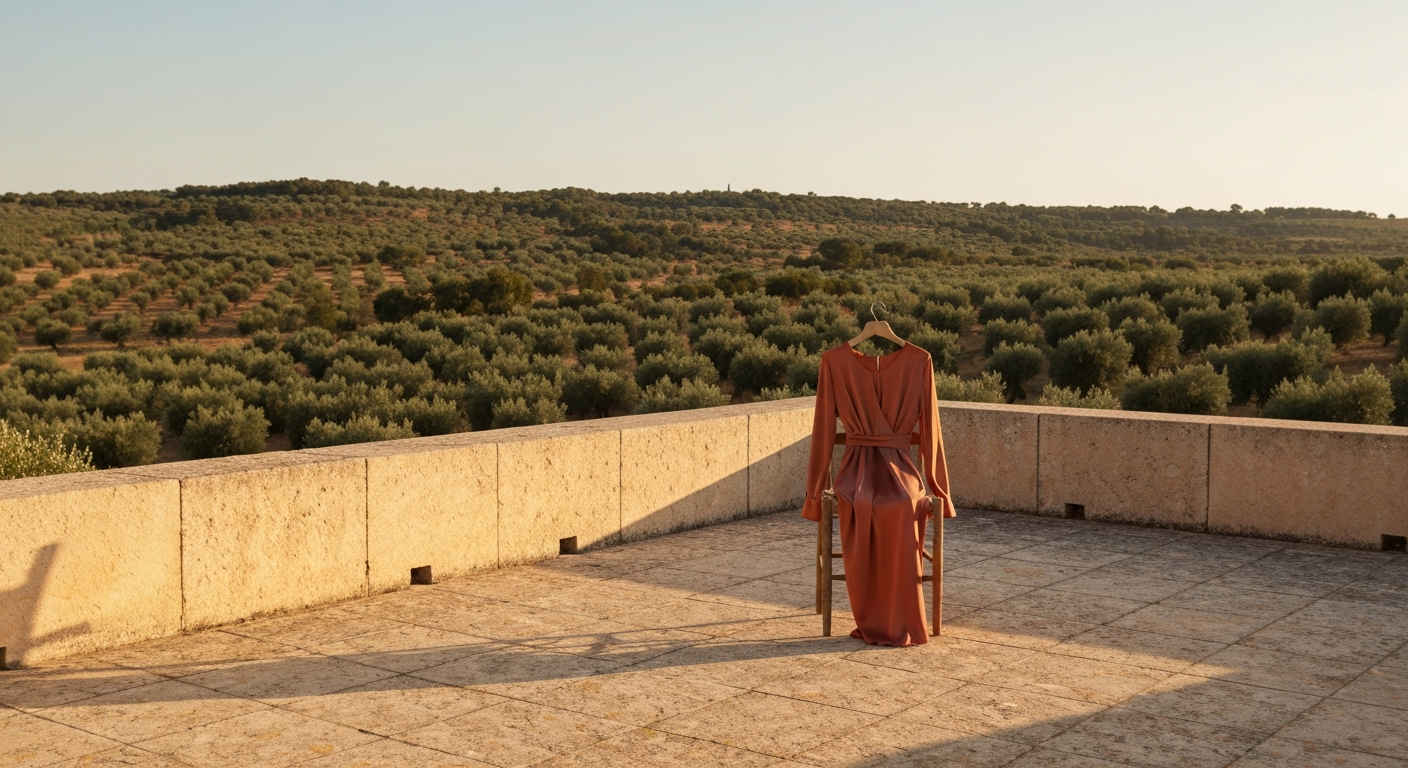
The palette that works in summer southern-European light is the palette of the landscape: terracotta, ochre, dusty sage, deep blue, warm amber. These tones hold detail and contrast in direct sun in a way that pale tones do not. Mid-toned colours, neither very pale nor very saturated, also work across the widest range of lighting conditions a summer day produces: harsh midday, gentler late afternoon, the warm gold of aperitivo hour, the blue-dark of dinner under stars.
The Foundation Beneath the Dress
For a backless or low-neckline dress at a summer wedding, the foundation question is sharpened by heat. A strapless bra in July at forty degrees is a different proposition than a strapless bra at an autumn wedding in cooler air. The mechanism that holds a strapless bra in position relies on friction, and friction becomes less reliable as skin temperature rises. The bra that held correctly at two in the afternoon has often moved by six.
Medical-grade silicone covers are a pressure-sensitive adhesive solution. The adhesive activates with body warmth and holds more consistently at elevated body temperatures than at lower ones. In the heat of a summer ceremony, the adhesive performs better than in a cool interior. This is the opposite of the intuitive assumption. The adhesive improves with the condition that challenges the strapless bra. For a full breakdown by neckline type, the backless dress guide addresses each cut specifically.
Colour and the Bride
The standard instruction, do not wear white, is broadly understood. The nuances around it are less so. Ivory is not white, but it is close enough that the photographs at a ceremony with an ivory-gowned bride will create ambiguity from any distance. Pale gold and champagne read as ivory in photographs. Pale blush in direct sunlight reads as near-white.
The clearest instruction is: choose a colour that cannot be confused with the bride's colour under any lighting condition. A deep teal, a terracotta, a genuinely dusky rose, a warm sage: all of these are unambiguous in any photograph and in any light. The colours that require qualification are the colours that create problems, because the photograph does not include the qualification.
The Midnight Test
By midnight, the summer wedding guest has been in the dress for twelve to fourteen hours. The light has changed four times. The temperature has dropped fifteen degrees from the afternoon peak. The shoes have navigated stone, grass, and a dance floor.
The dresses that are still working at midnight are the ones whose fabric breathes, whose construction holds, whose neckline has not required management, whose colour holds detail in three different lighting conditions. These dresses are not necessarily more expensive than the ones that do not last. They are more carefully chosen. That is a different category of investment.
A summer wedding in the south is one of the few occasions on which dressing with serious thought is proportionate to the occasion. The thought pays back in images that hold for twenty years, in a day that the dress never interrupted, in the midnight photograph where everyone is still correctly dressed and the light is the kind that only happens when everything else is also correct.
The back is open. What holds her disappears.

Matte and invisible under sheer.
€29,90€5,98 a pair
Korean silicone · 15+ wears per pair
“I carry them with me everywhere.”
Carol M.

