
Tokyo is the city you understand after your third visit. After Kyoto, which is about the past and its architecture of restraint. After Osaka, which is loud and feeds you loudly. Tokyo is the one that makes no immediate argument for itself and then, once the argument arrives, makes it completely. The suitcase makes the same argument, packed around a change of clothes and the Confidence Set.
Tokyo does not reveal itself to the scanner. It reveals itself to the returner.
The first visit is a logistics exercise. The subway map. The convenience stores at midnight. The sheer compression of a city that holds fourteen million people and produces almost no noise at street level. The second visit begins to feel like something. The third visit is when you understand what that something is: a city operating at a standard it does not discuss, because discussing it would be a form of lowering it.
The Concept That Has No Western Equivalent
The Japanese concept of iki resists clean translation. It arrived in Edo-period Tokyo as a sensibility specific to the merchant and artisan class: urbane refinement without ostentation. Not wealth on display. Not minimalism as aesthetic exercise. Something harder to name: the quality of a person who has eliminated everything unnecessary from their appearance and their manner and left only what is precisely correct for the situation they are in.
It is the quality you notice on Ginza at six in the evening without being able to immediately explain what you noticed. Silence is a form of confidence. The best-dressed woman in Ginza at six in the evening is the one you noticed last.
Iki is why Tokyo's dress culture cannot be reduced to a dress code. The city's evening logic is not about formality level. It is about precision. A clean cut, a fabric that behaves, a neckline that stays where it was placed. Nothing performing. Nothing exceeding what the moment asks. The city rewards this absolutely and forgives excess poorly.
Ginza at Six
Ginza at six in the evening is the most dressed quarter-hour in any city I know. The office workers coming out of the towers along Chuo-dori have not changed but they arrived this morning in something capable of carrying them through to dinner. The department stores, the Mitsukoshi and the Matsuya and the newer Ginza Six, are at their highest concentration of serious shoppers. The streets narrow toward the backstreets where the restaurants are already filling.
The Ginza of the international press, flagship stores and international brands, is only one layer. Beneath it runs a neighbourhood of tea rooms, specialist booksellers, galleries housed in unmarked buildings, and restaurants that seat eight and have been doing the same menu since their founding. None of these announce themselves. The tea room at the back of the stationery shop. The gallery on the fourth floor with no sign at street level. The sushi counter in the basement of a building that looks, from outside, like an accountant's office.
This is the structural logic of Tokyo luxury: the best things here require that you already know where they are. The city does not advertise its best rooms. It offers them to the people who were told about them by the people who were told before them.
The Counter, Not the Table
The restaurants that matter in Tokyo have six seats, a counter, and an owner who has been cooking the same three dishes since the 1970s.
This is a slight exaggeration. Kagurazaka Ishikawa, the three-star kaiseki restaurant in the Kagurazaka neighbourhood, has a seven-seat hinoki wood counter and private rooms beyond it. Chef Hideki Ishikawa's guiding principle is mui-shizen: cuisine true to nature, without artifice. The tasting menu changes completely with the season. In April it reads like a poem about spring in mountain Japan: bamboo shoots, cherry blossom vinegar, river fish. The counter seats book months ahead and are worth whatever inconvenience that requires.
Narisawa, in Aoyama, operates from the principle that the Japanese landscape is the ingredient. Chef Yoshihiro Narisawa's menu has appeared on the World's 50 Best Restaurants list for reasons that become obvious at the table: each course is a question about where the food comes from and how it arrived here. A forest floor rendered as a bowl. Bread fermented with soil from a specific mountain. It sounds conceptual. It tastes like it always made sense.
The city has more Michelin stars than any other. Nobody who lives here talks about it.
The evening rhythm runs in stages. Ginza until eight, when the department stores close and the neighbourhood shifts register. Nishi-Azabu from nine, which is where the counter restaurants sit in unmarked buildings on the narrow streets between the hills. The Nishi-Azabu that runs late is not the Nishi-Azabu of the guidebooks. It is a neighbourhood of alleys and wooden buildings and small bars where the person who made your reservation is also the person pouring your drink. By midnight the city's surface has thinned and what remains is the layer that was always there beneath it.
What the Evening Asks You to Wear
Tokyo's evening dress logic is not the Parisian model, where formality signals seriousness. It is not the New York model, where the outfit announces something about who you are. It is closer to an absence of announcement. The city asks you to arrive exactly as the occasion requires and to add nothing beyond that.
For Ginza at six this means: one clean line from shoulder to hem. A fabric that holds its shape through a two-hour dinner without needing intervention. A neckline that stays put. Tokyo restaurants are long evenings. The counter at Kagurazaka Ishikawa runs three hours. Narisawa runs longer. A dress that required management at hour one is a problem at hour three.
The invisible layer beneath a silk or crepe dress is what makes a neckline behave over the length of that kind of evening. Adhesive silicone covers, thin enough at the edge to disappear under any fabric weight, sit flat from the first course to the last and ask nothing of you while the food is doing all the work. The dress can be as architectural as the occasion demands. Nothing moves unless it is supposed to.
For the move between Ginza and Nishi-Azabu, the outfit does not change. It cannot, practically speaking: Tokyo's evenings are continuous, not staged. The same dress that works in a formal kaiseki counter works in a small bar at eleven. The city's dress logic is vertical, not horizontal. One very precise thing, worn with confidence, for the duration. Read more on how an evening that moves across registers asks the same of the outfit in every city.
Design, Not Fashion
Tokyo's relationship to fashion is particular. The city produced Issey Miyake, Comme des Garçons, Sacai. It hosts its own fashion week, which is smaller and more serious than its European counterparts and more interested in concept than in season. The designers who came from here were, almost without exception, interested in the relationship between the body and the garment rather than in the garment as decoration. The pleating that Miyake spent a career on was an engineering problem before it was a visual one.
The 21_21 Design Sight in Roppongi, the museum that Tadao Ando built with Miyake in 2007, makes this explicit. The building is designed around a single folded steel plate roof, the same gesture Miyake made with fabric: one material, one fold, an entire structure. Most of the building is underground. From outside it is almost invisible. The exhibitions inside rotate between design, craft, and manufacturing process. The building is the argument for what Tokyo thinks design is for.
The Nezu Museum, three subway stops away in Minami Aoyama, makes a different version of the same argument. The museum holds one of Japan's finest collections of pre-modern art: paintings, lacquerware, bronze, ceramics from the Nara period forward. The garden behind it, four acres of wooded paths and stone lanterns, is open with museum admission and takes forty minutes to walk properly. In April the garden contains things worth slowing down for. The museum is never crowded in the way that the Mori Tower or the teamLab installations are crowded. The people who know about it come for specific reasons and leave quietly.
Kagurazaka After Dark
Kagurazaka is the neighbourhood that was Tokyo's geisha district before it became a French-speaking enclave before it became what it is now: a layered neighbourhood of narrow cobbled lanes, French bistros, traditional ryotei, and the best concentration of intimate restaurants in the city that are not technically famous enough to require three months' planning.
The cobbled lane called Kakurezato, running up from the main street, is the correct entry point. The stone paving and the small wooden gates opening onto interior gardens are the physical evidence that this was a neighbourhood built for private transactions. Dinner, tea, conversation that was not meant to be overheard. That quality has not left. The restaurants that line these lanes operate on the assumption that the people arriving have been told to come and know roughly what to expect. The menus are seasonal. The sake lists are serious. The service is attentive without performing attentiveness.
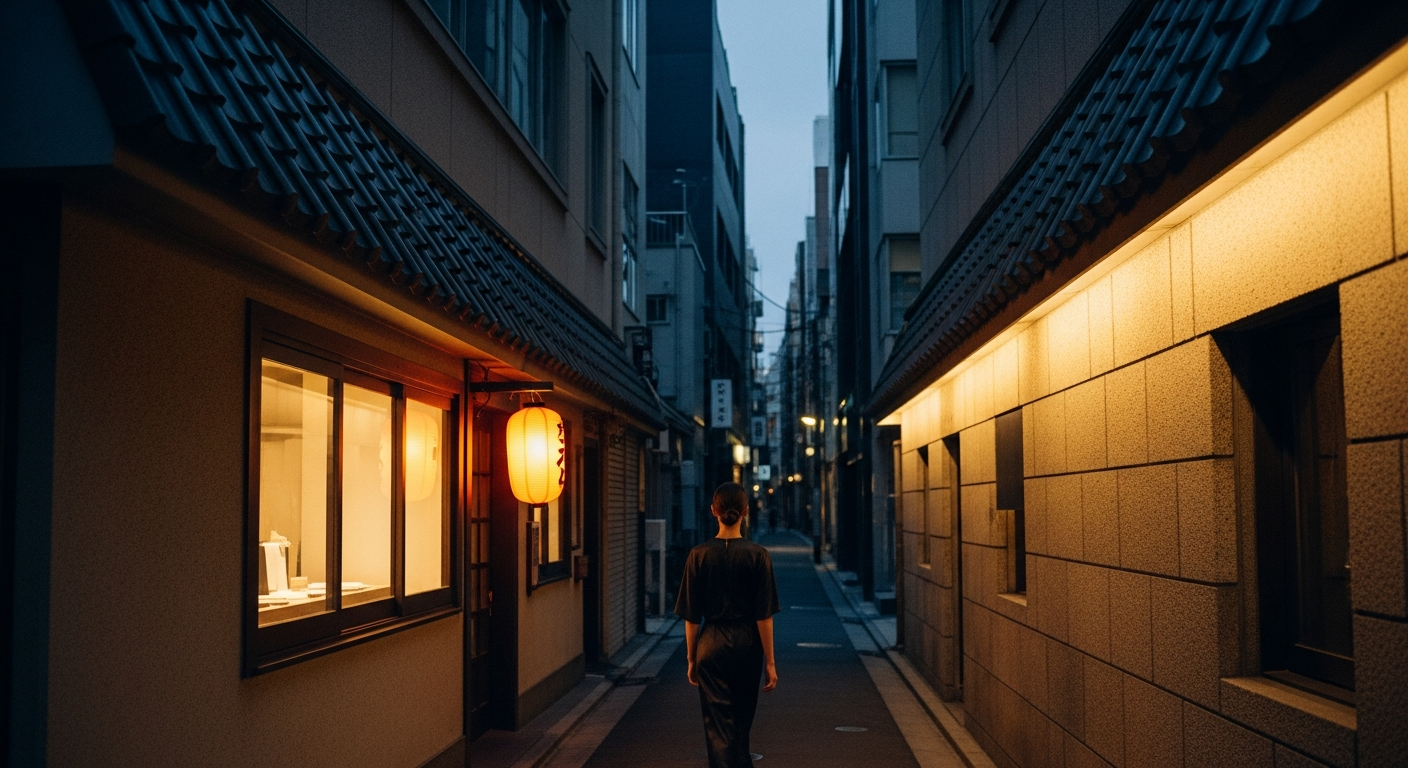
Tokyo at this hour, in this neighbourhood, is the version the city offers to the person who has been three times and stopped expecting it to explain itself. The cobblestones are uneven enough to require shoes that were designed for them. The lanes are too narrow for anything but single-file walking. The restaurant you are looking for is the one with the single paper lantern outside and no further indication of what goes on inside. This is information enough if you have been here before.
The Third Visit
The first visit leaves you with photographs and a list of things to try next time. The second visit answers some of those questions and generates better ones. By the third visit the city has shifted from subject to context. You are no longer studying Tokyo. You are in it, using it, moving through it at the pace it asks rather than the pace the itinerary set.
The fourth visit, if it comes, is when Ginza at six on a Tuesday in April stops being something you note and becomes simply the condition of a good evening in a city that rewards knowing it well. The reward is proportional to the patience. That is not a Tokyo thing. It is the thing that separates places worth returning to from places that are finished on the first pass.
The covers. Designed to disappear under everything.


