
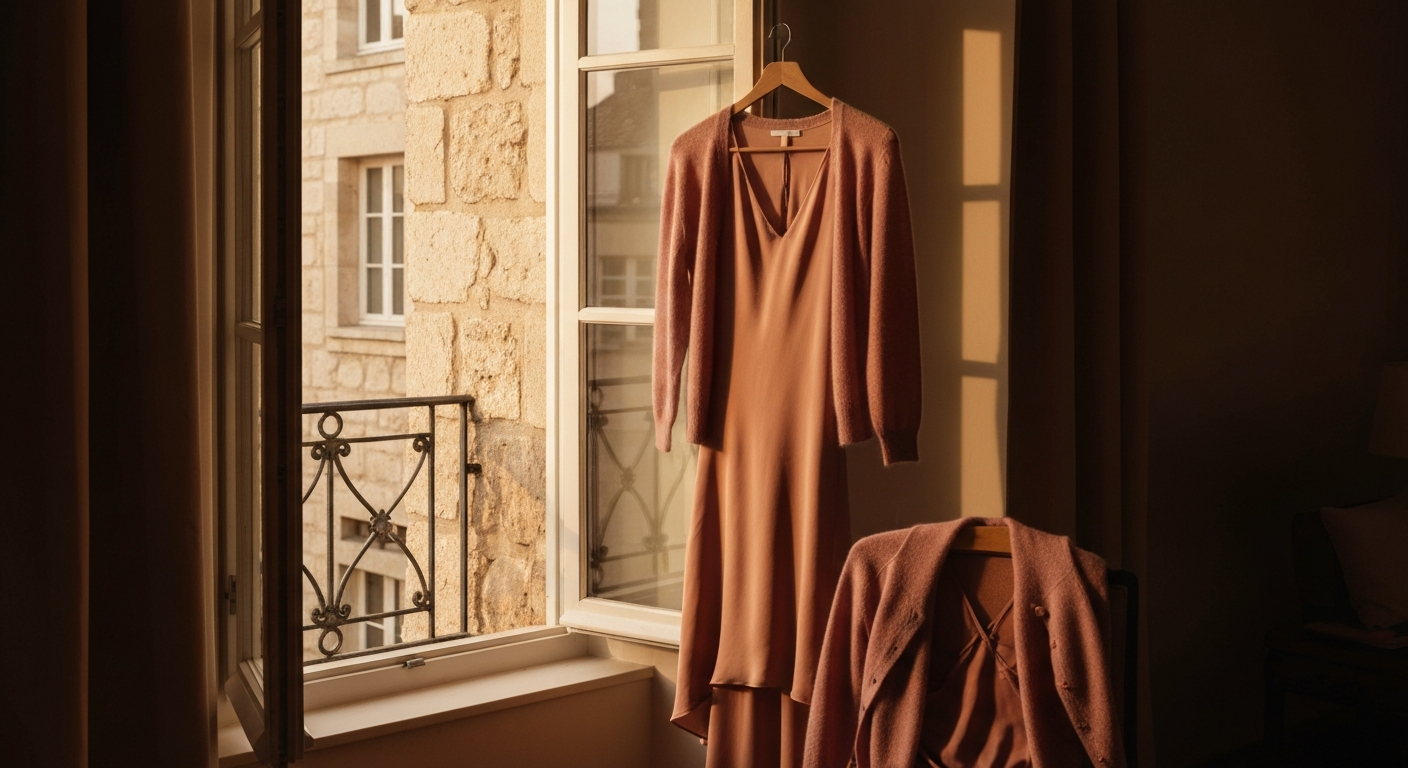
September in Milan has a quality of light that August does not. The angle shifts: still warm in the afternoon, still eating outside at nine in the evening, but with a coolness that arrives after ten that August never had. The Quadrilatero della Moda is already showing its September face by the first week of the month: heavier fabrics in the windows, coats appearing on the mannequins even when the street outside is twenty-five degrees and the tourists from further north look confused.
This is the transitional moment the fashion calendar acknowledges and the actual wardrobe resists. August is silk and linen and very little else. October is knit and structured wool and layers. September is a negotiation between them, and the negotiation is more interesting than either of the seasons on either side of it.
What September Asks
The transitional month does not want a new wardrobe. It wants the summer wardrobe with additions, and the additions are not what most seasonal edits suggest. A leather jacket is not a September addition; a leather jacket is an October addition that September has been borrowing from. What September actually needs is weight without closure. A cashmere cardigan that opens and closes over a summer dress is a September garment. A lightweight blazer in unlined cotton or viscose that can be removed at two in the afternoon when the sun returns is September. The heavy wool coat appearing in the September lookbooks of every major brand is aspirational fashion editorial and a practical lie.
The Milanese have been managing this month with a specific logic for decades: the base layer stays light, the additions are reversible, and the shoes change before the clothes do. By mid-September the suede boot is back on the street while above it the outfit is still decidedly August. This is correct. Feet perceive the season change before the rest of the body needs to respond to it.
The Fabric Register
Transitional dressing is a fabric conversation above all else. The materials that carry across the seasonal divide share certain properties: they are not dependent on a single temperature range to behave properly, they layer without adding visible bulk, and they can be read as intentional in either direction.
Silk charmeuse is the great transitional fabric. It drapes beautifully in heat, holds body warmth in cooler air, and requires nothing but a change in what surrounds it to move from August to October. A silk slip dress that was worn all summer with sandals becomes a September garment under a cashmere turtleneck. The same dress, belted with a leather belt and worn over a long-sleeve fine-knit, is an October garment. The silk has not changed. The conversation around it has changed.
Lightweight crepe performs a similar function, though its temperature range is wider: the texture of crepe holds its structure through variations in heat and humidity that silk resists. A crepe trouser in the right weight behaves at twenty-eight degrees in September and again at twelve degrees in late October. Wool crepe, the winter variant, begins the relationship in October. The lighter silk-wool blends that most Italian fabric mills produce for their autumn collections arrive in the shops in late August and are the most useful fabric in the transitional wardrobe: warm enough for the cooler days, fine enough for the warm ones.
The Layering Architecture
The error most transitional dressing makes is adding warmth at the outer layer first. A coat over a summer dress is the obvious move and also the least elegant one: the proportions are wrong, the coat is too heavy, the dress has no argument underneath it when the coat comes off. The better architecture starts from the inside.
A fine-knit long-sleeve base layer under a silk dress changes the fabric behaviour of the dress, adds thermal insulation, and closes the neckline options that were open in August. This is not always the right answer: a backless dress in silk cannot have a visible long-sleeve underneath it without losing the architecture of the cut entirely. For those pieces, the base layer needs to be invisible: no back straps, no visible neckline, nothing that interrupts the fall of the fabric.
For the silk dress that works through September in a city where the evenings drop to sixteen degrees, medical-grade silicone covers from Korea are what allows the summer dress to move through the cooler months with a fine-knit cardigan draped over the shoulders and nothing competing with the neckline or the back of the dress below it. The adhesive holds through a full evening of temperature change. The layer gives without the fabric knowing it is there. It is not a warm-weather solution and not a cold-weather one: it is what the transitional moment specifically requires.
Understanding the complete picture of what works under a backless cut through changing seasons is the groundwork that makes transitional dressing coherent rather than accidental.
The Shoe as Calendar
The Milanese observation about shoes holds: the foot is the part of the dressing decision that registers the season most accurately. The white sneaker belongs to August and to April. The loafer, in leather or suede, arrives in September and stays through November. The ankle boot follows in October. The transition from open-toe sandal to closed shoe is the single clearest seasonal signal in the wardrobe, because it is physical: the mornings have become cold enough that bare feet on stone floors no longer feel appropriate.
The Chanel ballet flat, which has been in continuous production since 1957 and has outlasted every seasonal fashion cycle that has attempted to declare it outdated, is a September shoe: it works in the heat when the sandal would be more obvious but is beginning to tire, and it works in the cool when the boot would be premature. The French understanding of the ballet flat as a perpetual wardrobe item is not fashion loyalty. It is a practical recognition that some garments solve permanent problems rather than seasonal ones.
The Scarf Returns
There is a specific moment in September, around the fifth or sixth in most European latitudes, when the scarf becomes relevant again. Not as warmth but as register. The silk square knotted at the neck or draped through the handle of a bag is not a thermal garment. It is a signal that the season has been acknowledged. The Italian woman who reintroduces the scarf in early September is not doing so because she is cold. She is doing so because the scarf is September's first statement, and the scarf is a statement she enjoys making.
The return of accessories is the transitional season's most eloquent announcement. Before the coat, before the boot, before the heavier knit: the scarf, the ring that was too much for August, the structured bag that was too stiff for the beach. Objects that were set aside for the heat begin their return, and their return is a form of dressing up that the summer wardrobe, stripped to its essentials, did not permit.
What Milan Knows and Paris Forgets
The Italian approach to the transitional season is built around the concept of ricercatezza: a studied elegance that looks effortless because the effort was invested in the choices rather than visible in the outcome. A September outfit in Milan shows its intelligence through the quality of the fabric and the precision of the proportion rather than through the novelty of the piece. The investment brands understand September. The fast-fashion brands produce September as a clearance event for summer stock, and the difference is visible in the quality of the drape.
Paris in September is Semaine de la Mode and the street style that surrounds it, which is largely theatrical. The actual Parisian daily dressing in September is more conservative than the fashion press acknowledges: navy trousers and a fine-knit sweater in cashmere, worn with the same loafers that have been on rotation since March, the scarf beginning its seasonal reappearance around the neck at the eight degrees of seven in the morning. The theatrical performance of the transition belongs to the fashion week images. The actual transition happens one sensible garment at a time.
The Capsule That Carries
A transitional wardrobe that holds through September and October is built around five or six pieces that can change character through layering and shoe choice: one silk or lightweight wool dress that works alone and over a base. One pair of wide trousers in a fabric that holds at multiple temperatures. A fine-knit cardigan in a neutral. A lightweight blazer. A good boot that arrives when the temperature gives permission.
The pieces that do not belong in this wardrobe: anything whose claim to relevance depends on a specific temperature window, anything whose silhouette only works in one direction, anything that asks for a specific undergarment that you will stop wanting to wear as the season changes. The wardrobe that holds through the transitional months is the one whose pieces remain credible as the light and the temperature shift around them.
September ends. October begins. The wardrobe already knows how to make the crossing.
We write about getting dressed with intention. One email when it matters.


