
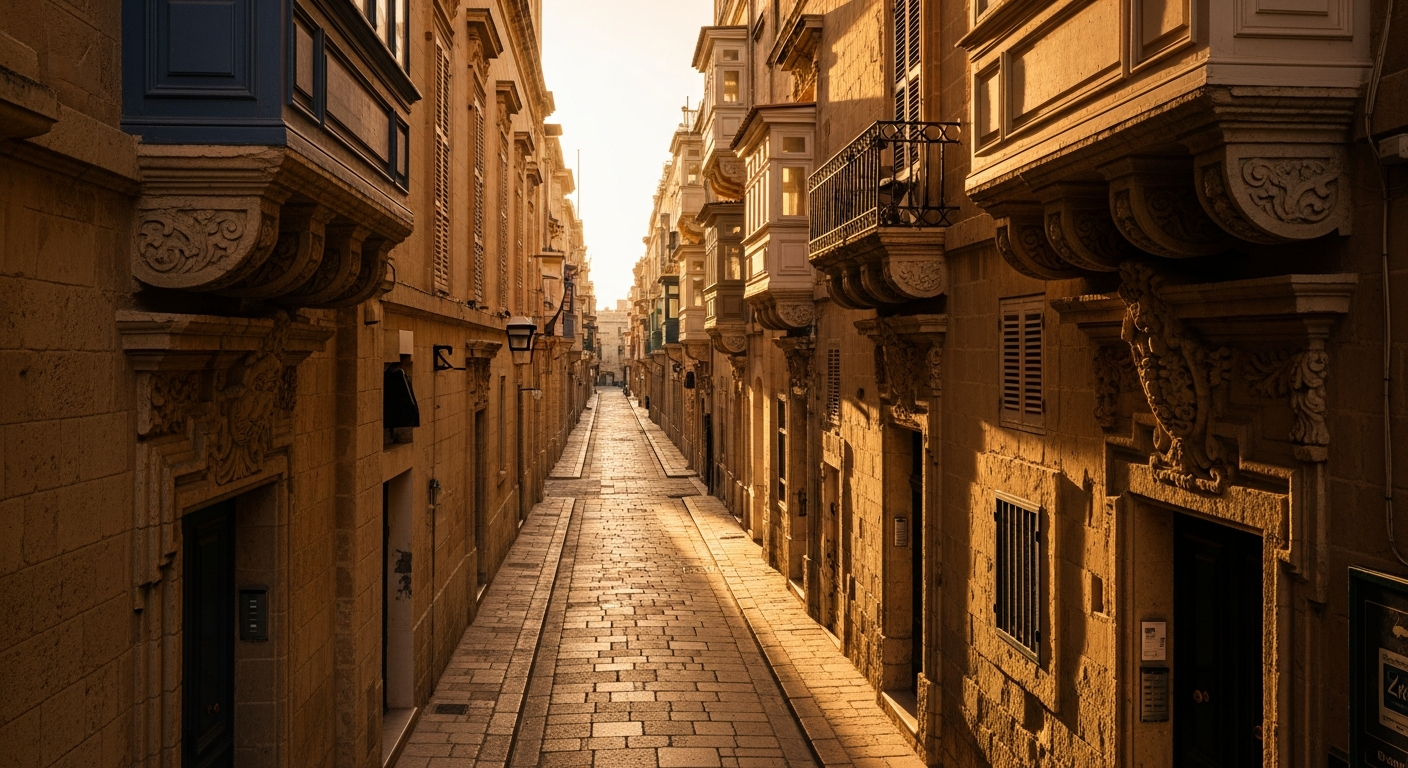
Valletta is the smallest capital city in the European Union, roughly one kilometre by half a kilometre, built on a peninsula between two harbours by the Knights of St John in the 1560s. Everything in it is the same colour: the warm honey-gold of Maltese globigerina limestone, which catches the afternoon light in a way that makes the city look, at certain hours, like it is lit from inside. At seven in the evening, walking up Republic Street from the Upper Barrakka Gardens, the stone is genuinely luminous. It is the most underrated capital in Europe and most people who go to Malta never go inside it. At that same hour, climbing the same street, she is wearing the silicone covers she put on without checking a mirror.
The Limestone and What It Means for the Walking
Valletta's streets are a grid, planned from scratch in the sixteenth century: rational, easy to navigate, and built on a steep ridge. Every street running east-west is either climbing or descending sharply. The surface underfoot is limestone slabs, worn smooth by centuries of foot traffic. In dry weather, which is most of the time in Malta, the limestone is pleasant to walk on. In rain, it becomes extremely slippery. The narrow lanes that drop steeply toward one harbour or the other are particularly unforgiving on smooth leather soles.
Flat-soled shoes or low block heels are the correct choice for Valletta. Not because of any dress code but because the physics of the streets demand it. The city is small enough to cover entirely in an afternoon, but most people end up covering it multiple times because the grid layout means you keep passing the same places at different hours and in different light.
The Cathedral and the Upper Barrakka
St John's Co-Cathedral is the most important art space in Malta. The floor is paved entirely with the funerary memorials of Knights, elaborate Baroque stone inlays in reds and yellows and blacks. Caravaggio's The Beheading of Saint John the Baptist hangs in an oratory to the side. It is the largest Caravaggio in existence and it is mounted at human scale, low enough to stand in front of and look at properly rather than craning upward.
The cathedral has a dress code: covered shoulders, covered knees. In summer, when Valletta runs at 28 to 30 degrees with a sea breeze that keeps it from feeling oppressive, the layers you carry for the cathedral are the same layers you want for the cooler parts of the evening. A lightweight linen jacket, a cotton wrap.
The Upper Barrakka Gardens are at the southwestern tip of the peninsula, a formal garden on the bastions with a view of the Grand Harbour that is so good it is difficult to believe it is not a painting. The view is best when the light hits the fortifications of the Three Cities across the water at the right angle to show the depth of the limestone. This is late afternoon. Plan accordingly.
Is-Suq tal-Belt
The covered market on Merchants Street was originally a Victorian market hall built in 1859, neglected for decades, and restored into its current form as a food hall in 2018. It is three storeys of Maltese food: pastizzi, ftira, local cheese, rabbit stew, freshly made gelato, Maltese wine from the Meridiana estate in the centre of the island. The ground floor has the prepared food stalls; the upper floors have sit-down restaurants with views down into the market below.
The market is busiest at lunch and runs through the afternoon. The air inside is cool relative to the street, the stone walls keeping the temperature stable. It is a useful midday anchor: you eat, you rest from the heat, you plan the afternoon from a bench with a coffee. Nothing needs to change sartorially from what you wore to walk the city in the morning.
Strait Street and the Evening
Strait Street was the entertainment district for the British Mediterranean Fleet, operational from the 1800s through to Malta's independence in 1964. At its height it had more than a hundred bars, clubs, and music venues along a single steep narrow lane. The current revival has brought it back as Valletta's main evening street: bars in former brothels, restaurants in former jazz clubs, the bones of the old buildings visible in exposed limestone walls and low arched ceilings. Palazzo Preca, run by sisters Roberta and Ramona, is one of the anchors of the street now.
The atmosphere is more neighbourhood bar than tourist trap, which is unusual in a city that has been on the tourist circuit since the Knights. For Strait Street evenings, the register is smart casual, but Valletta has a Catholic Mediterranean formality to its social code that means you dress with more intention than you might in a beach town. A fitted silk dress or a clean camisole with tailored trousers reads correctly. If the outfit is strapless or has a deep neckline, the base layer question answers itself: the city is warm enough that anything adding bulk is immediately wrong. Ultra-thin silicone covers, less than half a millimetre at the edge, let the dress work as it was cut without any additional infrastructure, which matters on a street where the bars are small and the light is low and the outfit is the full picture.
Noni and the Table Worth Booking
Jonathan Brincat's restaurant Noni, on Old Theatre Street, holds a Michelin star and demonstrates what Maltese cuisine becomes when someone takes the island's larder seriously: local fish, ftira bread transformed, seasonal vegetables from the plateau. The room is small. Book ahead. The tasting menu runs to nine courses and the wine pairings draw heavily from Italian and Sicilian producers, which makes sense given the fifty kilometres of water between Malta and Sicily.
For a longer evening, ION, at the Iniala Harbour House on the Grand Harbour promenade, has a rooftop dining room above the fortification walls with a view across the water to the Three Cities at the same hour the limestone goes luminous. These are not interchangeable. Noni is the chef's food. ION is the view. Both are worth the trip.
The Light at Seven
The thing about Valletta that justifies the trip is the light on the limestone at the end of the afternoon. The city faces west from the bastion gardens and the stone takes on the warm quality of something that has been absorbing heat all day and is releasing it slowly. The honey colour deepens. The shadows in the carved doorways go almost black. The harbour below turns copper. This is not a metaphor. It is a physical property of globigerina limestone that photographers know and architects know and that visitors find unexpectedly.
For evening dressing in warm Mediterranean cities with formal social codes, read Mediterranean summer dressing. Valletta is small enough to walk in an afternoon and complex enough to return to for a week. Most people who go once go again.
Packed beside the linen. Designed to disappear.


