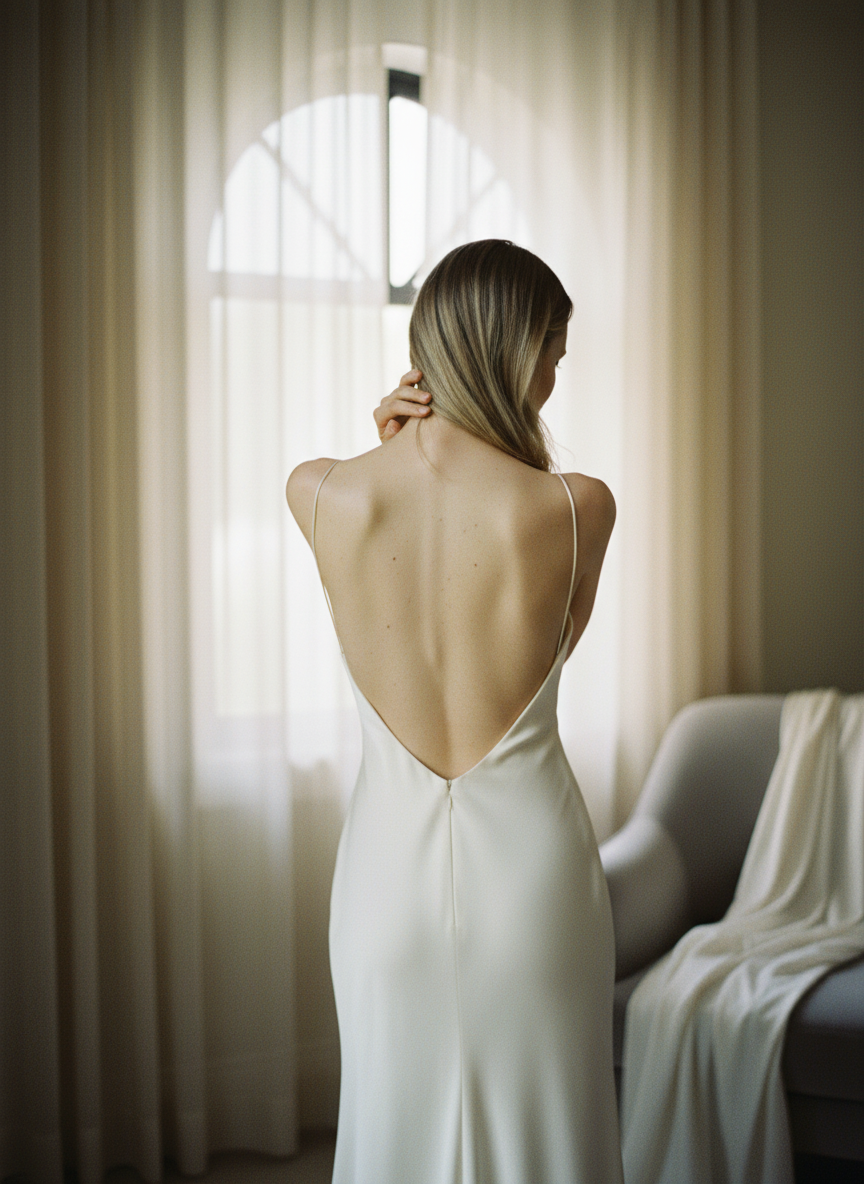
A dress fitting happens in a room where the light is controlled, the floor is level, the temperature is stable at twenty degrees, and the session lasts forty minutes. The wedding happens in a room, or a courtyard, or a clifftop, where none of those things are true. The fitting tells you whether the dress is beautiful. The dress rehearsal tells you whether the dress works.
These are different questions, and the fitting room is structurally unable to answer the second one.
What the Fitting Room Misses
A bridal atelier is a managed environment. The fitter knows the light, knows where to stand, knows that the mirror angle matters, and has arranged the session to show the dress at its best. This is the correct purpose of a fitting: to establish the ideal. But ideal is not the same as functional. The fitting room does not test the dress across time, across temperature change, across six hours of movement in a space the seamstress has never seen.
The dress rehearsal exists to run the test. It is not a second fitting. It is a simulation. You wear the dress, with the foundation you intend to wear on the day, in a setting that approximates the demands of the wedding, for a duration that matches the ceremony and the photographs that immediately follow. Everything that will fail will fail here, where the consequences are recoverable.
The Foundation Test Comes First
Before the dress goes on, the foundation goes on. This is the sequence that most dress rehearsals skip, and the skip is where the problem hides. A dress that sits perfectly in a fitting room with the fitter adjusting it by hand will behave differently when the body underneath it is supporting its own structure without assistance.
If the dress is strapless or backless, the foundation has to be resolved before the rehearsal begins. A strapless push-up shifts during movement. An adhesive bra that has not been worn before may place higher or lower than planned. Silicone covers that are the right size for the cup but placed at the wrong angle will affect how the neckline falls. All of these are adjustable problems, but they are only identifiable through wear, over time, with the dress on top.
The dress rehearsal is the first real test of the foundation and the dress as a system. Two hours in both, moving, sitting, standing, walking on the terrain of the venue or its equivalent: this is what the test requires. Medical-grade silicone covers from Korea, ultra-thin at the edge, adhere better with warmth and movement, and the first ninety minutes of wear tells you where the adhesive settles and whether the placement is correct. If anything needs adjustment, the rehearsal day is the day to find it. For a full overview of placement by neckline cut, the wedding day lingerie guide addresses each type separately, including the backless and open-back cuts that the fitting room most commonly under-tests.
The Floor Test
A rehearsal conducted on a flat indoor surface answers a partial question. The dress that moves correctly across a parquet floor may have a completely different character on the cobblestone courtyard in Sintra where the ceremony actually takes place, or on the uneven flagstones of the quinta in the Alentejo where the aperitivo will happen after. Hem clearance that is generous on a level floor becomes insufficient on a sloped garden path. A train that sweeps elegantly across wood becomes a management problem on rough stone.
The practical instruction here is specific: do the rehearsal on the actual surface of the venue, or the closest approximation available. Walk to the front. Walk back. Sit down in the chair that will be there. Stand up without assistance from the person next to you. If the ceremony takes place on a garden lawn, find a stretch of grass that approximates the density and slope. Grass varies considerably, and a firm, dry lawn in September near Comporta is a different surface from the soft, morning-wet grass of a manor garden in the Douro valley in May.
Timing the Dress
A dress rehearsal has a duration, and that duration should match the period from dressing to the end of the ceremony photographs. In most Portuguese and Spanish weddings, this is four to five hours: one hour getting ready in the suite, two to three hours of ceremony and couple photographs, the transition into aperitivo. The dinner is a separate phase; the rehearsal targets the first phase, which is the one where the dress is being photographed from every angle in conditions it has never experienced before.
Four hours is long enough for every predictable failure to appear. A foundation that shifts does so within the first two hours. A hem that catches on the heels shows itself the third time you walk down a step. A neckline that opened during photographs in session two will not close itself before session three. The problems are time-indexed. Run the time.
What to Document
The dress rehearsal produces information. Someone needs to capture it. The most practical system is a phone, propped at the angle of a camera, recording the walk-in, the sit-down, the stand-up, the walk out. The footage is not for the occasion; it is for the adjustment. A seamstress who receives a video of a hem catching on the heel step at the four-hour mark has something concrete to work with. A seamstress told that the hem feels slightly long has significantly less.
The video also reveals things the wearer cannot see. A neckline that has shifted forward is invisible from the front and obvious from the side. The gap at the back of a structured bodice that appears when the arms lift above shoulder height is not something the wearer perceives during the movement but is present in every photograph taken from a slight elevation, which is the angle most wedding photographers use in the first twenty minutes of couple work.
The Photographer Conversation
A rehearsal is also a preparation for the conversation with the photographer. Luisa Saraiva, who photographs weddings across the Alentejo and the Algarve, asks all her couples to send her a short video of the bride walking in the dress before the day. Not because she needs to plan the shots, but because the video reveals information she uses on the day: the pace of the walk, whether the train needs managing, whether the silhouette photographs best from a low angle or a standing one, whether the light catches the fabric from the front or the back.
The video from the dress rehearsal serves this purpose. It is a gift to the photographer and a gift to the day. The photographer who knows what to expect can be positioned correctly before the moment arrives rather than repositioning after it has passed.
The Morning of the Rehearsal
The rehearsal day should start with a version of the getting-ready sequence. Apply the foundation first, before anything else is on. Wait twenty minutes before putting the dress on. The adhesive needs the body temperature to activate properly, and the most common placement error is rushing this step and placing the covers before the skin is at its normal temperature from movement. The dress goes on after.
Then leave the house. Go somewhere with the physical characteristics of the wedding venue. Walk for thirty minutes. Sit at a table. Stand up again. Order something and eat it carefully. The test has to include the actions the day will include, not just the stationary pose in front of the mirror.
If anything is wrong, you have found it. Write it down. Photograph it. Send it to the seamstress or the bridal consultant with specifics: the hem catches the heel of the left shoe at the third step down. The neckline opens when the arms go above shoulder height. The bodice sits differently in the lower back than it did at the second fitting. These are solvable problems. They are only unsolvable on the day.
The Week Before
One dress rehearsal is the minimum. Two is better for a dress with significant construction: a heavily boned corset, an extended train, a backless design with no structural support beyond the adhesive foundation. The first rehearsal surfaces the problems. The second rehearsal, after the adjustments, confirms they are solved.
The week-before rehearsal is the standard interval. Close enough to the wedding that the dress is in its final state, far enough that any remaining alterations can be completed by the seamstress without pressure. A Wednesday rehearsal for a Saturday wedding gives two days for adjustments, one day for the seamstress to confirm the work is done, and one day of rest for the dress itself before it is needed again.
A dress that has been worn once, adjusted, and verified holds differently than a dress that goes from hanger to wedding morning. The fabric has settled. The foundation placement is established. The wearer has walked in it, sat in it, and knows exactly what it requires. That knowledge is not available any other way. Good for fifteen or more wears, the covers used at the rehearsal are the covers worn on the day: same adhesive, same edge profile, same placement, confirmed through experience rather than assumption.
The fitting room shows you what is possible. The rehearsal shows you what is real. Real is what matters on the day, on the terrain, in the light, across the hours that were never part of any fitting.
The checklist for the morning of. One email, everything you need underneath the dress.