
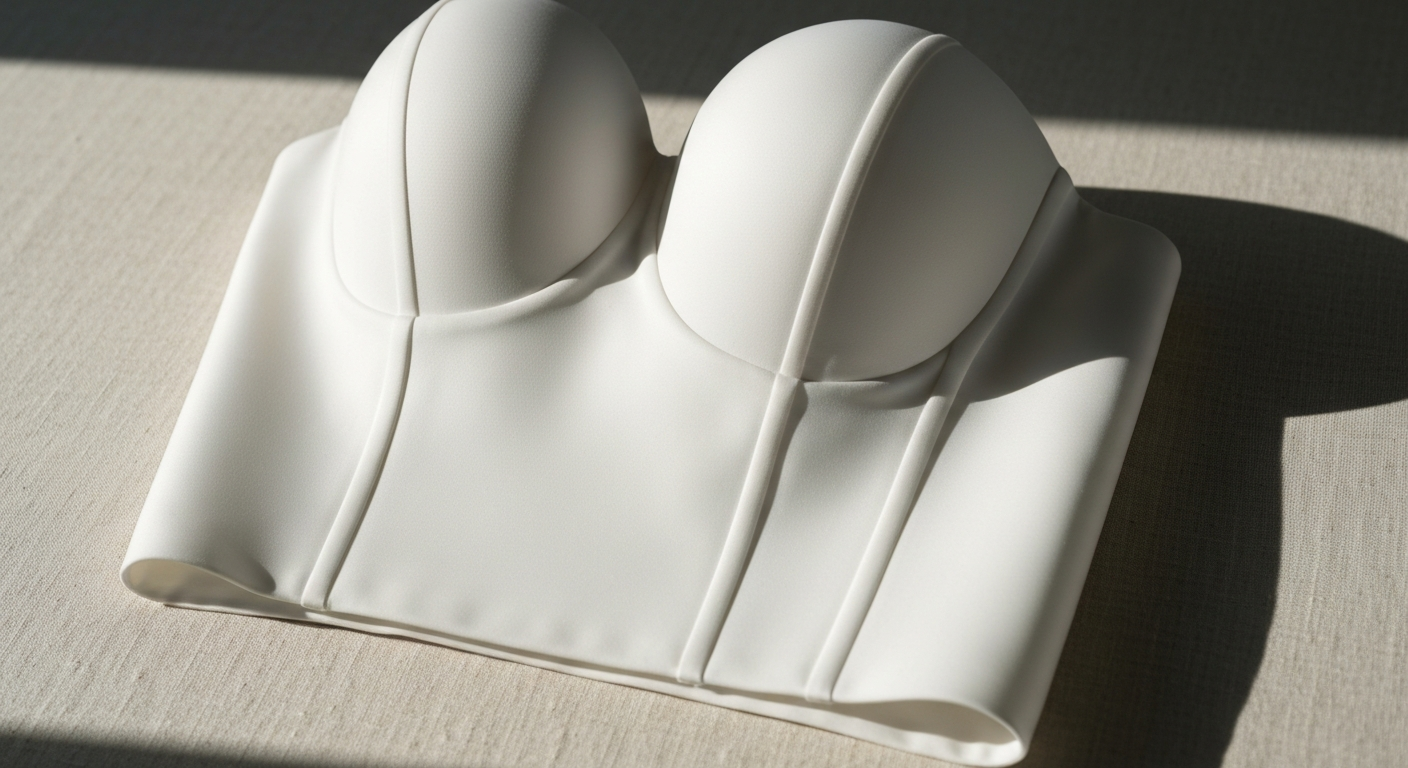
The strapless wedding dress is built around a structural argument: that a garment with no shoulder support can hold itself in position and hold its occupant in the confidence to move through a twelve-hour day without thinking about it. The construction makes this argument in boning, in busk closures, in corsetry channelling, in the specific weight and weave of the outer fabric. A duchess satin column does not move because it is designed not to move. A silk organza ballgown does not move because it has enough internal structure to create its own gravitational field.
The foundation beneath either of these dresses is not something the construction accounts for. The seamstress who fits the dress is fitting the dress. The foundation is the wearer's variable, and most wearers are left to solve it alone.
What the Dress Construction Decides
The best option under a strapless wedding dress is silicone nipple covers. Most strapless gowns have built-in boning and cups that provide shape without additional support; adding a strapless bra creates double-layer bulk at the bust. Avoid bustier-style bras: they compress silhouette and create visible lines under fitted bodices.
Not all strapless dresses are structurally equivalent. The silhouette that appears on a hanger at an atelier in Porto or at a bridal boutique in Madrid carries no information about what is happening inside the bodice. Two dresses of identical silhouette can have completely different internal architecture, one with substantial boning that functions as a standalone corset, and one with minimal boning that relies on the outer fabric to maintain shape.
The question to ask a seamstress directly, rather than trying to infer from the outside, is: can this bodice hold its position without an adhesive foundation. The answer is technical and specific. A heavily boned corseted bodice in duchess satin will hold for most cup sizes up to a D without assistance. A lightly boned bodice in chiffon or silk crepe will not hold reliably above a B cup for more than three to four hours of movement. Both are beautiful dresses. They require different foundation solutions.
A seamstress who has been fitting strapless bridal for more than five years will have a clear answer. The answer will also include whether a built-in cups option is available for the specific dress, whether the boning can be reinforced in alteration, and what internal tape options are compatible with the fabric. These are conversations worth having at the second fitting rather than discovering the answer on the morning.
The Strapless Bra Problem
The strapless bra is the first solution most women reach for under a strapless dress, and it is also the solution that fails most consistently across a long day. The physics are straightforward: a strapless bra relies on horizontal compression and friction to stay in position. Both of these mechanisms degrade over time with movement, heat, and perspiration. A bra that was correctly placed at ten in the morning may have migrated two centimetres south by two in the afternoon. The migration is not dramatic enough to be visible to guests, but it is fully visible in photographs taken from a slight elevation, and it requires manual correction every forty-five minutes to stay at its original position.
For a ceremony and cocktail hour lasting four hours, a well-fitted strapless bra by a specialist like Rigby and Peller, correctly sized and placed, handles the requirement adequately. For a twelve-hour day that includes dancing after midnight, the same bra will have been corrected eight to ten times before the evening ends. The wearer knows this. The photographs know this. The solution that reduces the management is the adhesive alternative, which improves with body warmth and holds without the horizontal compression mechanism that strapless bras rely on.
The Adhesive Option Under a Structured Bodice
A structured corseted bodice creates a specific placement requirement for an adhesive foundation. The bodice boning runs vertically along the sides and front of the torso, creating an inner structure that the adhesive foundation has to accommodate rather than compete with. The placement has to be inside the area the boning defines, centred with the bodice cups, at the height that aligns with how the neckline will sit when the dress is fully fastened.
This placement is established during a fitting, not estimated on the morning. The dress goes on. The neckline settles at its intended height. The position of the cup seam relative to the body is now defined. That position is where the adhesive foundation is placed. The measurement from a fixed point, typically the sternum notch, is written down. The placement on the morning follows the measurement. This is not complicated. It requires one person to be paying attention during the fitting and to write the number on a card that goes in the emergency bag.
Medical-grade silicone covers from Korea, ultra-thin at the edge, less than half a millimetre at the perimeter, sit flush against the skin without creating the visible line that a bra band creates at the outer edge of a strapless bodice. The ultra-thin profile is what allows the bodice to sit correctly over them without a visible structural interruption at the neckline.
Cup Size and the Foundation Decision
The strapless foundation decision is not the same decision for different cup sizes. For a B cup or smaller in a well-constructed strapless bodice, the bodice itself provides sufficient hold and coverage. An adhesive solution is a comfort and confidence choice, not a structural requirement. For a C cup, the bodice does most of the structural work and the adhesive solution provides supplementary coverage. For a D cup or larger, the structural requirement shifts: the dress's internal boning is unlikely to be sufficient without assistance, and the foundation solution needs to provide coverage and lateral support.
For larger cup sizes, silicone covers in the correct size combined with internal body tape along the inner side seam of the bodice creates a system. The covers manage the coverage requirement. The tape manages the lateral hold that the boning does not fully provide. The tape is applied to the inside of the bodice at the second fitting, with the seamstress present to confirm it does not affect the outer fabric or the boning channels. This is a conversation, not an improvisation on the morning.
What Happens at the Bustle
The strapless ballgown presents one more specific problem that the fitted column does not: the bustle transition. Portuguese and Spanish weddings commonly include a dress bustle for the dancing, where the train is looped up to allow movement. The bustle transition happens in a side room or a bridal suite alcove, with the maid of honour or the wedding coordinator managing the hooks and loops while the dinner speeches are still in progress and the band is tuning up forty metres away.
During the bustle transition, the dress is being manipulated by someone who is not the wearer. The bodice is being held at the sides while the back is being lifted. The adhesive foundation needs to hold through a series of movements that are different from the walking and sitting movements it has been managing for the previous eight hours. An adhesive that has been correctly applied and that has had the full benefit of body warmth throughout the day holds through this transition. An adhesive applied incorrectly in the morning, or one that has been partially lifted and re-applied during the day, has less reliable behaviour at hour nine.
The instruction is the same as it is for every other element of the dress system: resolve it before the day and trust it during the day. The morning that begins with a correctly placed foundation is the morning that ends with a foundation that is still correctly placed.
The Second Opinion
After the fitting, after the conversation with the seamstress, and after the dress rehearsal, the most useful additional check is a conversation with a woman who wore the same or a similar dress. Not an atelier staff member who sells the dress. A woman who wore it, for a full day, in weather that was not the controlled temperature of the fitting room.
The online communities around Portuguese and Spanish bridal, specifically the group forums on Portuguese Wedding Planners and the Spanish equivalent Bodas.net, contain thousands of accounts of exactly this experience. The specifics vary by body type and by dress construction, but the patterns are consistent: the solutions that hold for twelve hours are adhesive solutions applied correctly with sufficient time before the dress goes on. The solutions that fail are strapless bras chosen for fit in a static moment that becomes a dynamic day. The full protocol, including the application sequence on the wedding morning, is in the wedding day lingerie guide.
What the Photographs Know
The photographer at a strapless wedding is aware of the foundation question in the way that photographers who shoot weddings regularly become aware of recurring problems. A photographer like Jose Villa, who has shot strapless dresses on three continents, knows the angle from which a migrated strapless bra edge is first visible, and knows that the second hour of couple photographs is typically when the visible line appears if it is going to appear.
A foundation that requires zero adjustment from application to removal is a foundation that allows the couple photographs to proceed through the full session without the interruption of correction. The photographs from a session where nothing required management are consistently better than the photographs from a session where the wearer was partly attending to the dress. The camera registers attention. It also registers the absence of it, in a way that is visible in the face, in the posture, in the specific quality of presence that is either there or not there across the eight hundred frames the photographer shoots between ceremony and cocktail hour.
The strapless dress at its best is invisible architecture. It appears to hold itself. The photographs appear to show a woman who is completely at ease. The preparation that makes this possible is practical, specific, and done before the day. The day itself requires nothing except the occasion.
The checklist for the morning of. One email, everything you need underneath the dress.