A December ceremony in a stone chapel in the Minho, or in one of the converted palace hotels in Porto that host winter weddings the way the Azores hosts mist, has its own specific conditions. The ceremony space is cold. The stone absorbs cold and holds it. The heating, if the building is old, addresses the air but not the walls. The bride who arrives in a summer bridal fabric, in chiffon or organza or delicate English tulle, will spend the ceremony managing a sensation that has nothing to do with emotion.
The winter wedding gown is a different category of garment. Its fabrics have weight and structure. The decisions made about what goes underneath it are different decisions than the ones made in June.
Mikado
Mikado is a silk-polyester weave with a matte face and a substantial hand weight, originally developed in the nineteenth century for tailored evening wear and adopted by bridal designers in the late 1990s when the fashion moved toward structured, architectural silhouettes. Monique Lhuillier's use of mikado in her fit-and-flare bridal designs has been one of the defining influences on how the fabric is now read in ceremony contexts: architectural, confident, warm without being heavy.
Mikado holds its shape through cold air, which is not a trivial property. Lighter fabrics, particularly chiffon and organza, become more fluid in cold and are prone to wind-blown cling against whatever is underneath. Mikado does not cling. The weight of the fabric at a winter wedding ceremony means the line the designer intended is also the line present at the altar.
A mikado bodice, structured and boned at the interior, rarely requires additional foundation above the waist. The fabric is stiff enough to hold a sweetheart neckline in position without any external support. What a mikado gown does require, in terms of the wearing experience, is that nothing worn underneath creates a visible seam through the exterior. Mikado at body temperature reads smooth. Any seam or edge beneath it reads as a ridge.
Velvet
Velvet is the winter fabric that bridal designers return to every few years, and the brides who choose it are, without exception, buying a specific atmosphere rather than a season-neutral choice. A velvet gown at a Christmas wedding in a candlelit church absorbs the candlelight rather than reflecting it. Silk velvet, which is the variant used in couture and high-end bridal, has a depth of colour that accelerates through the evening: the dress at midnight looks different from the dress at noon, richer, the pile catching the low warm light in a way that synthetic alternatives cannot replicate.
Carolina Herrera has designed in velvet for winter bridal collections several times, most consistently in wine, midnight navy, and ivory. The ivory velvet bridal gown is a specific choice that reads period without being costume, formal without being stiff. It photographs with a warmth that white silk does not produce in winter light.
Velvet is heavier than it looks, and the weight accumulates over twelve hours. The bride who is wearing a velvet gown in December needs to have accounted for this in the fitting, including the full weight of the skirt when walking. The foundation question for velvet is the same as for mikado: nothing with a visible edge, nothing with a seam that reads through the pile. The pile of the velvet catches everything. A foundation with a thick edge band produces a visible ring. Seamless solutions, or solutions without perceptible edges, are the correct choice.
Heavy Crepe
Heavy crepe is the fabric that works at winter weddings for the same reason it works at Parisian dinner parties in November: it moves with authority. A crepe column dress on a woman who carries herself well is the most reliable option in a winter ceremony context because the fabric is completely neutral in relation to the environment. It does not compete with the setting. It does not make a statement about the weather. It provides a clean, matte surface that allows the wearer to be the content rather than the garment.
Crepe does stretch. At body temperature over the course of a day, it relaxes slightly, and the relaxing is visible in certain cuts, particularly at the hip and across the upper torso. This is not a fabric failure. It is the nature of the weave, and it is why fittings for crepe gowns are done at the end of the day rather than the beginning. The fitting appointment at three in the afternoon for a crepe gown produces a different result than the same appointment at ten in the morning, and the alteration specialist who understands the fabric will schedule accordingly.
The Strapless Winter Neckline
The strapless sweetheart neckline on a winter gown creates a specific temperature problem that summer brides do not encounter. The bodice is structured and warm where the fabric covers the body. The neckline and the shoulder are bare, which in a stone church in December means cold. This is not a vanity concern. Cold affects posture. A woman who is cold at the shoulder rounds forward slightly, which changes the presentation of a sweetheart neckline in the photographs.
The standard solution is a cover-up for the ceremony: a faux-fur stole, a cashmere bolero, a beaded topper. Brides who use this approach carry the cover-up during photographs and the reception, which extends the getting-dressed sequence and creates a styling variable throughout the day. The brides who avoid the problem at the source do so by choosing a neckline with sleeve or by selecting a fabric that provides its own warmth.
The foundation underneath a strapless winter bodice follows the same logic as any strapless cut: the boning in the gown provides most of the support, the interior structure in a well-made bodice does the work. The foundation question is whether anything additional is required at the chest, and the answer depends on the specific construction of the bodice. At the fitting, move in the dress without the cover-up for thirty minutes to confirm. If the bodice holds, nothing additional is required. If it does not, address this at the three-month fitting rather than the week of the wedding.
The Backless Winter Gown
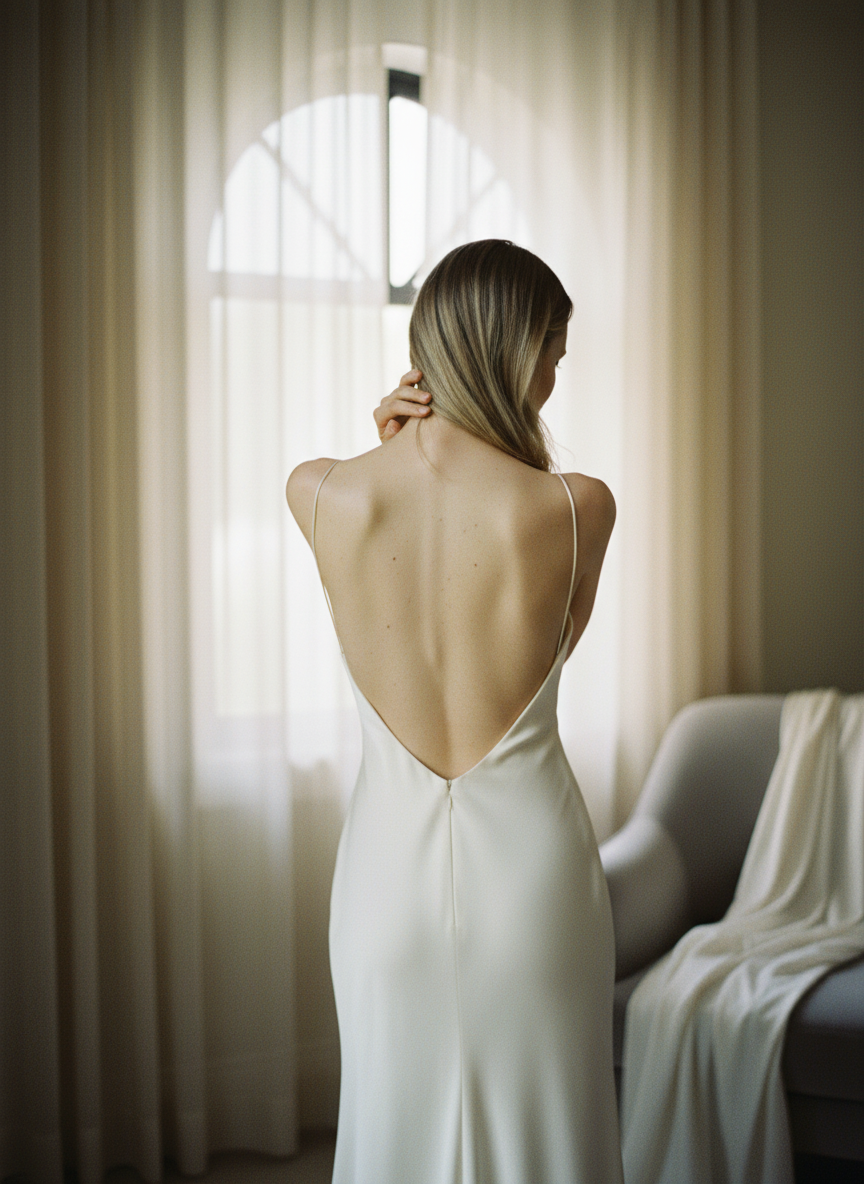
The backless winter gown is a specific choice that requires explanation. In December, in a stone building, a bare back is a deliberate statement about the wearer's relationship to formal occasion dressing: that the beauty of the design outweighs the comfort consideration, that the photographer's image of the bare back in the stone archway is worth the ten minutes of cold between the car and the chapel door. This is a calculation that some brides make and that the gown they choose expresses explicitly.
The foundation for a backless winter gown in a heavy fabric is solved from the front. Medical-grade silicone covers from Korea, less than half a millimetre at the edge, hold cleanly against skin across the full temperature range of a winter wedding day: the cold of the church, the warmth of the reception, the heat of the dancefloor at midnight. The adhesive releases cleanly at the end of the evening. The back remains exactly as the designer intended, from the ceremony through the last photograph.
At the correct weight, this is a solution that does not register through heavy crepe or mikado. The edge is below the threshold of visibility through any fabric with substance. This is the specific engineering problem that medical-grade silicone solves, as described in the production process that makes ultra-thin adhesive edges possible: the precision at the edge is manufactured, not approximate.
The Morning in Winter Light
Winter morning light in Northern Portugal arrives late and stays low. At nine in the morning in December, the light through the windows of the bridal suite is horizontal, warm, and golden in a way that August light never achieves. The getting-ready photographs taken in this light have a quality that summer bridal photography does not. The velvet absorbs it. The mikado catches it at the folds. The crepe resolves it into smooth warm shadow.
The foundation is in place before the dress goes on. The dress goes over the head or closes at the back, depending on the silhouette. The alteration specialist closes the last hook or draws the last lace. The cover-up, if there is one, is placed over the shoulders for the walk to the chapel.
Inside the chapel, in the cold that the stone has been keeping since November, the dress is doing what it was constructed to do. The fabric is warm. The structure is holding. Nothing underneath is asking for attention. The winter morning light is doing the rest.
The photographs from a winter wedding in stone light have a quality that summer weddings rarely achieve. The depth of the fabric, whether velvet absorbing candlelight or mikado catching the low horizontal sun at noon, reads differently on camera than it does to the eye. The person inside the dress, having resolved every preparation variable across the weeks before the day, is not inside the garment. She is inside the moment, which is what the photographs record.
The checklist for the morning of. One email, everything you need underneath the dress.