
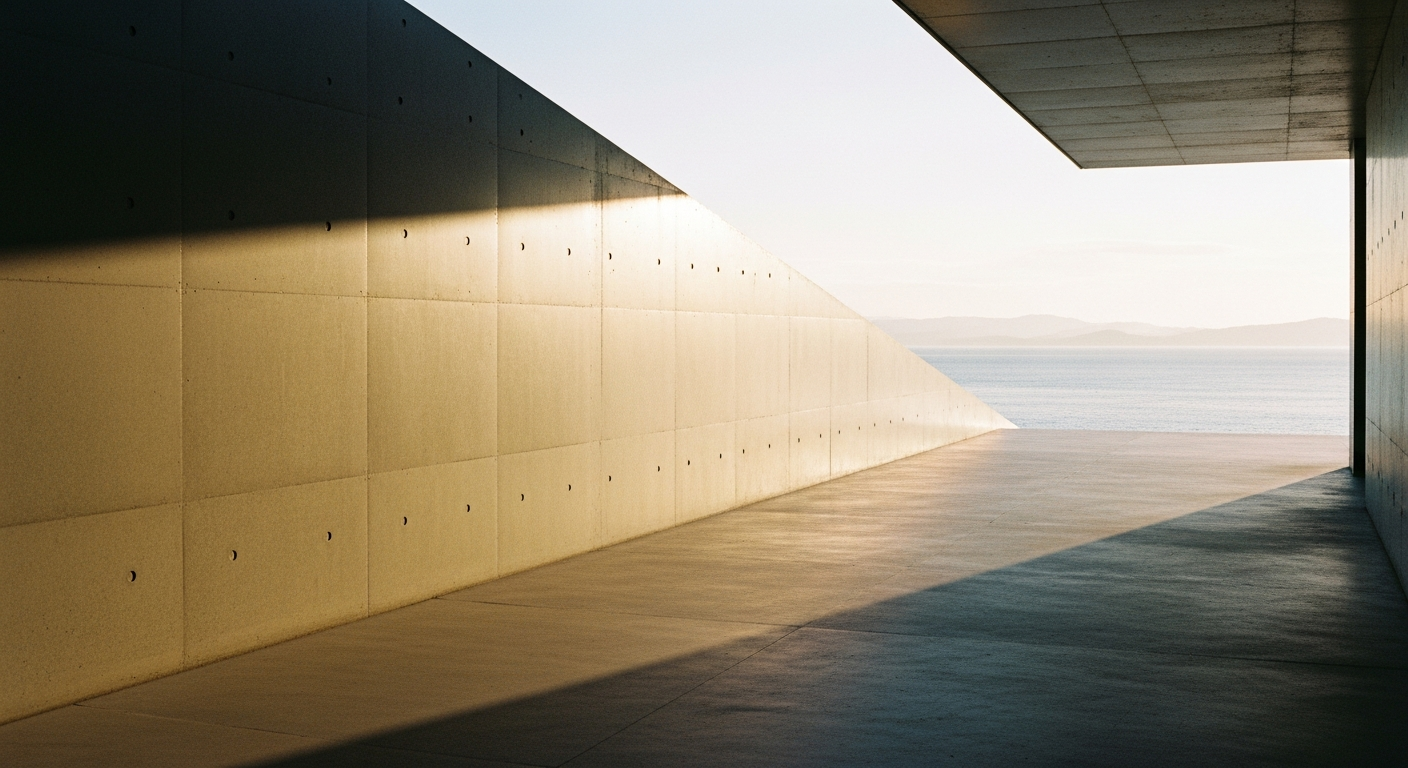
Kyoto is the Japan of the guide book. Naoshima is the Japan of the architect. You will not find Naoshima on most itineraries because it requires a detour to Okayama Prefecture, a ferry from Uno port, forty minutes on water, and a willingness to spend two or three days somewhere that has no castle, no temple circuit, no UNESCO site, and no tour buses. The ferry bag for those two or three days holds little beyond the Confidence Set. What it has instead is Tadao Ando's concrete against the Inland Sea, a Yayoi Kusama pumpkin on a pier, and a level of silence that modern Japan almost never offers. The inconvenience is the selection mechanism. It always is.
Soichiro Fukutake and the Island That Should Not Exist
The story of Naoshima begins not with an architect but with a publisher. Soichiro Fukutake inherited Benesse Corporation, an educational publishing company based in Okayama, from his father in 1986. He had a vision that was either quixotic or prescient, depending on when you evaluated it: a near-depopulated fishing island in the Seto Inland Sea, already suffering the industrial pollution that scarred much of Japan's postwar coastline, would become a site for contemporary art and architecture of the highest order. He hired Tadao Ando. He commissioned artists instead of art fairs. He built slowly and carefully, starting in the late 1980s, finishing nothing quickly. The result, now operating as Benesse Art Site Naoshima, is one of the few places in the world where the buildings are as important as the objects inside them.
Fukutake did not build a museum complex. He built a relationship between art and landscape that takes the Inland Sea as a permanent and necessary participant. Every room, every terrace, every sight line in the Ando buildings on Naoshima is oriented around water, light, and the horizon. This is not decoration. It is argument. The argument is that art requires silence, and that Naoshima, an island of under three thousand residents with no nightlife and no airport, provides it.
Tadao Ando and the Concrete Logic
Ando designed three major structures on the island: Chichu Art Museum, the Lee Ufan Museum, and Benesse House, which functions as both museum and hotel. The buildings share a material vocabulary: poured concrete, natural light, geometric precision, the refusal of ornament. Concrete is not a neutral choice in this context. Ando uses it against the organic disorder of the landscape, the irregular coastline, the unpredictable sea, the overgrown hillside. The buildings do not yield to their setting. They insist on their own geometry inside it, and the tension between the two is where the architecture happens.
The Chichu Art Museum is built almost entirely underground. The roof is at grade level on the hillside; below it, a series of concrete chambers hold three permanent installations: Claude Monet's late Water Lilies paintings, a room of work by James Turrell, and Walter De Maria's Time/Timeless/No Time, a granite sphere set in a chamber where light arrives from above at different angles through the day. Turrell's Open Sky is a room where the ceiling opens to a square of sky, and the light inside the room shifts continuously with the weather and the hour. You sit on a concrete bench and watch the sky change. There is nothing else to do. After twenty minutes you realise there is nothing else you need to do.
The Monet rooms are the most unexpected part of the building. The paintings are large and familiar from reproduction, and you expect to be disappointed by the gap between what you know and what you find. You are not disappointed. The rooms were designed specifically for these works: the floor tiles are hand-set white marble, the light is entirely natural, and the scale of the room was determined by the scale of the paintings. The relationship between the room and the work is not the typical museum relationship of neutral container and exhibited object. The room argues for the paintings. The paintings complete the room.
Kusama, Teshima, Inujima: The Island Chain
Naoshima is the centre of an archipelago of art islands reachable by the same ferry network from Uno port. Teshima, the island to the west, holds the Teshima Art Museum, designed by architect Ryue Nishizawa and completed in 2010. The structure is a single concrete shell, curved and low, without columns, open at two oval apertures that admit light, wind, and the occasional insect. The interior is empty except for water. Small droplets rise from the concrete floor and move across the surface in response to air current and gradient, pooling, separating, running in paths that are never identical. The work is by artist Rei Naito. There is no object to look at in the conventional sense. The room itself is the work. You walk slowly and watch where the water goes.
Inujima, the smallest of the art islands and the least visited, holds the Inujima Seirensho Art Museum, a contemporary art space built inside the ruins of a copper refinery that operated briefly in the early twentieth century and was abandoned in 1919. The artist Yukinori Yanagi and architect Hiroshi Sambuichi preserved the refinery chimneys and brick walls and built the museum around and through the existing industrial structure. The building uses no conventional heating or cooling system; it is cooled by underground water and heated by solar gain through the brick mass. The collision of the nineteenth-century industrial ruin with twenty-first-century art is not gentle. It is the most difficult of the three islands to parse on a single visit, and probably the most rewarding on a second.
Yayoi Kusama's yellow pumpkin sits at the end of a pier on the southeast coast of Naoshima, large enough that it reads from the ferry before anything else on the island does. The original installation was placed here in 1994. A typhoon took it into the sea in 2021 and it was recovered and returned in 2022. A red pumpkin, larger and climbable, sits at Miyanoura port where the ferries arrive. Between the two pumpkins, across a twenty-minute walk, is most of what you need to understand about how Naoshima handles the relationship between art and public space: with directness, without explanation, and without any apology for the fact that a very large polka-dotted gourd on a pier in the Seto Inland Sea is an entirely reasonable thing to encounter.
The Ferry and What You Wear On It
The approach to Naoshima is part of the experience in the way that the drive to Skibo is part of the experience. The ferry from Uno port takes forty minutes, running southwest into the Inland Sea, and the island appears gradually: first the pumpkin, then the low hills, then the small harbour at Miyanoura. The sea on a clear summer morning is flat in a way that the Mediterranean is not. No swell, no chop, almost no wind. The light reflects off it at a low angle and stays there. It is worth standing on the deck for the full approach.
The Chichu Museum sits on the western hill, twenty minutes by bicycle from the harbour. The path rises through pine and scrub oak before the building emerges, or rather doesn't emerge: only the entrance pavilion is visible above grade, the rest buried. Visiting in summer means managing the heat between the open hillside and the cooled concrete interiors. A linen shift dress, worn on the ferry and through the museum rooms at golden hour, handles both. The thin silicone layer underneath means the dress falls without interruption through seven hours of walking and sitting on concrete benches, with no visible line, no adjustment required. The building is doing enough work already.
Where to Stay and Where to Eat
Benesse House is the obvious answer and the right one. Tadao Ando designed the original building in 1992 and has added to it over the years: Benesse House Beach, Benesse House Park, and the Oval, a circular structure reached by a dedicated monorail from the main building and sitting above the Inland Sea with thirty-metre views in three directions. Oval rooms book twelve months out for peak summer. The other structures are more manageable. The museum collections are accessible to hotel guests at night, after public hours, when the building empties and the Monet rooms are yours alone for as long as you can stay awake.
The dining on the island is limited and correct for what the island is. The restaurant at Benesse House serves Setouchi olive oil with bread and runs a menu that leans toward the local catch, the specific fish of the Inland Sea rather than the sashimi of a Tokyo counter. Sanuki udon, the thick wheat noodle from nearby Kagawa Prefecture on Shikoku, appears in almost every small restaurant and canteen on the island: firm, a little chewy, in a broth that is lighter and cleaner than anything produced further north. Eat it once in the morning and once at lunch. The simplicity is the point.
The Setouchi Triennale, the contemporary art festival held across the art islands every three years, draws significant crowds in its exhibition windows. Outside those windows, the island runs on its own quiet logic. Summer is the editorial season. The light is long. The ferry runs four times a day. The concrete holds the heat of the afternoon and releases it slowly after sunset, and the outdoor terrace at Benesse House in the early evening is warm in a way that has nothing to do with the air temperature. For packing light across a week of island-hopping between Naoshima, Teshima, and Inujima, the logic is the same as any capsule travel wardrobe: fewer pieces, each doing more work, nothing announcing itself.
The Inland Sea at the End
The Inland Sea is not the Mediterranean. It is not the Aegean. It is flatter, quieter, and the light falls on it differently. There is no swell to hear against the hull at night. The water between the islands does not move in the way ocean water moves. It sits. The ferry crossing between Naoshima and Teshima takes twenty-five minutes on water that is, on most days, barely distinguishable from glass. Naoshima is built exactly for that light. The Ando buildings face the sea. The Kusama pumpkin points toward it. The Teshima droplets run toward the aperture that faces it. Everything on these islands has been oriented toward a body of water that asks for nothing and receives everything. That is a particular kind of invitation, and one that Kyoto, for all its gravity, does not make.
Die Cover. Gemacht, um unter allem zu verschwinden.

Unsichtbar unter rückenfreien und trägerlosen Schnitten.
€14,90
Silikon aus Korea · hautfreundlich

