
The Hawa Mahal at 7am
The Hawa Mahal glows in the colour of the canteria it is made from: Jaipur sandstone, the specific pink-terracotta tone that gives the city its epithet. The Palace of Winds was built in 1799 by Maharaja Sawai Pratap Singh as a screened gallery from which the women of the royal household could observe street life without being seen. Its facade is five storeys of 953 latticed windows, jharokhas in Rajasthani, each one a different geometric study in the same coral-pink stone. From the street, at 7am, before the tour groups arrive and before the heat builds to its full weight, it is the most beautiful thing in a city full of beautiful things. By the time the heat climbs, you stop noticing the silicone covers under the silk.
By ten, the temperature is climbing toward thirty-five. By two, it is forty or above. Jaipur in April is a city that teaches you to organise your day around the sun.
The Haveli System
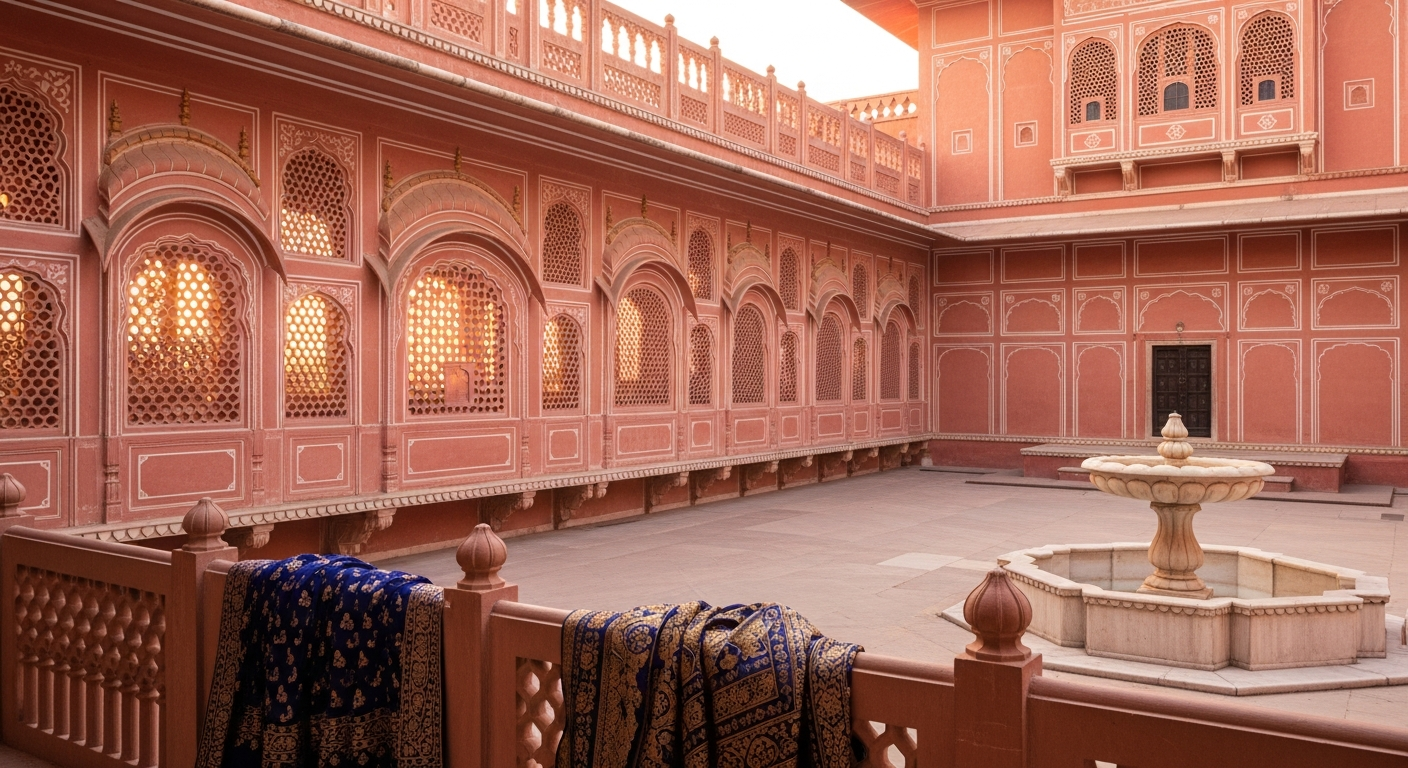
A haveli is a private mansion built around an internal courtyard, the architecture of wealth in Rajasthan. The walls face outward in plain canteria. The ornament is inside: frescoed reception rooms, carved marble jalis, painted ceilings in the Jaipur school that runs to hunting scenes and court portraits in deep indigo, crimson, and gold leaf. The courtyard at the centre drops the temperature by ten degrees and functions as the entire social architecture of the house.
Samode Haveli, in the old city, dates to the eighteenth century and operates now as a hotel. The frescoes in the public rooms are original and the restoration is conservative, meaning you can see the age in them. The fountain in the inner courtyard runs. Hundreds of candles light the pathways at night. The slow-cooked lamb here is rogan josh, developed in Kashmir and adopted into Rajasthani cuisine, the sauce built on Kashmiri red chiles rather than the fresh chiles of the south. It arrives at a colour almost the same as the sandstone outside. Order the crisp parathas straight from the tandoor alongside it.
The Johri, at Lal Haveli in the Johari Bazaar quarter, received a Michelin key in 2025. It is smaller and more intimate than Samode, tucked into the jewellers' quarter where the lanes narrow around goldsmith workshops. The vegetarian menu at the Johri Restaurant changes by season and draws on local produce with a precision unusual for a hotel kitchen. Sit in the haveli courtyard and eat the menu the kitchen decides rather than the one you think you want.
Johari Bazaar
Johari Bazaar, the jewellers' market, is the axis of Jaipur's textile and gem trade and has been since the eighteenth century. The jewellery here is mostly silver set with semi-precious stones cut in the local tradition: Kundan inlay work, meenakari enamel in the Jaipur style, polki diamond settings that use uncut stones mounted in gold foil rather than faceted gems.
The textiles are block-printed cotton in the Sanganeri and Bagru styles, hand-embroidered silks, and Jaipuri rajai, the lightweight quilted cotton blankets that are one of the city's most practical exports. The block printers at the back of the bazaar use carved teak blocks on cotton pre-washed in river water. The indigo and rust colours they produce are not reproducible by machine: the slight irregularities in the block print are what make the cloth look alive.
For the forty-two-degree afternoon, the practical choice is a lighter cotton-silk blend, printed in the pale indigo or the rust that the block printers turn out on the same blocks their grandfathers carved. The silk question in Jaipur is about weight and weave rather than provenance. Rajasthani silk is typically heavy and richly coloured, suited to the palace interiors it was made for. The lighter blends survive an afternoon in the bazaar and an evening on a haveli rooftop.
Laxmi Misthan Bhandar
Laxmi Misthan Bhandar, known to anyone who has been in Jaipur for more than a day as LMB, is a confectionery institution on Johari Bazaar that has been producing sweets and snacks since 1954. The dal baati churma here is the correct entry point to Rajasthani cuisine: hard wheat rolls baked in a tandoor and served with two preparations of lentil, one spiced with cumin and asafoetida and one rich with ghee, and churma, coarsely ground wheat crushed with sugar and clarified butter. It is a meal designed for the desert, where fat and carbohydrate and protein arrive together and the body converts them to energy for the next long stretch.
The ghewar is the answer to what comes after: a disc of fried flour batter soaked in sugar syrup, topped with rabri and pistachio. LMB makes the version with rose water in the rabri. Eat it standing at the counter.
Amber Fort
The road to Amber Fort climbs through the Aravalli hills, twelve kilometres north of the city, and arrives at a Rajput fortress begun in the sixteenth century by Raja Man Singh I and expanded over the following century by Jai Singh I. The approach from below is the view most people know: pale ochre walls rising from the hillside, reflected in the artificial lake Maota below.
Inside, the Sheesh Mahal is the room that justifies the climb. The Mirror Palace's ceiling and walls are covered in convex mirror fragments set in white plasterwork and when a single candle is lit in the room, the reflections multiply to thousands. The guides claim the effect simulates stars. It simulates something, though the word that arrives is not stars.
The fort's internal gardens are planted with roses and jasmine. In April the jasmine is past peak but the residual scent in the enclosed courtyards is still present at dawn.
The Evening Logic
Jaipur organises itself around the evening in April and May, when the temperature drops from forty-two to a still-warm twenty-eight and the rooftop restaurants and garden terraces fill after dark.
The evening requires something that absorbed the day's heat and recovered from it. A silk that has been folded in a bag for six hours and emerges without permanent complaint. A fabric that can move from an afternoon in the bazaar, where the fabric merchants press cold lassi on you and show you their newest block prints, to dinner on a rooftop where the Jaipur skyline is entirely illuminated temples and palace towers. What sits beneath it should be equally unconcerned with the transition. Ultra-thin at the edge, less than half a millimetre. The adhesive holds through the afternoon and the evening both. Nothing to manage.
The transition between bazaar and rooftop dinner is the rhythm of the Jaipur day. You do not change clothes. You adapt. Read more on what the backless silk blouse requires before you pack it.
Getting the Timing Right
Jaipur in October and November is fifteen degrees cooler and the tourist volumes are manageable. April is harder and more honest. The light at Hawa Mahal at 7am in April, the stone turning the exact colour of the dawn it has been absorbing for two hundred and twenty-five years, is something the cooler months do not replicate.
Go in the heat. Understand the city on its own terms. The haveli system was built for this specific temperature problem. Trust it.
Packed beside the linen. Designed to disappear.


