
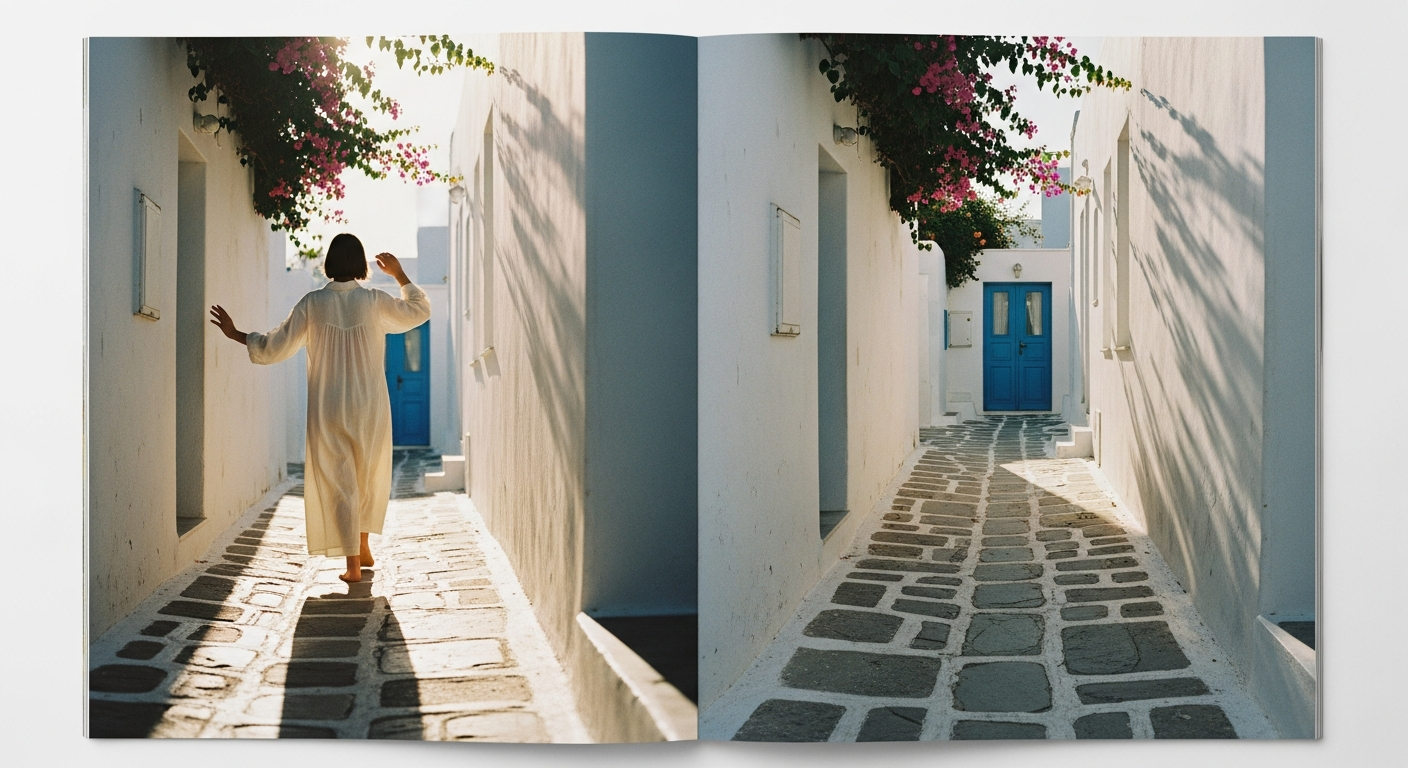
The short answer: matte silicone covers. Mediterranean heat dressing runs on fewer layers, not more structure, and the fewer layers there are, the more each one has to do alone. A boned or banded bra runs hot against skin already working to cool itself, and prints through linen the moment the fabric dampens. Silicone covers sit flat against the skin under a single layer of linen or cotton and hold through a full day in the sun without adding a layer to manage. Everything below is the longer answer: how the region dresses for heat, and what changes once the light turns to evening.
The Logic of Dressing in Heat
Heat changes the logic of getting dressed. In the Mediterranean in July, the woman who looks right has solved a problem in advance, and the solution is always the same: fewer choices, better ones, dressed for evening from the moment she opens the wardrobe in the morning.
This is not minimalism as aesthetic. It is minimalism as physics. Linen is not a trend in the Cyclades or the Amalfi hills or the Moorish lanes of Essaouira. It is the only answer to air that sits at thirty-two degrees without moving. The Italian fashion industry codified this in 2026: linen dominates spring-summer collections not because anyone decided it was fashionable, but because no other fabric makes the same trade. Breathable enough to wear through midday. Structured enough to carry into an eight o'clock dinner without declaring itself casual.
The Cyclades in particular teach you something about colour. Paros was known in antiquity for its marble, pure white and cold, quarried from the hills that still bear the marks. The buildings absorbed that palette. Every surface is the colour of a thing that has had the heat leached out of it: white, bone, the grey-blue of a shadow at two in the afternoon. When you dress against that backdrop in anything louder, the architecture wins. Dress in ochre or sand or the off-white of unbleached linen and something happens: you become part of the place rather than a visitor to it.
What Heat Asks of a Wardrobe
Two linen dresses, one lighter than the other. A pair of flat leather sandals that work on both uneven stone and a restaurant floor. One layer for evenings that produce a sea breeze without warning. The lanes in the tighter sections of most Cycladic villages will not accommodate a bag worn on the side. Shift it to the front.
The error most women make in Mediterranean heat is solving for the beach and nothing else. The beach is the easy part. The packing challenge is the same seven days running: a morning that involves a market, a midday that involves direct sun on pale limestone, an afternoon that involves a boat, and an evening that involves a table at the edge of something beautiful where the light is still good at nine and you have not been back to the room.
That last part is where the logic compounds. The dress that reads well at a white marble table in a candlelit courtyard in Naxos town is the same dress that could not have survived a different kind of afternoon. The neckline is part of it. A deep V or a low back has its own structural requirement: something underneath that does not interrupt the line of the garment and does not announce itself in either direction. Medical-grade silicone covers from Korea sit flat under any weight of fabric, hold through the heat, and release cleanly. Good for fifteen or more wears. In the Cyclades you will use every one of them.
The Hours and What They Ask
The Mediterranean day has a different structure than northern European instinct expects. The real heat is from eleven to four. Lunch moves late, to two or two-thirty. The meal is not quick. It arrives from a kitchen that has been working since morning on things that cannot be rushed: slow-braised lamb on Naxos, octopus dried in the sun before it meets the charcoal, the revithada chickpeas that have been in the baker's oven since the evening before. You will be at the table for two hours. The light will be brutal and the wine will be cold and the tablecloth will be the colour of the wall behind it.
None of this is a hardship. It is a rhythm. The afternoon between three and six exists in Mediterranean life as a kind of unofficial institution: the shuttered hour, the cooling hour, the hour that belongs to nobody in particular. The woman who learns to respect this hour arrives at dinner unhurried. The woman who fights it arrives frantic and overdressed and has made three choices she will regret by eight o'clock.
The Transition
There is a specific moment in a Mediterranean afternoon when the decision gets made. The boat has returned. The harbour at Spetses or the dock at Parikia. You have been in salt water and sun for four hours and dinner is at nine and there is no logical reason to return to the room between now and then. The dress you put on this morning has to carry you through. This is the test. Not how it looks in the wardrobe. How it holds up across a full Mediterranean day, from market to sea to table, without revision.
This is why the number of garments matters less than the quality of the single one. A dress that earns trust does not require reconsideration at six in the evening. It is already working. You arrive at the table unhurried because the clothes are doing their job.
On Packing, Specifically
The tyranny of options dissolves once you accept that heat imposes a uniform. Not literally. But functionally. The range of what works narrows until what is left is what is genuinely right. Linen in natural tones. Flat sandals that have been broken in. One thing that works for evening without effort. A fabric layer that weighs nothing.
What you do not need: anything synthetic, anything that requires ironing, anything in a colour you cannot wear twice. The Mediterranean is not interested in novelty. The women who live there do not perform dressing. They are dressed. The distinction is visible at any cafe terrace in Antiparos or Spetses or Positano, and it never comes from the number of choices packed. It comes from having made fewer, better ones before the bag was zipped.
The view from the ferry between islands at dusk is one of those things that does not translate into photographs the way it is in life. The light is the colour of the stone and the water has absorbed it and the horizon is not where you expect it to be. Dress for that view. Dress to be present in it. Bring what survives the whole day, and leave the rest at home.
For further reference: what to wear under a backless dress and our guide to ultra-thin silicone covers for the evenings that require them.
Packed beside the linen. Designed to disappear.

Matte and invisible under sheer.
€29,90€5,98 a pair
Korean silicone · 15+ wears per pair
“I carry them with me everywhere.”
Carol M.

