
Menorca is the Balearic island for people who have been to Ibiza and survived it. Ibiza is organised around performance: the night, the music, the spectacle of people who want to be seen being present at something. None of that performance is required underneath, just a pair of silicone covers instead of a visible strap. Formentera is quieter but deliberately minimal in the way of a place that knows it is fashionable for being minimal. Mallorca is for everyone, containing every category of visitor and the infrastructure that serves them all.
Menorca does none of this. It is a UNESCO Biosphere Reserve with 216 kilometres of coastline, a gin with a geographical indication that predates the tourist economy by two centuries, and a fishing village that produces the best lobster stew on the Mediterranean. It is also, for much of August, fully booked. This is the only performance Menorca allows itself.
The capital is Mahón, at the eastern end of the island, and the harbour is the second-deepest natural harbour in the world after Sydney. The British used it to station the Royal Navy in the eighteenth century. The consequence of that occupation is still visible in the Georgian-style facades along the port, in the sash windows that appear nowhere else in the Balearics, and in the gin.
Xoriguer is one of only two gins with a geographical indication, the other being Plymouth. The distillery opened in 1784 to supply the British garrison, using a copper pot still and local grape spirit rather than grain. The juniper grows in the surrounding forest. The gin is botanically lighter and slightly sweeter than London dry style. You can visit the distillery on the harbour road and taste before you buy. Buy the larger bottle. It lasts the trip and improves the terrace at your villa.
Fornells is on the northern coast, a thirty-minute drive from Mahón, and the harbour there is occupied by traditional wooden boats called Llauts whose single purpose is lobster. The Fornells lobster fishermen have been making the same argument for generations: the lobster in this bay is the best in the Mediterranean because the water is cold enough and clear enough and they have been fishing it long enough to understand it.
The caldereta de langosta, lobster stew, arrives at the table in the pot it was made in. The base is tomato and onion reduced for hours, the lobster added at the end and cooked through in the sauce. The bread is for the sauce. At El Pescador, on the harbour road at Fornells, eat this at lunch rather than dinner because the light on the harbour at one in the afternoon is better than any candle arrangement. Plan the rest of the day around the stew. It earns the rest.
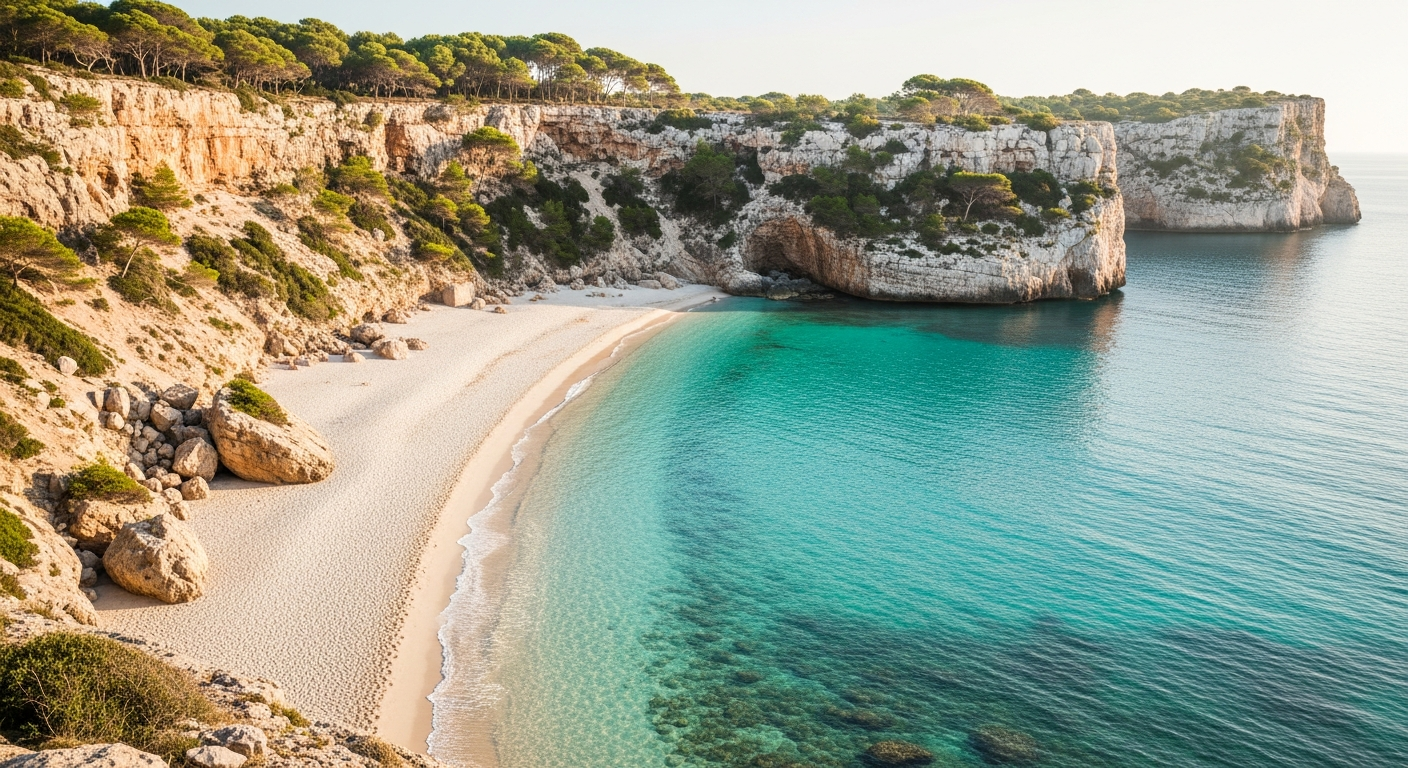
The beaches of Menorca are mostly calas: sandy coves between limestone cliffs with pine trees at the edge and water that is turquoise in the geological sense, coloured by the white sand below. Cala Macarella is the most photographed. Go to Cala Macarelleta, the smaller cove a ten-minute walk through pine trees, before nine in the morning or after five in the afternoon. Between those hours it is full.
The northern coast calas are different. Reddish sand instead of white, ochre cliffs, waves from the Tramontana wind that comes down from France and makes the north coast unsuitable for swimming much of the year and remarkable for walking the rest of the time. The path along the north coast, the Cami de Cavalls, circles the entire island in 185 kilometres. Walk sections of it. The route has been used for centuries by the cavalry that patrolled the coastline. The stone walls that edge it are the same stone walls that have been there since the Bronze Age.
The prehistoric structures are everywhere on the island and largely without interpretation panels. The taules are T-shaped stone formations, a pillar supporting a horizontal capstone, some of them four metres tall, whose purpose has not been agreed upon. The talaiots are circular towers. The navetes are boat-shaped stone chambers used for collective burial. These structures date to 2000 BCE and earlier. They sit in the middle of fields and on clifftops and in the pine forests behind the calas. You encounter them without preparation. There are over a thousand of them.
The dress code on Menorca is less studied than elsewhere in the Balearics, and that is not a criticism. The people who come here are more interested in the water than the terrace. The restaurant in Mahón you book a week in advance is not performing a scene; it is making very good local food. The women who eat at the harbour restaurants in Es Castell or at the port at Ciutadella on the west end of the island dress simply and well. Linen. Things with a clean neckline or an open back. The evening temperature drops a full ten degrees from the midday heat and the breeze off the water is consistent.
What the evening at a harbour table requires is a dress that works without additional fabric beneath it. Medical-grade silicone covers from Korea, invisible under any fabric weight, hold through a full day at the cala and a dinner that runs to midnight. Good for fifteen or more wears. The adhesive releases cleanly. Nothing to carry. Nothing to plan around. The dress does the work and the harbour does the rest.
Ciutadella is on the western tip of the island and is the more beautiful of the two cities, though Mahón would disagree. The cathedral there was begun in the fourteenth century and finished several centuries later, visible in the facade's layers. The old town behind the cathedral has lanes narrow enough that the buildings above touch at the roofline. In June, the Festa de Sant Joan fills the streets with horses that rear on their hind legs in a tradition that has continued since the fourteenth century. The riders wear period costume. The horses are Menorcan breed, heavy and black, trained from birth for the rearing. It is one of the more extraordinary things in the Balearics and it is entirely local in its origins and its continuation.
Come to Menorca in June or September. In June the island is green from the spring rains and the calas are not yet crowded. In September the water is at its warmest and the August families have returned to Barcelona and Madrid. Either month is better than the peak of August, which is when the island is at its most itself, the island-born Menorquins slightly outnumbered in the calas by the mainland visitors who come every year because this is what they know of summer.
Those repeat visitors are not wrong. The island earns its return. The Tramontana wind, the limestone paths, the caldereta in Fornells, the gin from 1784: none of it is for performance. It is simply what a place looks like when it has been itself long enough to stop explaining itself.
For packing the calas right, what to wear under a backless dress is the practical companion.
The product referenced above is available at Skindelle.
Packed beside the linen. Designed to disappear.


