
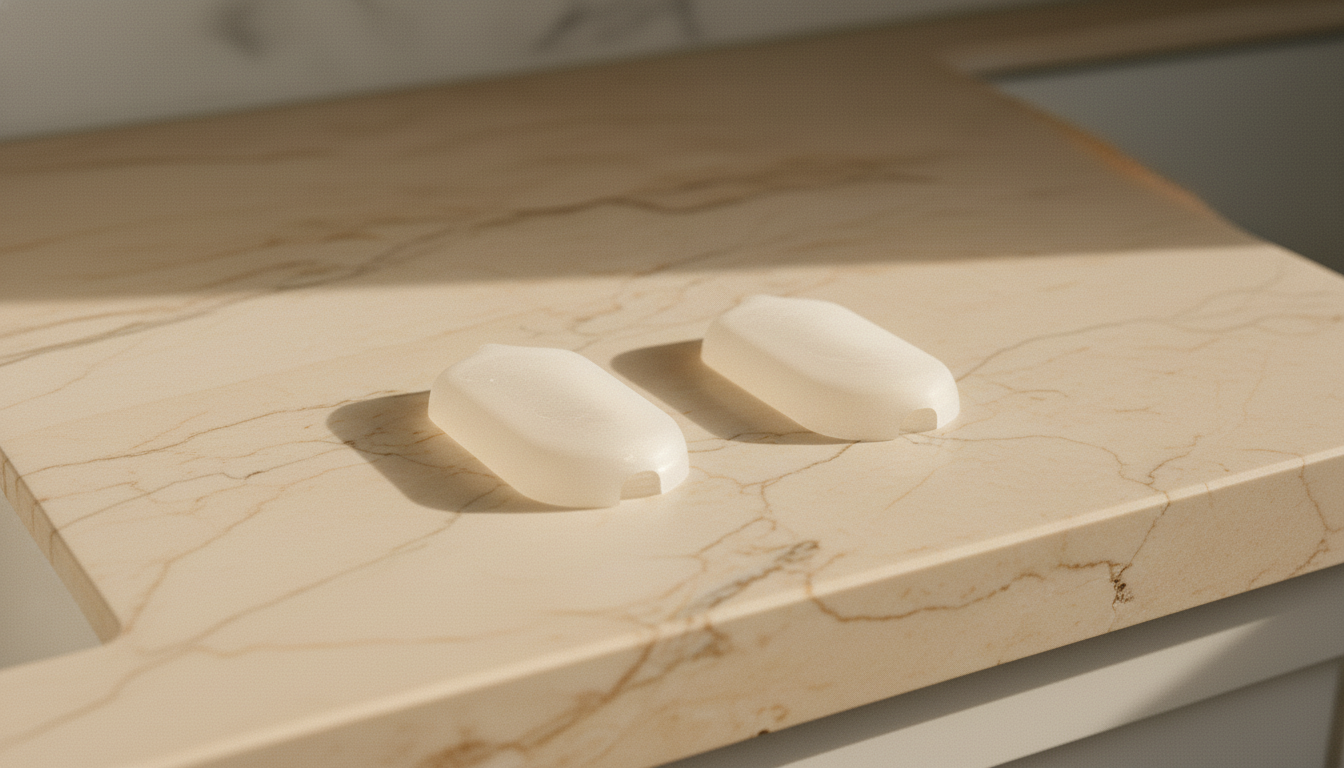
Adhesives that stick to skin fall into two broad types: those that bond to your skin's proteins and pull them away on removal, and those that hold through close surface contact and release cleanly. The skin-safe version is the second kind. The difference is not cosmetic. It accumulates across repeated wears.
The short answer: silicone-based adhesive, not the cheaper alternative. The difference is not marketing. A pressure-sensitive adhesive either bonds to the surface of the skin or it bonds into it, and only one of those releases cleanly after eight to twelve hours of wear. Silicone covers use the surface-bonding kind on purpose, made from medical-grade silicone that is REACH-compliant and skin-kind rather than merely strong. The silicone version can be worn, removed, and worn again fifteen or more times without the skin paying for it. Everything below is the longer answer: the chemistry of why one adhesive bonds to proteins and the other does not.
The first medical adhesive tape appeared in 1845. A surgeon pressed india rubber, pine gum, and turpentine onto fabric strips and used them on wounds. It held. The residue was significant, and repeated removal sometimes caused more damage than the wound being treated. He was solving an adhesion problem. What he had not yet accounted for was a biology problem. Those two problems turned out to be the same problem, and a hundred and eighty years of adhesive development has largely been the process of finding that out.
An adhesive that sticks well is not the same as an adhesive that is safe for skin. The two requirements overlap in some designs and diverge sharply in others. For a product worn against warm skin under clothing for eight to twelve hours and removed dozens of times across months of use, the design choices that determine safety are very specific. They are also readable, once you know what to look for.
How different adhesives bond to skin
Pressure-sensitive adhesives bond through light contact, without heat or solvent. At the moment you press one against your skin, the adhesive flows slightly to conform to the surface, then holds. The question is what it is conforming to and bonding with.
The cheaper category of adhesive is strong, stable, and inexpensive to produce. It is widely used in medical tape and wound dressings for exactly those reasons. It is also an adhesive that bonds to the proteins in your skin, not just the surface. When you remove it, some of those proteins come away with it. That is not a defect in a poorly made product. It is how the chemistry works. Microscopy studies that have examined skin after removal show more protein residue from this kind of adhesive than from silicone, after the same wear duration. An adhesive that bonds to the proteins in your skin is not borrowing against the surface. It is removing from it, one wear at a time.
The silicone version works differently. Adhesion happens through close surface contact. The adhesive conforms to the topography of your skin and holds through that conformity, not through chemical bonding to the proteins underneath. The same microscopy studies found significantly less protein residue after silicone removal. The silicone adhesive releases from the skin surface. The cheaper kind takes part of it.
What sweat and heat do to each type
Skin under clothing is a warm, humid environment. Your body temperature under an adhesive product is higher than the surrounding air, and moisture accumulates in a way that changes how adhesives perform.
The cheaper kind of adhesive tends to lose grip in this environment. Moisture interrupts the surface contact the bond depends on. Some versions are engineered to resist moisture by increasing initial adhesion strength, but stronger initial adhesion means a harder removal profile. The product holds through the evening, and removes more aggressively at the end of it.
Medical-grade silicone adhesives are not affected by moisture in the same way. The mechanism that holds them against skin functions across a moisture film in ways that other adhesive types do not. This is not a minor distinction for a product worn through dancing, outdoor heat, or any situation where perspiration is part of the scenario. The adhesive that holds and releases cleanly in those conditions is the one built for them.
What tested for skin contact means
The testing that separates adhesives safe for extended skin contact from those that merely hold a seal evaluates three things: whether the material damages skin cells directly; whether repeated exposure triggers an immune response over time; and whether it causes direct irritation at the contact site.
The distinction between the second and third matters. An immune response to repeated exposure is different from direct irritation that resolves when the product is removed. One is a learned reaction that worsens with use. The other is a direct tissue response. Both are tested separately, because a material can produce one without the other.
A product that has been through this testing has documentation the manufacturer can reference. If they cannot, the skin-safe claim is a label choice, not a test result.
What you feel at removal
The practical summary is felt rather than read. Properly made medical-grade silicone releases in a clean peel. The skin underneath looks the same as before. There is no residue, no redness at the removal line, no rawness that appears the morning after. A cheaper adhesive, whether a different chemistry entirely or a lower-grade silicone, leaves a faint residue and, over repeated use, a subtle rawness at the edge.
That texture difference is not imagined. It is what the testing is designed to prevent, and what the chemistry, when done correctly, actually delivers.
The manufacturing conditions that make this possible at consistent quality are a separate story. The Korea manufacturing story covers why the country became the right place to build this particular product.
You've read about them. Now see them.

Matte and invisible under sheer.
€29,90€5,98 a pair
Korean silicone · 15+ wears per pair
“I carry them with me everywhere.”
Carol M.

