
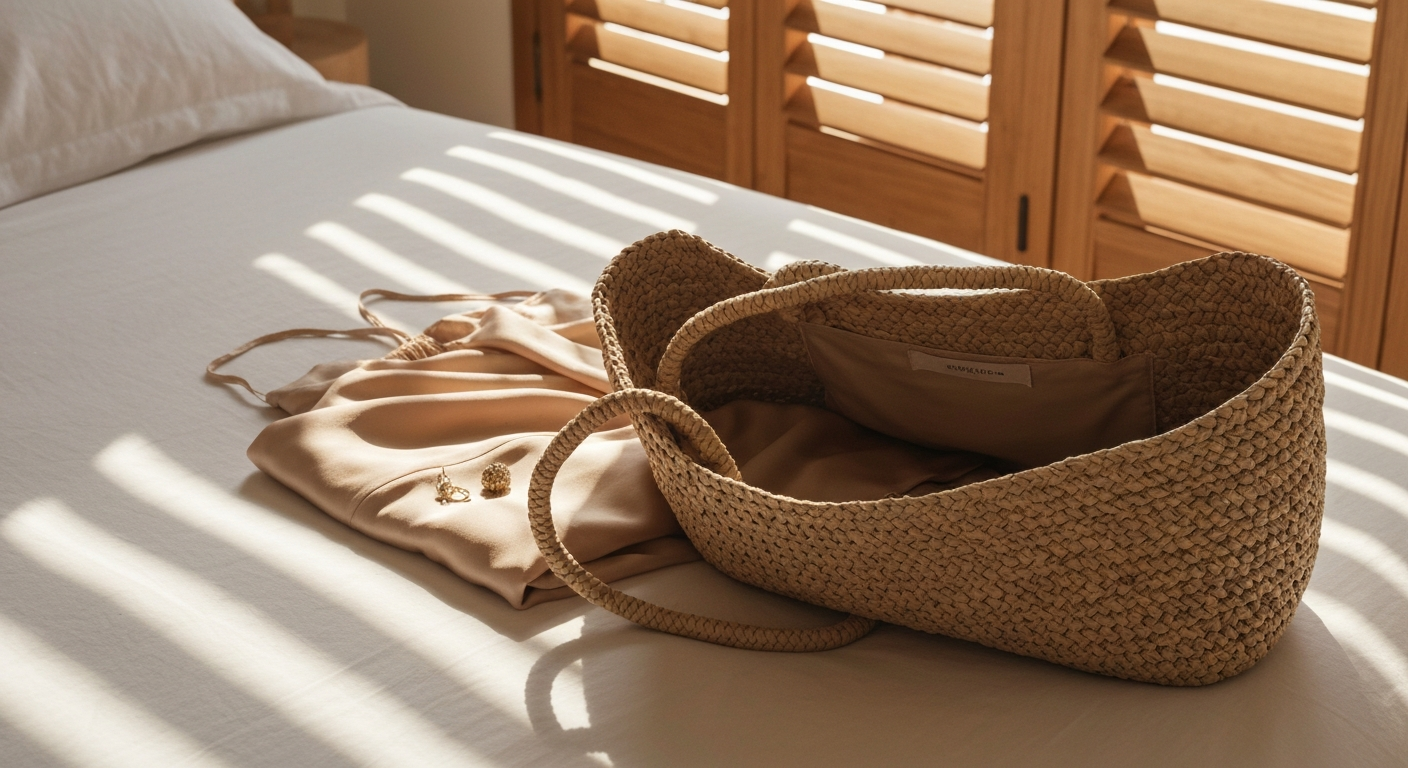
The short answer: the bra is the biggest thing in the bag relative to what it does. Three bras for a week's climate and dress-code range take up the volume of a second dress. Silicone covers replace most of that volume with almost none, and pack flat in their own case. One week, one invisible layer, most of the bag back. Everything below is the longer answer: the packing discipline behind the carry-on, and exactly what the bra problem costs in space.
The flight to Tulum leaves at seven in the morning. The bag is packed the night before. The decisions are made at ten-thirty on a Tuesday after a full week of work, under the particular pressure of knowing that the next eight mornings will be spent in a different country and whatever is in the bag is everything. The bag is a carry-on. It has been a carry-on since the last time a checked bag arrived in a different city and the whole trip reorganised around the absence of it.
Travel packing is a discipline with a long literature. The capsule wardrobe is a documented concept: Susie Faux coined the term in London in 1973, referring to a small collection of timeless pieces that work in combination. Donna Karan's 1985 Seven Easy Pieces collection formalised the idea for American fashion. The principle has not changed in fifty years. A small number of items, each chosen with precision, each working with every other item. Nothing that only works once. Nothing that requires something that is not already in the bag to work.
The Bra Problem in a Carry-On
A bra is large relative to its function in the context of a carry-on. The underwire takes up structured space. The padding takes up volume. A conventional bra in a carry-on is four or five pairs of underwear in volume. Three bras, which is the minimum a week's travel in a warm climate typically requires, particularly if the holiday involves beach, evening outings, and excursions in different dress codes, take up the kind of space in a carry-on that is exactly the space that could have been the second good dress.
The conventional solution to this is compression: rolling the bras into the cups of the shoes, tucking them into corners, choosing sports bras over underwired for the flexibility they allow in packing. None of this solves the fundamental problem, which is that three bras, compressed or not, are three bras in a bag that cannot afford them.
The capsule travel wardrobe built around backless, strapless, and halter-neck dresses, which is a natural building-block wardrobe for warm-climate travel, cannot use conventional bras for most of its garments anyway. A backless dress eliminates the bra entirely unless an adhesive alternative is used. A halter neck eliminates the conventional strap arrangement. A strapless requires either a strapless bra or nothing. The result is that three bras in a carry-on are often three items that only work with one or two of the pieces in the bag.
The Arithmetic of the Invisible Layer
Silicone covers replace the functionality of a bra for any garment that does not require lift: backless, halter, low-cut, strapless, sheer. Good for fifteen or more wears from a single pair. One pair takes up the space of a coin purse. The weight is negligible. The entire foundation question for a week of varied dressing is answered by an item smaller than a pair of earrings.
The specific arithmetic for a seven-day warm-climate trip: one linen dress for daytime, one silk dress for evenings, one swimsuit coverup that doubles as a beach-to-bar layer. These three items, well chosen, cover the full range of the week. The conventional bra works with the linen daytime dress if the neckline is modest enough. It does not work with the evening silk dress, which is low-cut. It does not work with the coverup, which is designed to be worn without one.
Medical-grade silicone covers from Korea, ultra-thin at the edge, work with all three. The linen dress in direct afternoon sun, the silk dress at a candlelit dinner table, the cotton coverup walking back from the beach at dusk. One item that replaces the three-bra calculation entirely, and takes up none of the space they would have occupied.
Heat, Humidity, and Adhesion
The tropical travel destination presents specific conditions that affect how adhesive products behave, and the choice of product matters in this context more than it does in a temperate climate. High humidity affects the adhesion of most skin-contact products: the water vapour in the air creates a partial barrier between the adhesive surface and the skin, reducing the bond strength over time. High temperature causes perspiration, which has the same effect. A product designed for temperate conditions in Seoul or Lisbon may behave differently in Tulum in August or in Bangkok in March.
The application matters as much as the product. Clean, dry skin, no lotions, no oils, no spray tan: these are the conditions that maximise adhesion in any climate. In high humidity, allowing the skin to cool before application, avoiding application immediately after sun or shower, and pressing firmly for thirty seconds on application rather than ten creates a bond that holds through the conditions the day will produce. The product holds through perspiration if the initial bond was established correctly.
The specific testing that informs this is from the Korean semiconductor and medical device manufacturing sector, which uses pressure-sensitive silicone adhesives in environments ranging from surgical theatres to electronics clean rooms. The same adhesive chemistry that holds a sensor to skin through a surgical procedure holds through a dinner in humid heat with appropriate application.
The Three-Outfit Architecture
The capsule wardrobe for a warm-climate trip works by multiplication: three garments, chosen to combine, produce more than three outfits. A linen shirt that works alone during the day works differently belted over the silk slip for an evening. The silk dress worn full-length for dinner works shortened with the hem tucked for a morning walk. The swimsuit coverup that is designed as a layer works as a standalone in the right context.
The designer Carolina Herrera, who built her career on the principle that occasion dressing should be solved with fewer, better pieces rather than more options, has noted in several interviews that the women she dressed who were most consistently well-dressed were the ones who bought less and thought more. The capsule travel wardrobe is this principle applied under specific constraint: the constraint of the carry-on, the constraint of the week, the constraint of the tropical heat that makes certain fabrics impractical and certain garments redundant.
Linen and silk cover the full temperature range of a warm-climate day: linen breathes in the heat of the afternoon, silk performs in the cooler evenings and air-conditioned restaurants. Both fabrics are compromised by conventional bra structures in the neckline configurations that work best in the heat: backless, halter, and low-cut. Both fabrics work with an invisible foundation that has no structure and no visible mechanism.
What Doesn't Make the Bag
The capsule packing methodology is defined as much by exclusion as by inclusion. The items that do not make the bag in a well-designed carry-on are the items that only work once: the dress that requires a specific bra that is only in the bag for that dress. The evening shoes that are too heavy to carry as backup to the daytime sandals. The coverup that requires the full swimsuit it was designed to coordinate with, rather than working as a standalone garment.
A conventional bra that only works with the linen day dress but cannot be worn under the silk evening dress or the coverup is an item that takes up space and serves one function. In the arithmetic of a carry-on, one-function items are the first to go. The invisible layer that covers all three functions is not one item replacing one item. It is one item replacing the entire bra calculation, freeing the space for the garment that was going to be left behind.
The Return Flight
There is a specific test of a travel wardrobe that only happens at the end of the trip: the carry-on going home is slightly fuller than the carry-on going out. It contains everything it contained on the way out plus whatever was bought, plus the items that were washed and slightly shrunken, plus the shoes that somehow took more space after a week of being worn. The bag that was full on the way out is now overfull on the way back.
The capsule packer builds this arithmetic into the original packing. The space that would have been occupied by three bras and their structural volume is available space on the return flight. The item that replaced them takes up the space of a small pouch. The return bag closes cleanly. The thing bought in the market on the last morning, the piece of fabric, the ceramic, the thing that was the whole point of going, fits without question.
The guide to what the backless and halter-neck travel dresses actually require underneath them covers the structural logic. The principle is the same as the capsule wardrobe principle: one right thing replaces many compromises. In a carry-on, the right thing is the one that takes up the least space and answers the most questions. That is the arithmetic of the invisible layer.
The Seven Mornings
Seven mornings in a different country, opening a bag that contains exactly what was needed and nothing that was brought just in case. The linen dress is the same dress it was on Tuesday night when it was packed. The silk dress is ready for tonight's dinner. The coverup is for the hour between the beach and the shower. Everything works. Nothing was left behind that was needed. Nothing was brought that was never used.
This is the quiet satisfaction of packing well: not the triumph of fitting a lot into a small space, but the absence of regret. The trip was possible because the bag was right. The bag was right because each item answered a question and nothing wasted its space. The invisible layer at the bottom of the bag, smaller than anything else in it, answered the most questions.
The dress decides what shows. The covers decide what does not.


