
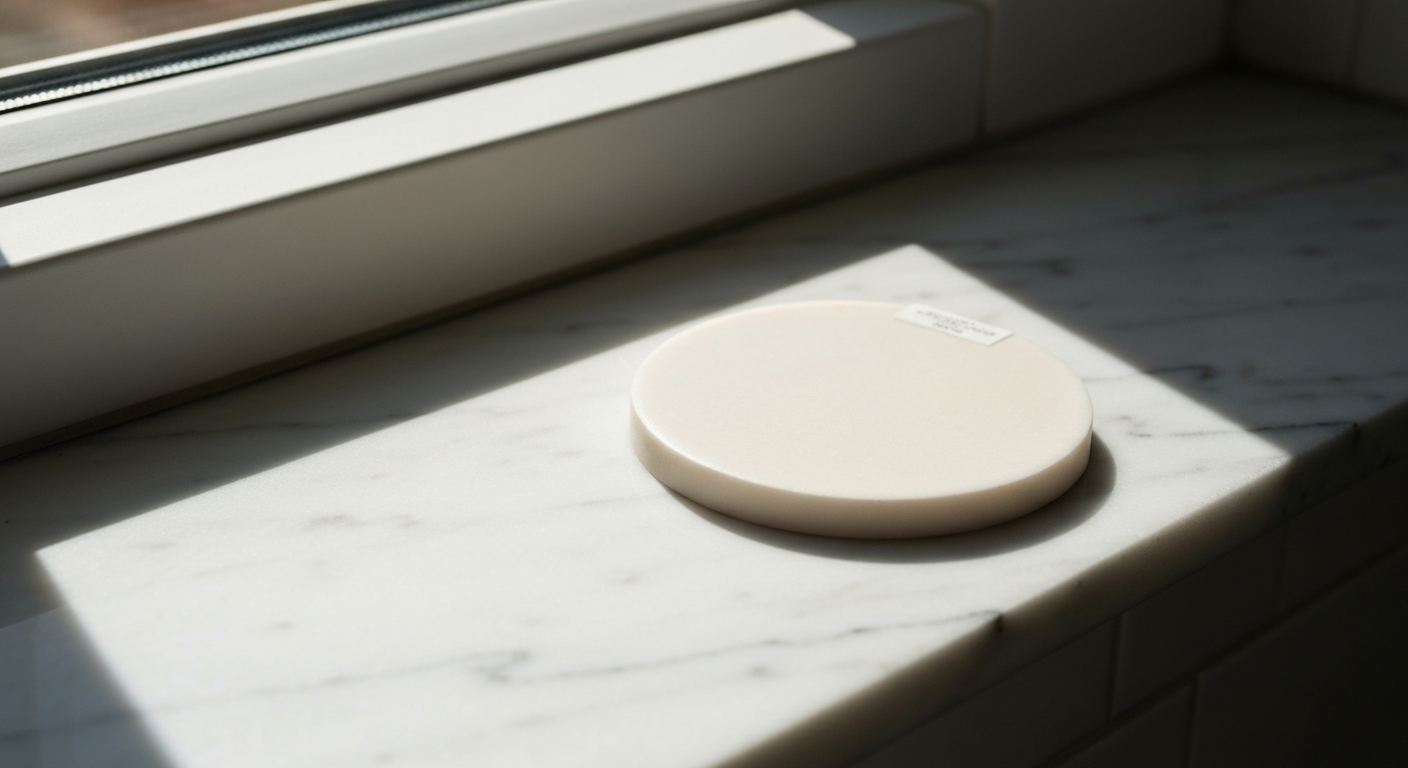
Silicone does not chemically degrade under normal use conditions. The adhesive weakens because the contact interface accumulates contamination. Sebum, cosmetic polymers, and residual product from previous wears reduce the surface area where polymer-to-protein contact can form. Thorough cleaning with water and a pH-neutral cleanser restores the interface.
The short answer: the silicone itself never wears out. What weakens is the contact between the pad and the skin. Usually that means oil, lotion or sweat sitting on the surface before you apply. Clean, dry skin restores full grip on the same pair of silicone covers, wear after wear. That is what makes fifteen or more uses realistic, not optimistic. The interface degrades. The material does not. Everything below is the longer answer: the chemistry of why silicone holds, and what specifically breaks the hold.
Silicone does not degrade the way most materials do.
It does not rot, oxidise, or absorb water. The silicon-oxygen backbone that makes up polydimethylsiloxane is chemically inert against most organic compounds. Acids, bases, most solvents: none of them attack the polymer in any meaningful way during normal use. This is why platinum-cured silicone remains the material of choice for surgical implants, infant feeding equipment, and long-contact skin applications.
And yet, reusable silicone adhesive weakens over time. The mechanism is worth understanding precisely because it has nothing to do with chemical breakdown of the silicone itself, and everything to do with what accumulates between the adhesive surface and your skin. The distinction matters because it changes what you can do about it.
What the adhesive actually does
Platinum-cured silicone achieves adhesion through van der Waals forces: the cumulative electromagnetic attraction between polymer chains and the proteins on the skin surface. This type of adhesion is called dry adhesion or molecular contact adhesion. It requires no tackifier chemical added to the silicone. The polymer simply achieves conformal contact with skin and the distributed force across the full contact area is enough to hold it in place.
The critical variable is the cleanliness of the contact interface. For van der Waals adhesion to develop fully, the two surfaces must achieve actual molecular proximity. Any film between them, oil, protein residue, cosmetic polymer, even plain water, reduces the number of surface points that make contact. Reduce those contact points enough and the adhesive force drops below functional threshold.
Sebum: the main antagonist
Your skin continuously produces sebum, the lipid-rich oil secreted by sebaceous glands. Sebum is a mixture of triglycerides, wax esters, squalene, and free fatty acids. It is not harmful. It is a functional component of the skin barrier. But for a silicone adhesive that relies on direct polymer-to-protein contact, sebum is the primary interference layer.
After each wear, a thin residue of sebum remains embedded in the microscopic pores of the silicone surface. Because silicone is nonpolar and sebum contains fatty acids, there is a degree of chemical affinity, not bonding, but enough that sebum does not simply rinse away with water. A proper cleaning protocol removes the majority of this residue. What it cannot always address is residue that has worked deeper into the silicone surface over many cycles. This is the irreversible component of adhesive decline, and it explains why a cover that cleans up fine at three months begins to lose its grip even after cleaning at twelve.
The rate at which this happens varies considerably between people. Skin that produces more sebum will deposit more residue per wear. Hot weather increases sebum production. Exercise amplifies it further. Two people following identical care protocols will get different lifespans from the same covers because their bodies are different. This is not a product inconsistency. It is normal biological variation that the material cannot compensate for.
Sunscreen and moisturiser
Silicone-based sunscreens and moisturisers introduce a chemically similar but distinct problem. Many cosmetic formulations use silicone copolymers, dimethicone, cyclomethicone, as their base. When these contact the adhesive surface, the polymers are chemically similar enough to the cover itself that they do not rinse away with water. They bond at the surface level and are difficult to remove without a mild surfactant.
The implication is straightforward but not always intuitive: silicone products applied to the chest area before wearing covers will compromise the adhesion even before the covers are on. The skin should be clean and dry, with no product applied to the placement area. This is not a preference. It is a requirement for the adhesion mechanism to function as intended.
Oil-based sunscreens present the same problem through a different pathway. Fatty oils interrupt van der Waals contact in the same way sebum does, but at much higher concentration. A sunscreen applied generously to the chest and then wiped can still leave a residue layer that drops adhesion to near zero on the first application.
Temperature and humidity
Platinum-cured silicone cures optimally at 20 to 30 degrees Celsius and around 50 percent relative humidity. These parameters, specified in addition-cure silicone manufacturing, reflect the conditions under which the cross-link density is most uniform. Outside this window, particularly at elevated temperatures or high humidity, the physical properties of the cured elastomer change.
For wearable covers, the relevant range is narrower. Body temperature sits around 37 degrees, and the cover reaches near that during extended wear. This does not damage the silicone. What it does is increase the rate at which sebum is deposited into the surface pores, because warmth liquefies sebum slightly and drives it deeper into contact surfaces. It also means the surface is harder to clean at full saturation: warm residue in pores requires thorough cleaning, not just a quick rinse.
Humidity affects the surface differently. High ambient humidity before application can create a thin condensation layer on skin that prevents full molecular contact. For this reason, applying covers to skin that is slightly warm and fully dry, as opposed to skin that has recently been in a steam room or a hot shower, produces better adhesion. Not because moisture attacks the silicone, but because it occupies the interface where adhesion needs to develop.
Storage conditions
The silicone surface is prone to contamination from anything it touches during storage. Dust, textile fibres, lint, and skin cells all adhere through the same van der Waals mechanism that makes the cover useful. A cover stored face-down in a drawer accumulates surface contamination even without being worn. Covers stored on their original backing, or in a sealed case, preserve the adhesive surface between uses.
Temperature extremes during storage accelerate cross-link stress in the elastomer. A cover left in a hot car for several hours is not necessarily ruined. PDMS maintains its mechanical properties up to roughly 150 degrees Celsius. But the repeated expansion and contraction of the polymer at the adhesive surface, through thermal cycling from cold to hot and back, gradually increases microscopic surface roughness. This reduces conformal contact over time in ways that are difficult to reverse.
The clean case that medical-grade silicone covers from Korea ship with is not a marketing accessory. It is the storage environment that the adhesive requires between uses. Closing the cover onto its backing sheet and keeping it in the case eliminates both contamination and thermal stress during storage.
How to read declining adhesion
The first sign is usually a change in how the cover seats. Fresh covers with clean adhesive surfaces feel like they are drawn onto skin. Covers beginning to lose adhesive function feel like they are placed rather than drawn. The difference is subtle but consistent: one requires active pressure to position, the other holds position without significant pressing.
Edge lifting before the centre lifts is the second indicator. Van der Waals adhesion is distributed across the full surface, and the edges are where the contact area is smallest per unit of silicone thickness. Edges lift first when total adhesion drops below threshold, while the centre still holds. A cover that lifts at the edge after two hours, rather than holding cleanly through an eight-hour day, is communicating that the adhesive surface needs cleaning, or that the surface has begun to degrade beyond what cleaning recovers.
The product page at skindelle.com describes these as good for fifteen or more wears under normal conditions. That figure reflects median performance with correct care on clean skin with no interfering products. For skin that runs warm and oily, fewer wears is the realistic expectation. For skin that is dry and cool, more wears is possible. There is no precise number that applies across all bodies and conditions. The material is consistent. The variables are human.
The care article at how to care for silicone covers covers the cleaning protocol that keeps the adhesive surface functional across as many uses as possible. That protocol was built around the chemistry described here: surfactant to dissolve sebum, cool or lukewarm water rather than hot, full air-drying before replacing on the backing.
What is reversible and what is not
Surface contamination from sebum, sunscreen, and environmental particles is largely reversible through correct cleaning, particularly in the first several uses. The silicone has enough surface texture to release these residues when washed with a mild surfactant and handled gently. The adhesive function is close to original after proper cleaning in this phase.
Penetration of residue into the deeper pore structure of the silicone, combined with any physical surface damage from handling, is not reversible. No cleaning protocol, no matter how thorough, restores the original surface geometry once the pores are occupied or the surface is scratched. This is the permanent component of wear, and it accumulates whether you notice it or not. The cover continues to function beyond the point where the adhesive is pristine. When function drops below acceptable threshold is a judgement call that belongs to the person wearing it, not the manufacturer.
All reusable adhesive materials have this curve. Understanding where you are on it is more useful than searching for a wear number that does not universally apply.
Related: How they hold up. What a pair survives, and what shortens its life.
You've read about them. Now see them.

Matte and invisible under sheer.
€29,90€5,98 a pair
Korean silicone · 15+ wears per pair
“I carry them with me everywhere.”
Carol M.

