
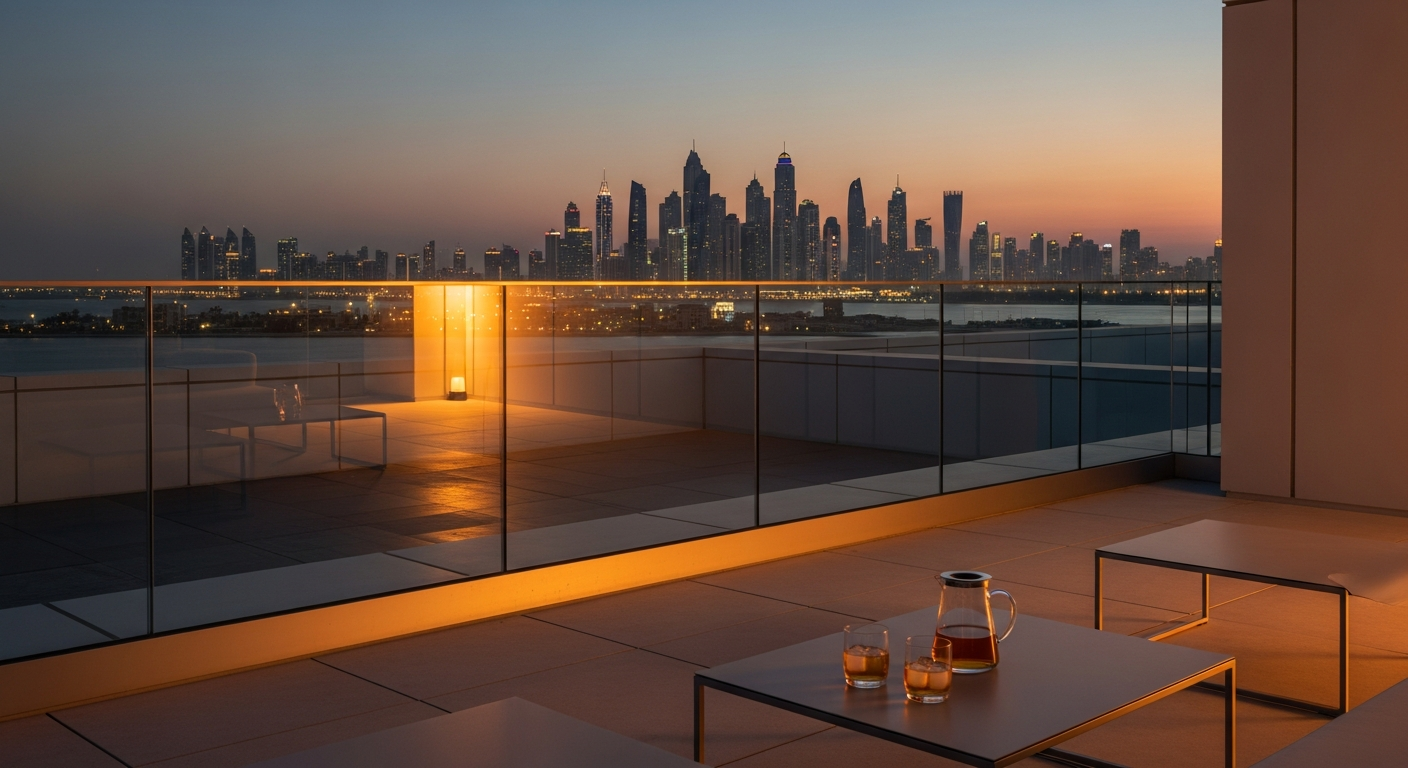
Dubai is not the Middle East in the way that Marrakech is the Middle East or Petra is the Middle East. It is a city that built itself, largely, in the last forty years on the premise that no constraint is permanent: the desert can be air-conditioned, the sea can be reclaimed, the night can be extended indefinitely. For women who travel there, the dress code question is more specific and more interesting than the standard cultural sensitivity framing suggests. The evening register in Dubai is genuinely elevated. The city dresses for dinner in a way that most European cities stopped doing in the 1980s. For an evening dressed to that standard, the case holds a slip dress, good sandals, and a pair of silicone covers folded flat in the corner.
The Temperature Reality
The relevant fact about Dubai's climate for anyone dressing for it: the temperature at nine in the evening in July is thirty-eight degrees. The temperature at the same hour in January is twenty degrees. Both are evenings that require thought. The summer months, from May through September, deliver a heat that is not the Mediterranean dry heat that a linen dress manages comfortably. Dubai in July is humid as well as hot, the Gulf's humidity pushing inland in the late afternoon, and anything that does not breathe reads against the body rather than with it.
The indoor temperature, in the hotels and restaurants of the DIFC and Downtown districts, is the opposite: the air conditioning in Dubai's premium venues is aggressive in the way of a city that treats cold air as a luxury good. A cardigan or a wrap is not optional from June through September; it is the difference between a comfortable dinner and three hours of mild discomfort in a cold room.
DIFC and the Modern Evening
The Dubai International Financial Centre, built around a circular open-air plaza called the Gate Village between 2004 and 2010, is the district where the city's contemporary fine dining concentrated. Zuma arrived here in 2008, the Dubai outpost of the London izakaya-style restaurant created by Rainer Becker. The format, sharing plates brought to the table in a continuous sequence, suits the Dubai evening's social rhythm: long, unhurried, built around conversation. Zuma was ranked in the World's 50 Best in the MENA for several consecutive years, and the crowd on a Thursday night reflects the international composition of the city: financial professionals, extended families from the Gulf, visitors from across the region and from Europe.
The dress register at DIFC restaurants is smart-formal in the international sense: no casual wear, no sportswear, nothing that reads as beach or resort wear regardless of the hotel package you arrived on. For women, cocktail to midi length, structured or well-cut fluid. The logic is the same as a good London or Paris restaurant with the additional constraint that the walk from the hotel to the venue, even a short one, will be through thirty-five degree air. Anything that wrinkles in heat is not a useful choice.
The Hotels as Architecture
The Burj Al Arab, completed in 1999 and designed by Tom Wright of Atkins, is the building that established Dubai's architectural register: overscaled, deliberately spectacular, built to be a civic symbol rather than merely a hotel. It sits on an artificial island connected to Jumeirah Beach by a private causeway. The floor-to-ceiling height of the main atrium is one hundred and eighty metres. The design logic, a sail shape that references the dhow trading vessels of the Gulf, is legible from the Jumeirah Beach strip.
The newer hotels of Palm Jumeirah and Dubai Creek Harbour operate differently: quieter scale, private beach clubs, the evening centred around the pool terrace rather than the lobby. One&Only The Palm, Atlantis The Royal, the Raffles at One Central: each has a distinct social register that informs what the evening looks like and what it requires from the person dressing for it.
What Works, and Why
The practical vocabulary for Dubai evenings: midi length or floor length, because the convention of covered knees in semi-public settings is still operative even in the most international venues; fabrics that breathe in the outdoor heat and do not look exhausted after twenty minutes in air conditioning; nothing that requires structural underwear in the sense of anything visible. The city's evening aesthetic is glamorous in a way that several other major destinations are not. The heels work because the venues are designed for them: smooth floors, valet parking, no cobblestone.
For a backless design or a low neckline in this context, the solution has to be as permanent as the evening requires. A Dubai dinner extends from nine at night to midnight or beyond. Medical-grade silicone covers, ultra-thin at the edge, less than half a millimetre, hold correctly through a dinner of that duration in a room that alternates between forty-degree outdoor arrivals and twenty-two-degree indoor seating. The adhesive releases cleanly. Good for fifteen or more wears. In a city where the wardrobe investment for a four-night trip is not casual, the foundation layer needs to perform accordingly.
The Souks and the Morning
The Gold Souk in Deira, the original commercial district on the Creek's northern bank, has operated continuously since the 1940s. The architecture is a covered arcade of shops, the roof a traditional barjeel windcatcher construction, the individual stalls displaying gold jewellery by weight. The price is negotiated rather than fixed. The standard displayed weight in the souk is eighteen and twenty-two carat because the Gulf market has historically preferred higher-carat gold to the Western standard of nine or fourteen. Walking the souk in the morning, before the heat arrives, is a different Dubai from the DIFC evening: older, denser, more specifically itself.
The Spice Souk, a five-minute walk from the Gold Souk across the Creek by abra water taxi, sells saffron from Iran, dried limes from the Gulf coast, frankincense from Oman, and rose water from the Dades Valley in Morocco. The specific aromatic quality of the souk at eight in the morning, before the crowds, is something the hotel zone cannot replicate.
The Timing Question
The best time to visit Dubai is between October and April, when the temperature holds between twenty and twenty-eight degrees and the outdoor evening is genuinely comfortable. The summer visit is possible because the infrastructure exists to make it possible, but it is a different experience: more interior, more controlled, less spontaneous. The city was designed for comfort in extreme conditions, and it performs this function reliably. The question is whether a city experienced entirely through glass and air conditioning is the same city as the one where the January evening on a rooftop terrace above the Creek is the thing you came for.
Dubai does not ask you to acclimatise to it. It has already acclimatised to you, in advance, at considerable expense. Whether that is the thing you want from a city is a question only you can answer. For the evening that it offers, in the DIFC or on a Palm terrace, the city delivers its version of luxury with a consistency that few places match.
Packed beside the linen. Designed to disappear.


