
Niseko is the mountain you go to after the European Alps have stopped teaching you anything. After Verbier, which is about the party. After Courchevel, which is about being seen at the party. After Aspen, which is about the après-ski performance and the specific social economy of the base lodge. Niseko does not perform. It does not need to. It has the snow. Here the base lodge keeps the same rule, nothing underneath but the Confidence Set.
The Japow phenomenon, as serious skiers call it, is not marketing. Niseko United, the four linked resorts of Hirafu, Hanazono, Niseko Village, and Annupuri, receives an average of fifteen metres of snowfall per season. That number is not a rounding error. Fifty feet. It arrives from Siberia across the Sea of Japan, picking up moisture, and deposits itself on the upper slopes of Mount Yotei and the linked terrain below in a way that buries the lift towers and turns ordinary tree runs into something that photographs do not capture. The snow is so light and so deep that the standard European technique for off-piste, the low crouch and the heavy pressure, does not work here. You float differently. It takes a run to understand, and by the second run you understand why people come back every January.
The Logic of Niseko United
The four resorts share a lift pass and an interconnected trail map. Hirafu is the largest and the most commercial, with the greatest concentration of restaurants, bars, and the kind of infrastructure that makes an international ski crowd comfortable. Hanazono sits to the east of Hirafu and tends quieter, with terrain that favours intermediate skiers who want the same snow without the crowds on the main lifts. Niseko Village clusters around a Hilton and a Hyatt and runs its own gondola, more resort-contained than village-integrated. Annupuri, to the west, is the local mountain. Families and long-term residents ski Annupuri. The lift lines are shorter and the runs are gentler, but the snow is identical, because the snow is everywhere.
The town below all of this is Kutchan, a working agricultural town that has been incrementally absorbed into the tourist economy without entirely surrendering its original character. The convenience stores stay open through the night. The ramen shop near the train station does not have an English menu. The 7-Eleven on Route 343 is, in the way of all Japanese convenience stores, better stocked than most European supermarkets.
Mount Yotei at Dawn
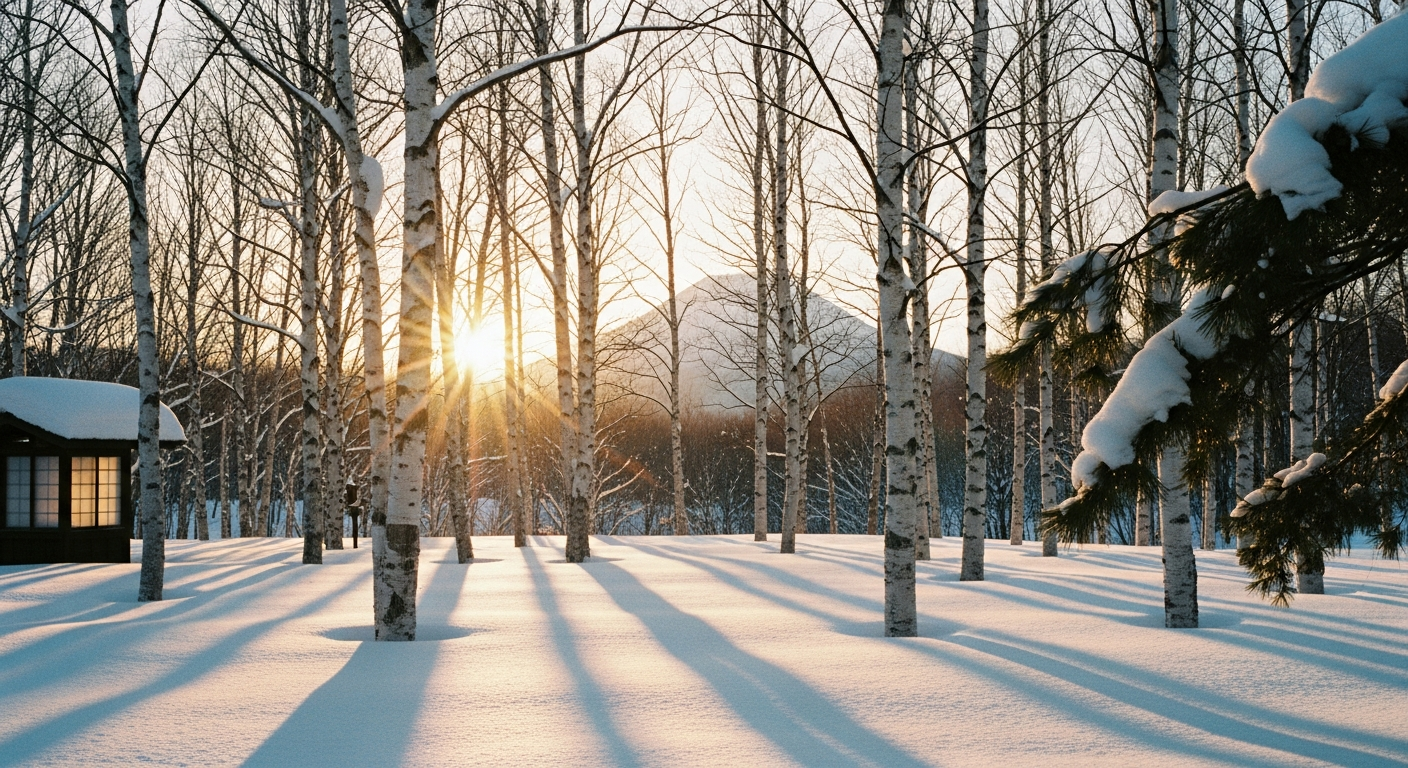
The view that orients Niseko is not the slopes. It is Mount Yotei, the dormant stratovolcano that rises to 1,898 metres on the southern side of the valley, visible from the resort terraces when the cloud lifts. The mountain is almost perfectly conical, earning its common name: the Hokkaido Fuji. On a clear morning in February, with the first lift not yet running, Yotei holds the pink of the early light before the valley floor has seen any of it. The view is unphotographable in the sense that it never looks in a photograph the way it looks in person. The scale of the thing does not compress.
The Evening Register
The mistake first-time visitors make in Niseko is carrying European après-ski logic into a Japanese resort. In Verbier or Val d'Isere, the transition from skiing to evening is aggressive and public: ski boots to the bar, wet gear on the chair beside you, the social performance of having been on the mountain all day. In Niseko, the mountain ends. The onsen begins. These are not sequential activities in the European sense of getting cleaned up before dinner. They are the evening, or at least the first half of it.
Zaborin, the ryokan in Hirafu, is the right reference point. The property sits on a hillside, twelve rooms built low into a forest clearing, each with its own indoor and outdoor bath fed by the local spring water. The architecture is contemporary Japanese: exposed timber, deep overhangs, screens that slide to open the bath to the snow outside. After a day on the mountain, the outdoor bath in winter is not a luxury addition to the experience. It is the point. The water is hot enough that the cold air above the bath creates a curtain of steam, and the snow accumulates on the bath's wooden edge while you sit below the waterline. The body opens. The legs stop objecting. The light in the pine forest goes from grey to dark while you are still in the water.
Kasara Niseko Village, the boutique hotel within the Niseko Village resort, runs a similar logic at a different price point, with communal onsen facilities rather than private baths. Aya Niseko, a ski-in ski-out apartment building at the base of Hirafu, does not have its own onsen but sits within walking distance of the public baths in the village. The hierarchy matters less than the principle: whatever the accommodation, the evening in Niseko is structured around the bath before the dinner, not the bar before the dinner.
What to Wear and When
The question of what to wear in Niseko runs across three registers, and the failure mode for visitors from European ski destinations is treating them as one. The mountain requires what any serious powder mountain requires: technical outerwear that moves well, base layers that breathe, gloves rated for extended cold. None of that is unusual. The unusual part is the evening.
The onsen transition changes what you bring. After the bath, back in your room or in the ryokan common area, the natural dress is the yukata, the lightweight cotton robe provided by the property. The yukata is not loungewear in the European sense of something you wear before getting dressed. It is a complete garment for moving through the property, going to dinner in the ryokan's dining room, sitting in the lobby afterward with tea. If you are at Zaborin, the ryokan's kaiseki service comes to the room, and the yukata is what you wear for the meal.
Hirafu village after dark runs on a different logic. The izakaya row below the main lift, the small restaurants packed tight along the road through the village, requires what the resort restaurants do not: a considered outfit. Not formal. Not ski wear. Something in between that reads correctly in a room where the locals are eating properly and the food deserves attention. A knit dress works. A sweater over something fitted works. The adjustment is small but it matters, because the izakaya is not a bar with food. It is a restaurant with a specific social contract about the table and the people at it.
The skin after the onsen is warm, open, still flushed from the water. A thin invisible layer under a knit dress means the dress moves the way it should, without interruption, through a two-hour dinner where the only thing that should require any attention is the yakitori and whoever is sitting across from you.
Kamimura and the Hirafu Dining Hierarchy
The dining ceiling in Niseko is Kamimura, the restaurant operated by chef Yuichi Kamimura in Hirafu. Kamimura holds three Michelin stars, the highest rating, and the menu is a kaiseki-influenced tasting menu built from Hokkaido ingredients: crab from the Okhotsk Sea, vegetables from farms in the Kutchan valley, dairy from the cattle operations that make Hokkaido butter one of the better-known Japanese food products. The reservation requires advance planning in a way that the rest of the resort does not. The room is small. The service is unhurried in a way that extends the meal well past two hours, which is not a problem if you understand that the meal is the evening.
Below Kamimura, the dining in Hirafu runs from izakayas to ramen shops to J-Sekka, the Japanese contemporary restaurant at the Niseko Park Hotel, which handles the middle register well: full menu, no tasting requirement, reliably good with the local seafood. The evening sequence that Niseko rewards most is this: onsen at five, izakaya at eight for the long meal and the local sake list, a walk through the village afterward in whatever cold the February night has arranged.
The Discipline of Underdressing
The women who ski Niseko regularly dress for the onsen as much as the slopes. The ski outfit is technical and temporary. The evening outfit travels light: two good knit pieces, one something for the formal dining, flat boots that work on snow-compacted streets. Nothing that announces itself. The Japanese aesthetic at altitude is not minimal in the self-conscious European luxury sense. It is minimal in the sense that the environment has already done everything that display could ever do, and the correct response is to stop competing with it.
The packing list for a week in Niseko is short. Technical ski gear. Two evening pieces. Good warm socks for the ryokan floors. The rest is the mountain and what the mountain gives you.
For the full logic of packing light for a week without sacrificing the evening register, the approach is the same whether the destination is alpine Japan or a Mediterranean island: seven days, one invisible layer.
When to Go
Go between mid-January and early February. Go anywhere else and you will always know you were early or late. The snowpack has settled but not consolidated. The resort is at full operation. Yotei is clear on more mornings than not. The light in the late afternoon, when the sun drops behind the mountain and the slopes go into shadow, is the colour of something that does not have a name in English. The Japanese call it tasogare, the hour when you cannot tell one person from another. On a powder day in Niseko at that hour, on the last run before the lifts close, you do not need to be able to tell anyone from anyone. The snow is enough.
I copricapezzoli. Pensati per sparire sotto qualsiasi capo.

Invisibile sotto abiti senza schiena e senza spalline.
€14,90
Silicone coreano · delicato sulla pelle

