
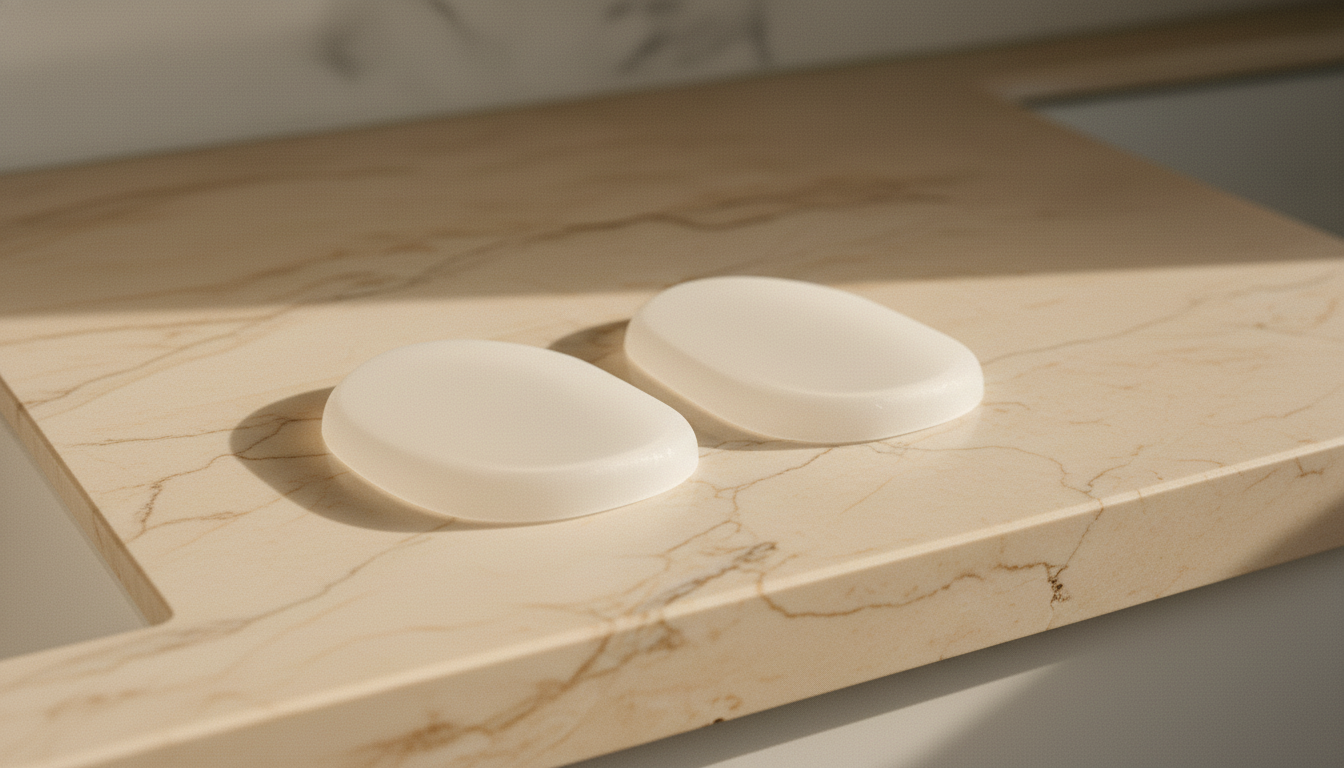
Sweat does not fail silicone adhesive the way it fails acrylic. The bond is physical contact rather than chemical adhesion, so moisture at the interface does not dissolve it. Eccrine output during sustained exercise sits between one and four litres per hour. The adhesion mechanism has to handle that, not assume dry conditions.
The short answer: silicone covers, not single-use glue. Sweat does not test adhesive the way people assume. It gets underneath it, not through it. Medical-grade silicone covers hold against the skin itself through a class, a run, a set on court, the way a one-time adhesive rarely does. Heat was never the real problem. Moisture finding the seam was. Everything below is the longer answer: what sweat actually does to an adhesive bond, and why the chemistry fails exactly where you need it not to.
At rest, the human body produces between 0.5 and 1 litre of sweat per hour in warm conditions. The same adhesive properties that matter for a long evening in a backless dress are tested far more rigorously by 45 minutes of sustained exercise. During sustained exercise, that figure rises to between 1 and 4 litres per hour depending on intensity, ambient temperature, and individual physiology. The eccrine glands, the primary sweat-producing structures distributed across most of the body's surface at densities up to 400 glands per square centimetre in the palms and somewhat lower on the torso, do not distinguish between situations where you need adhesive to hold and situations where you do not.
This is the problem that most adhesive products are not designed to solve. They are designed for sedentary or low-activity wear: a dinner, a ceremony, an evening where air conditioning exists. The chemistry that holds under those conditions fails predictably under exercise conditions, and the failure is not random. It follows directly from how the adhesive works and what sweat does to that adhesive mechanism.
What Sweat Does to an Adhesive Bond
Sweat is not pure water. Eccrine secretion contains sodium chloride, potassium, bicarbonate, lactate, urea, and trace antimicrobial peptides including dermcidin. The primary function of eccrine sweating is thermoregulation: water evaporates from the skin surface and carries heat away. The secondary effect, from an adhesive standpoint, is that the fluid accumulates between the skin surface and any adhesive product applied to it.
For single-use glue, moisture is destructive. The water molecules migrate to the adhesive-skin interface, where they compete with the adhesive for the skin surface. The bond does not fail instantly; it weakens progressively from the edges inward as moisture penetrates under the cover. As body temperature rises during exercise, the single-use glue softens slightly, which accelerates this edge-weakening. The first visible sign is the edge lifting. Within minutes of edge failure, the cover shifts under fabric or releases entirely.
Temperature adds a separate variable. As body temperature climbs during exercise, single-use glue crosses into a zone where it softens. What held firmly at rest starts to shift. The higher the temperature, the less predictable the hold.
Silicone Adhesive Under Load
Silicone adhesives behave differently because the adhesion mechanism is different. The bond is physical rather than chemical: the medical-grade silicone adhesive layer conforms to the micro-texture of the skin surface through close molecular contact rather than through a chemical adhesive reaction. This conformance-based mechanism is not disrupted by moisture at the interface because the contact is not dependent on the skin surface being chemically active or dry.
Medical-grade silicone adhesives used in wearable monitoring devices, such as continuous glucose monitors and cardiac event monitors, are specifically tested for maintained adhesion across exercise conditions, including shower exposure and prolonged sweat. The adhesion requirements for a device that must stay attached to the forearm through a triathlon training session are stringent. The same adhesive chemistry that meets those requirements is the relevant specification for adhesive covers that must hold through a yoga class, a cycling session, or a run.
Body movement during exercise creates dynamic mechanical loads on the adhesive bond that static wear does not. Reaching, rotating the torso, flexing the pectoral and shoulder girdle muscles: each of these creates shear forces at the adhesive interface. A cover that holds under static body-temperature conditions may fail under the combined load of moisture and dynamic shear. The correct test is not whether the cover sticks at room temperature on clean, dry skin. It is whether it holds at 38 degrees, under sweat, through 45 minutes of movement.
Fabric and the Sweat Equation
The outer garment worn over adhesive covers creates its own contribution to the performance environment. High-performance activewear fabrics are designed to move moisture away from the skin surface through capillary action, which reduces the moisture load at the skin-adhesive interface relative to a sealed garment. Wearing an adhesive cover under moisture-wicking fabric is more forgiving than wearing the same cover under silk or polyester satin, which traps moisture at the surface.
Under a workout top, a well-applied silicone cover feels like nothing at all: no edge catching fabric, no sensation of movement, just skin doing its job while you focus on the class.
For yoga and low-to-moderate-intensity movement, a quality silicone adhesive cover under a moisture-wicking top performs reliably. The sweat load remains below the threshold that challenges the adhesive mechanism, and the dynamic loads are within the range that silicone adhesion handles well.
For higher-intensity exercise, the analysis changes. Running, cycling, and HIIT training generate sustained eccrine output and continuous dynamic loading. The honest assessment is that these conditions push any non-integrated adhesive product beyond its design envelope. Technical sports bras with built-in support are engineered specifically for these demands. Adhesive covers are not. A cover that holds well through a 30-minute heated yoga session may not hold through 60 minutes of interval training, regardless of the adhesive quality, because the cumulative sweat load eventually exceeds what any surface-adhesive bond can sustain against continuous movement.
This is not a flaw in any particular product. It is the honest limit of surface adhesion under extreme load. Knowing that limit is more useful than pretending it does not exist. The question is not whether a product exceeds its design parameters under extreme conditions but whether it performs reliably within its design parameters, which include: warm moderate-activity wear, sustained long-wear events, low-to-medium intensity movement including yoga, pilates, dance, and cycling at comfortable temperatures.
Application Before Exercise
The application surface must be completely clean and dry. Any residual moisturiser, body oil, or sunscreen at the application site creates a barrier between the skin and the adhesive that compromises initial bond strength. Exercise application is less forgiving of incomplete surface preparation than evening wear because the adhesive begins under mechanical load almost immediately.
Apply covers at least fifteen minutes before beginning exercise, and at room temperature rather than immediately after a shower when skin is still warm and slightly swollen from hot water. The adhesive bond strengthens slightly as it equilibrates to skin temperature. An initial cool application to normalised skin gives the bond its best starting point before the eccrine system activates.
Medical-grade silicone covers from Korea made to the correct specification hold through moderate exercise sessions when properly applied to clean, dry, room-temperature skin. The adhesive releases cleanly after exercise-level sweat. Wash with mild soap and water, air dry fully, and adhesion is restored for the next use. The product does not degrade from moisture exposure in the way that single-use glue alternatives do.
What Holds and Why
The covers that hold through exercise are the ones designed around silicone adhesive chemistry with a feathered edge that distributes adhesive load across its full perimeter rather than concentrating it at a sharp cut boundary. A sharp die-cut edge creates a stress concentration point where edge-lifting initiates under shear. A feathered edge, tapering to under half a millimetre across the full perimeter, distributes the load and delays edge failure significantly.
Movement athletes and dancers have known for decades that the limiting factor in adhesive performance is the edge, not the centre. The centre of a well-applied cover stays attached. The edge is where the failure originates. Engineering the edge correctly is the single most important construction decision for a cover intended to be worn during movement.
The combination of medical-grade silicone body, silicone adhesive layer, and feathered perimeter edge is the specification that holds during movement up to and including sustained moderate-intensity exercise. It does not eliminate the physics of sweat. It manages them well enough that the cover becomes one fewer thing to think about during a class, a performance, a morning run. The physiology is unchanged. The material keeps pace with it.
You've read about them. Now see them.

Matte and invisible under sheer.
€29,90€5,98 a pair
Korean silicone · 15+ wears per pair
“I carry them with me everywhere.”
Carol M.

