
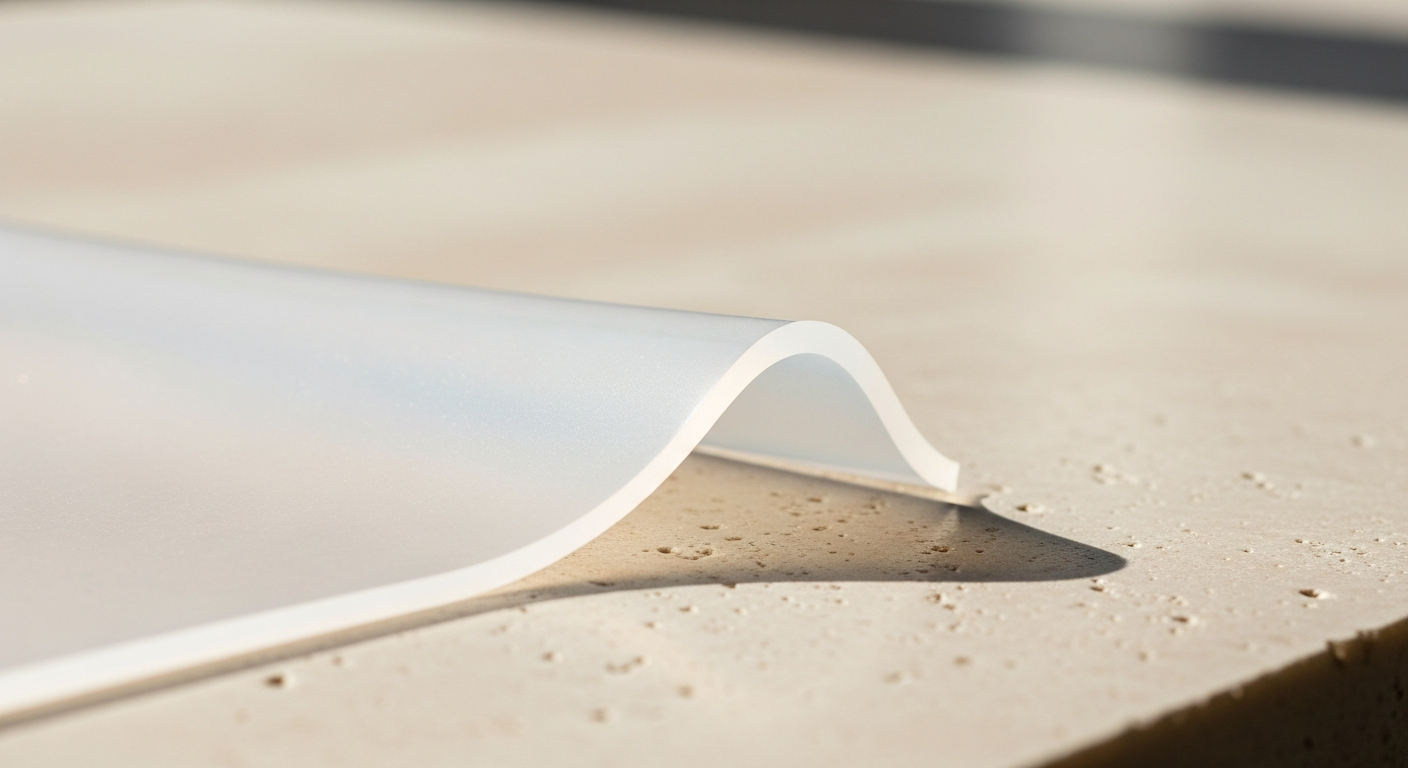
The short answer: silicone gel, not acrylic, and the difference is what happens on removal. Acrylic tape, the chemistry behind most disposable pasties, bonds to the skin's own proteins as well as to the surface. Peeling it off pulls at both. Silicone gel bonds by contact alone and releases the same way, without the residue or the redness. Silicone covers hold their adhesion across fifteen or more wears without the bond degrading, skin-kind rather than aggressive. Everything below is the longer answer: acrylic, silicone, and polyurethane, and what each one actually does to skin.
The first commercial pressure-sensitive adhesive appeared in 1845. A surgeon named Horace Day applied a mixture of india rubber, pine gum, turpentine, and litharge to strips of fabric and used them on wounds. The product worked in the narrow sense: it stuck. But the chemistry was provisional, the residue was significant, and the repeated removal of adhesive from skin caused damage that sometimes exceeded the wound it was meant to protect. Day was solving an adhesion problem. He was not yet thinking about a biology problem. The two problems turned out to be related, and a hundred and eighty years of adhesive science has largely been the process of discovering exactly how.
A pressure-sensitive adhesive, or PSA, bonds through the application of light pressure without requiring heat, solvent, or chemical activation. The adhesive is viscoelastic: it flows slightly at the moment of contact, creating molecular-scale intimacy with the substrate surface, then recovers elastically to maintain the bond. The science of designing a PSA for skin contact requires controlling this flow-and-recovery cycle in ways that do not disturb the stratum corneum, the outer layer of skin that is simultaneously an adhesion substrate and a living tissue that repairs itself and that you are going to have to remove the product from at some point.
Three Chemistries, Three Profiles
Medical skin-contact adhesives are predominantly built on one of three chemistries: acrylic polymers, silicone gels, or polyurethane. Each has a distinct adhesion mechanism and a distinct biological interaction profile.
Acrylic pressure-sensitive adhesives are built from crosslinked acrylic polymer networks. They are strong, durable, and relatively inexpensive to manufacture. Adhesion strength to stainless steel for topical acrylic PSAs ranges from approximately 4.6 to 17.2 Newtons per 25 millimetres, which gives a sense of the mechanical force involved in removal from skin. Acrylics are used extensively in medical tape and wound dressings because of their stability and availability in a wide range of tack levels. The removal challenge is real. Scanning electron microscopy studies have shown higher amounts of skin protein deposited on acrylic test strips than on silicone equivalents after equivalent wear periods, indicating that acrylic adhesives bond to skin proteins as well as to the skin surface. Repeated removal pulls the outer skin layer. In clinical settings, adhesive-related skin injury is documented as a significant category of iatrogenic harm in patients requiring frequent device repositioning.
Silicone gel adhesives work differently. The adhesion mechanism is primarily van der Waals forces rather than mechanical interlocking or covalent bonding to skin proteins. The gel conforms at a molecular level to skin topography, creating contact area, but releases cleanly because the bond is physical rather than chemical. The same scanning electron microscopy studies that showed protein deposition on acrylic strips found significantly less on silicone: the silicone adhesive releases from the skin surface rather than taking part of the surface with it. For products worn against healthy skin for extended periods and removed repeatedly, this distinction has measurable consequences in terms of skin condition over time.
Polyurethane adhesives occupy a middle ground: stronger than silicone gel, gentler than acrylic, with moisture vapour transmission properties that help maintain skin condition under occlusive devices. They are used in extended-wear wound management and continuous glucose monitors. The chemistry is effective but expensive to manufacture at consistent quality, and the formulation sensitivity requires tighter production controls than either acrylic or silicone.
What ISO 10993 Actually Tests
ISO 10993 is the standard issued by the International Organization for Standardization that governs biological evaluation of medical devices, including skin-contact products. The relevant parts for a topical adhesive are ISO 10993-5, which tests cytotoxicity by exposing the adhesive to mammalian cell cultures and evaluating cell death or impaired growth, and ISO 10993-10, which covers sensitisation and irritation.
Sensitisation testing under ISO 10993-10 evaluates whether repeated exposure to the material induces an acquired immune hypersensitivity in the test subject. This is the mechanism that causes contact dermatitis from certain adhesive formulations: not an immediate reaction to a known allergen, but a learned response that the immune system acquires over time. The sensitisation protocol uses a maximisation test, which exposes subjects to concentrations above normal use conditions to accelerate any response that might develop slowly at use-level exposure. A material that does not sensitise under these conditions is a material that is unlikely to cause acquired contact dermatitis in normal use.
Irritation testing evaluates tissue response after direct application, typically on a dermal or mucous membrane model. It looks for inflammatory markers: erythema, oedema, and cellular damage at the application site. The distinction between sensitisation and irritation matters clinically: sensitisation is an immune response that worsens with repeated exposure and persists after exposure ends; irritation is a direct tissue response that resolves when exposure stops. Both are evaluated separately because a material can be sensitising without being immediately irritating, and irritating without inducing sensitisation.
An adhesive product that carries ISO 10993-10 certification has passed both the sensitisation and irritation evaluations under the conditions the standard specifies. That documentation exists in a file at the manufacturer. If a manufacturer cannot provide it, the certification claim is marketing language, not a test result.
The Skin Physiology That Adhesive Designers Work Around
Skin is not a static substrate. The stratum corneum turns over continuously; its outermost cells are shed and replaced from below at a rate that varies by body location and individual biology. Under an adhesive product, the local environment changes: temperature rises, moisture accumulates, transepidermal water loss is altered. These changes do not automatically cause damage, but they influence how the adhesive performs over time and how the skin responds to removal.
High moisture environments reduce the adhesion of most acrylic PSAs because water films interrupt the contact between polymer and skin surface. Some acrylic formulations are specifically engineered for moisture-resistant performance, but they typically achieve this by increasing initial tack, which creates a harder removal profile. Silicone gel adhesives are inherently less affected by moisture because the van der Waals adhesion mechanism functions across a water film in a way that hydrogen-bonding adhesive mechanisms do not. This makes silicone the dominant adhesive chemistry in skin-contact applications where sweat, heat, and physical activity are part of the wear scenario.
A twelve-hour wear under clothing, through a full evening including dancing, involves all of those factors simultaneously. The medical-grade silicone covers designed for exactly that scenario use an adhesive that releases cleanly at removal, leaves no residue, and is good for fifteen or more wears without performance degradation, because the silicone gel chemistry does not form covalent bonds with skin proteins that weaken with each application and removal cycle. The adhesive does not consume itself in doing its job. That is a material science property, not a product promise.
Removal Trauma and the Cumulative Case
Adhesive-related skin injury is classified in wound care literature into three categories: skin tears from mechanical force at removal, skin stripping where the adhesive removes stratum corneum cells with the device, and contact dermatitis either from direct irritation or from sensitisation. All three have mechanical and chemical causes that good adhesive design addresses separately.
Mechanical force at removal is minimised by low initial peel strength and by adhesive that releases in a peeling motion rather than requiring a pull perpendicular to the skin surface. Skin stripping is minimised by adhesive that bonds to the skin surface rather than to the proteins within it, the distinction that the scanning electron microscopy protein deposition studies reveal. Contact dermatitis is minimised by biocompatibility testing under ISO 10993-10.
The cumulative case for silicone over acrylic in long-term skin-contact applications is not that acrylic is harmful and silicone is safe. It is that for products worn repeatedly by the same person on the same skin over months, the per-wear cost of an acrylic adhesive's more aggressive bonding mechanism accumulates into a skin condition outcome that a silicone adhesive's mechanism avoids. Over fifteen wears, across a year of use, on skin that is also exposed to sun, sea, and ordinary friction, the adhesive chemistry you choose is doing cumulative biological work that begins on the first application.
Horace Day understood in 1845 that making something stick to skin was useful. The chemistry he built that first medical tape from is, by modern standards, entirely unsuitable for the purpose. The hundred and eighty years between his india rubber formulation and a platinum-cured silicone gel produced under Korean KGMP standards represents a long negotiation between adhesion performance and biological safety. The negotiation is, for the most demanding skin-contact applications, largely resolved. The manufacturing standards that closed that gap are worth understanding in their own right.
You've read about them. Now see them.

Matte and invisible under sheer.
€29,90€5,98 a pair
Korean silicone · 15+ wears per pair
“I carry them with me everywhere.”
Carol M.

