
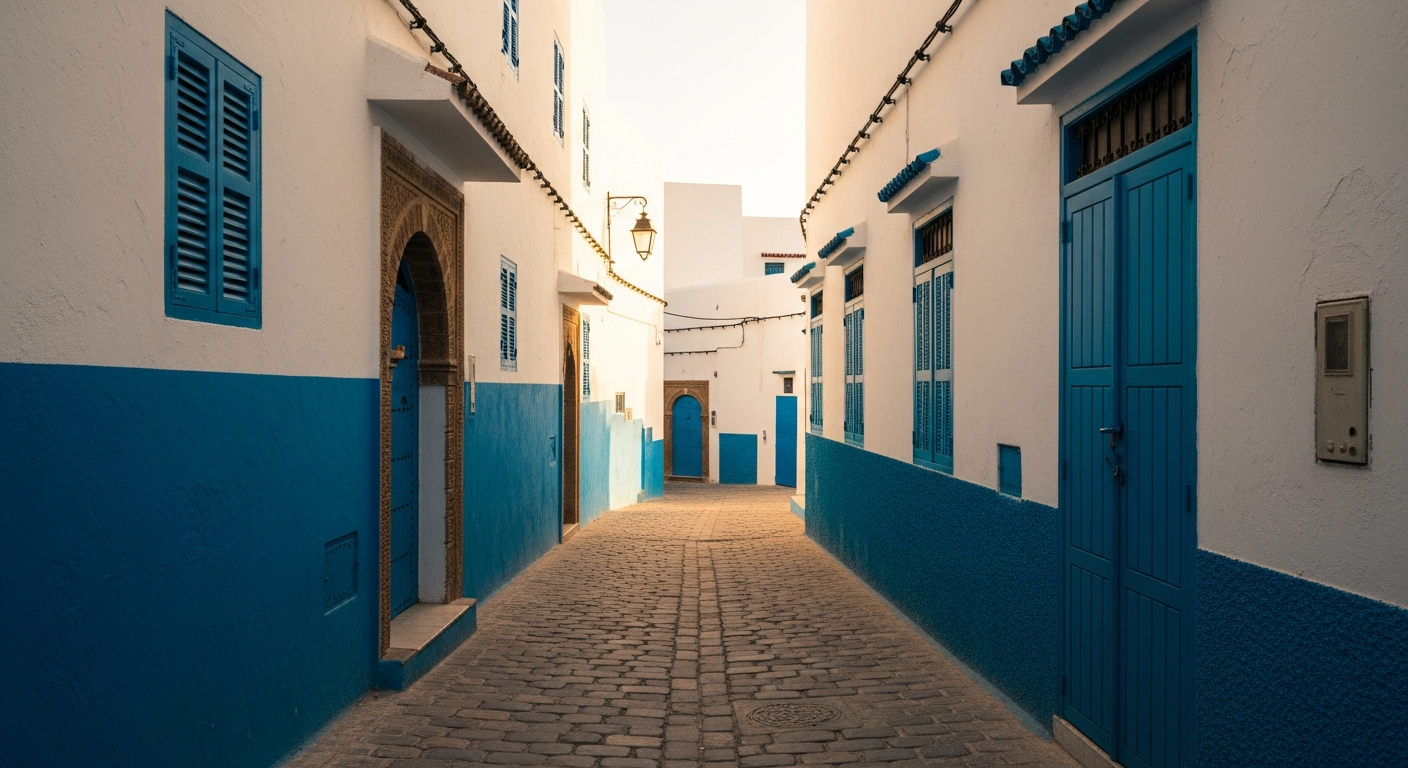
Essaouira is the city that Marrakech visitors miss because the desert is easier to explain. The desert has dunes. Essaouira has the Alizé, the Atlantic wind that arrives from the northwest and never fully stops, that keeps the air clean and the streets cool and makes the city feel awake in a way that the medinas further inland do not. That wind decides how loose everything else gets, all the way underneath to the same set of silicone covers.
It is also, incidentally, a UNESCO World Heritage Site. A question of military architecture rather than ornament. The ramparts were designed in the eighteenth century by Théodore Cornut, a French engineer working for the Moroccan sultan Sidi Mohammed ben Abdallah. The plan was a grid of white streets behind fortified sea walls, a trading port that could receive European ships and Saharan caravans simultaneously. The plan worked. The city it produced is one of the most rational on the Moroccan coast, a word you do not associate easily with this country.
The walls face the Atlantic. At five in the evening, when the light comes off the water at a low angle, the stone turns the colour of old cream. Stand on the Skala de la Ville, the sea-facing rampart that runs the length of the northern coast, and look west. The cannons are still there, Portuguese-era bronze, trained on a sea that stopped requiring defence several centuries ago. What they point at now is nothing but water and light. The view is better for the absence of anything in it.
The port is where the city declares itself. Blue fishing boats, cobalt paint on wood, the colour a tribute to the Phoenician murex dye that was produced on the nearby Purple Islands in antiquity. The boats come in by midday. At the grill stalls on the Skala du Port, the day's catch is laid on ice: sardines, swordfish, sea bream, occasionally lobster. You choose your fish. They grill it over coals. You take your paper-lined tray to a plastic table and eat with your fingers while the gulls circle and the smell of the sea mixes with woodsmoke.
There is no reservation system. There is no menu. It is the best meal in Essaouira and it costs less than anything in the medina.
Inside the medina, the streets are three metres wide and the walls are whitewashed to the point of blue-white, the kind of surface that bounces light in all directions. The Alizé threads through the lanes. You can hear it before you feel it, a low pressure difference between the street and the open ramparts that means the city breathes. Even on afternoons when the sun is direct overhead, the wind keeps the temperature ten degrees below what Marrakech is recording.
The woodworkers are on Rue Skala. Thuya wood, a burl grown in the surrounding forest that, when polished, shows a grain like water. Boxes, bowls, frames. The smell is cedar-adjacent and sweet. It is one of three smells that define Essaouira: thuya, cumin from the spice stalls, and the salt that comes off the Atlantic and coats everything within two blocks of the walls.
The Gnaoua World Music Festival arrives in June and transforms the city for four days, filling the squares and ramparts with free concerts. The Gnaoua are a brotherhood of spiritual musicians, their roots in sub-Saharan Africa, their music a repetitive trance that the Atlantic wind seems to amplify. Half a million people come for the festival. The other eleven months, Essaouira belongs to artists, surfers, and the particular category of traveller who prefers a city that does not perform for them.
The evening dress code here is not Marrakech's maximalism. Essaouira runs cooler and dresses accordingly. Linen. Cotton. Fabrics that move with the Alizé rather than resist it. The women who have been coming for years wear the same thing on the ramparts at sunset that they wear at dinner: a single good piece, something with a clean neckline or an open back that earns its simplicity. The wind makes everything feel more dramatic than it is. A backless dress on the Skala de la Ville at seven in the evening is architecture. What makes it possible is what cannot be seen: medical-grade silicone covers from Korea, less than half a millimetre at the edge, invisible under the lightest cotton. The adhesive holds through salt air and wind. The dress moves freely. Nothing interrupts the line.
Argan oil country begins just outside the city walls. The argan tree grows in a region that exists almost nowhere else on earth. The cooperatives along the road to Agadir are women-run, as they have been for generations. The oil from culinary pressing is golden and nutty. The oil from cold pressing is used on skin. Buy both. The airport versions are fine but the cooperatives are where the quality actually lives.
Accommodation inside the medina runs from budget riads to places like the Palais des Remparts, a restored eighteenth-century mansion on Rue Oqba Ibn Nafia where the rooms look directly onto the sea wall and the sound of the Atlantic at night is constant. Book six weeks ahead in June. The rest of the year, two weeks is usually sufficient.
Come in October if you can. The summer crowds have returned to Casablanca and Marrakech. The Alizé is still present but softer. The light on the ramparts is amber rather than white. The grill stalls are still there, the fish still fresh, the smoke still rising. The city at that hour, with the Atlantic light failing and the fortifications turning gold, is one of the better arguments for the Atlantic coast.
It does not ask for your attention. It already has it.
The journey from Marrakech takes three and a half hours by road through the Argan forest. The bus is reliable. The shared taxi is faster and more interesting. Either way, arrive in the afternoon. The light on the ramparts at that hour is the light the city was built for, and you want to see it on the first day so you understand what you are staying for.
For packing decisions before you go, what to wear under a backless dress covers what the wind will not.
The product referenced above is available at Skindelle.
Packed beside the linen. Designed to disappear.


