
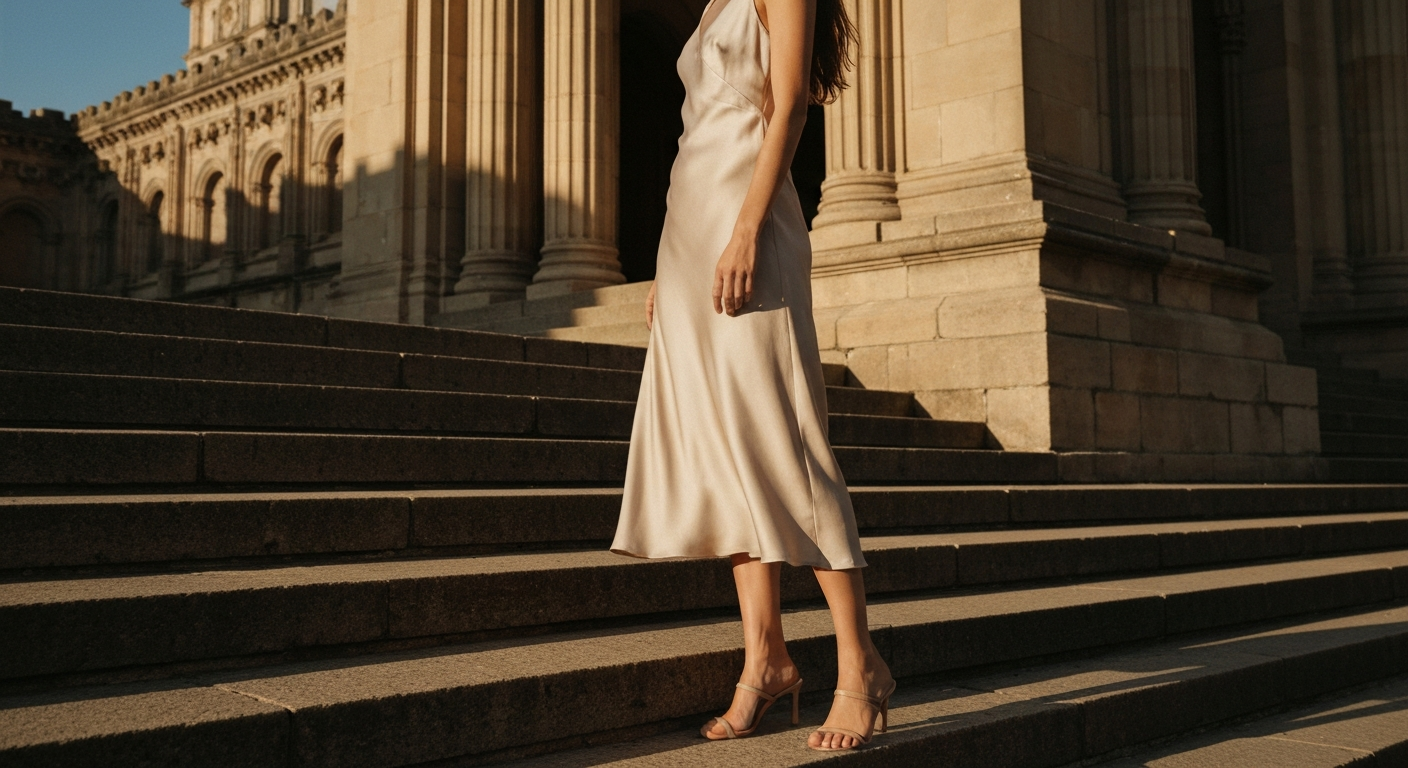
The academic gown opens in wind, and the dress underneath is fully photographed from below, at outdoor angles, in direct sun. The neckline chosen for the party afterward faces a sightline it was never dressed for. Silicone covers solve the coverage question under both the gown and the dress beneath it.
The short answer: the Confidence Set. A gown is not a fixed garment. It falls open at the front. The sleeves shift with every arm movement and open new sightlines through the sides. The dress underneath is what the camera actually sees, for the length of the ceremony and every photograph after it. The set gives the dress a clean line and coverage that holds under a gown moving unpredictably in the wind and in a parent's photograph. Nothing to check and nothing to fix before the procession starts. Everything below is the longer answer: the gown's actual construction, and exactly where it exposes what is underneath.
The academic regalia of a British university has not changed significantly since the fourteenth century, when Oxford and Cambridge adopted the closed cloak as the standard academic garment, derived from the ecclesiastical cope. The gown worn at a graduation ceremony today, whether at a red-brick civic university in Birmingham or a sandstone institution in Edinburgh, is a direct descendant of a medieval garment designed for a cold stone hall in a northern European winter. It was not designed around what would be visible when it opened at the front in bright outdoor July light while a parent lifted a phone camera.
This is the fundamental irony of graduation dressing: the gown that is the ceremony's main visual event is worn over a dress chosen for the party afterward, and the dress chosen for the party afterward was not necessarily chosen with the gown's construction in mind. The result, in the photographs taken outside the ceremony hall in the afternoon light, is sometimes a record of this miscalculation.
The Gown Anatomy
Academic gowns, across most European university traditions, share several structural features that directly affect what is visible underneath them. The gown is open at the front, meaning the full length of the dress underneath is visible to the camera whenever the gown falls or is held open. The sleeves of the gown are typically wide, loose, and not structured to stay in place: they move with the wearer's arms, creating changing sightlines through the sides that can expose the foundation garment in ways that fixed sleeves would not. The gown is usually slightly shorter than the dress it covers, or at the same length, so the hem of the dress below the gown is visible from the front in most photographs.
The gown is also remarkably good at capturing and amplifying wind. Outdoor graduation photography in June or July in the United Kingdom, which is where a large proportion of European university ceremonies take place, involves the specific aerodynamic quality of a heavy open cloak in sea or estuary wind. The gown billows and opens. The dress underneath is fully visible. The photographs taken at these moments, from a parent at five metres distance with a phone held at chest height, create an angle that is quite different from the controlled standing shot that most women anticipate when they choose the dress.
The Photography Reality
Graduation photography falls into several distinct types, each with its own angle and lighting situation. The formal photograph taken inside the ceremony hall by the professional photographer provided by the university: this is controlled, frontal, usually from a fixed distance, in consistent indoor lighting. The candid photographs taken by family outside the hall immediately after: these are taken from varying distances, at varying angles, under full outdoor light. The posed group photographs on the steps or in the courtyard: these involve multiple people arranged at different heights, taken from slightly below and in front, in the harshest available light of the day.
It is the third category that causes the most visible problems. A slightly below-angle outdoor shot in full sun creates a sightline down the front of the open gown that is unlike any other photograph the dress will ever face. The sun overhead provides no shadow across the neckline. The angle sees through the opening of the gown at a downward plane. The family member with the phone is not thinking about sightlines; they are trying to get everyone in frame before the clouds shift. The result is a photograph that captures things the dress was not dressed for.
For the necklines that work under the evening conditions of the graduation party, the V-cut, the halter, the silk slip, these necklines tend to be exactly the ones that are most visible in the downward outdoor angle of the ceremony photograph. Silicone covers from Korea, less than half a millimetre at the edge, invisible through any fabric weight, mean that the neckline photographed in full outdoor sun looks exactly the same as the neckline chosen in the bedroom mirror. No visible mechanism. No visible line. The gown opens in the wind and the dress underneath it is exactly what it was intended to be.
The Two-Occasion Problem
The graduation dress serves two occasions that have almost nothing in common. The ceremony is a formal, structured event: seating, processing, standing, the receipt of a degree, more processing, photographs. The party afterward is usually loud, late, involves dancing or at minimum extended standing at a bar, and extends to a temperature and a time that the ceremony could not predict. The dress must hold both without compromise.
The classic solution to this problem is the midi dress: long enough to work under the gown with something visible at the hem, structured enough to read correctly in the ceremony hall, interesting enough to work at the dinner and the bar afterward. The silk midi in a print, the structured jersey in a bold solid, the bias-cut dress in a muted luxurious fabric: these are the graduation dresses that travel between the two occasions without requiring a costume change.
The Florentine designer Salvatore Ferragamo, whose archive includes several decades of occasion dressing for a specifically Italian conception of the formal event, operated from a principle he called the single-dress solution: an occasion outfit should not require reinforcement from other garments. It should be complete as a single garment, with everything else in service of it rather than in addition to it. For the graduation dress, this means the dress and its foundation must be solved as a unit. The gown goes over a solved garment, not over a garment still working out its questions.
What the Dress Must Do in the Morning
The schedule of a graduation day is long and physically varied in ways that no other formal occasion quite replicates. The morning involves whatever preparation time the wearer allows herself at home, which is typically less than planned. The travel to the venue involves the gown, which is usually collected there and is warm and slightly awkward in the summer heat. The ceremony itself involves extended sitting, then standing and walking in a procession, then more sitting. The photography session outside follows the ceremony and can last ninety minutes in full outdoor sun.
The dinner and drinks afterward begin in the early evening and run, depending on the institution and the social circle, until midnight or later. The dress has been on for twelve hours. The foundation that was correct at nine must still be correct at midnight. The adhesive that held through the ceremony and the photographs must still hold through the dancing.
Medical-grade silicone from Korea holds through this full sequence: humidity, perspiration, movement, the combination of formal sitting and outdoor sun and late-night warmth. Good for fifteen or more wears. Releases cleanly at the end of the evening without ceremony. The dress that was fully solved at the start of the day is still fully solved at the end of it.
The Parent's Photograph
There is one specific photograph that is taken at almost every graduation, in almost every country, with almost identical framing: the parent standing next to the graduate, holding their arm, both of them looking at the camera in front of the ceremony hall, in full outdoor light, the parent slightly shorter or taller, the gown open or held to the side. This photograph is taken by another family member, at a slight distance, at roughly standing height, and it is the photograph that will be framed and placed on a shelf in the family home.
It is taken in whatever light exists at that moment. There is no photographer directing it, no consideration of angle or neckline or what the gown is doing. It is the most natural and the most permanent photograph of the day. It is also the one in which, if the dress under the gown was not fully solved, the evidence is most visible and most permanent.
The guide to what the necklines that work for evening actually require applies directly to the outdoor graduation context. The logic is the same: the neckline that works for the party must also work for the photograph that will outlast the party by thirty years.
The Party Afterward
By eight in the evening, the gown is folded in a bag or handed back to a collection point and the dress is the whole story. The occasion has shifted from ceremony to celebration. The friends who have gathered for the dinner or the bar or the club are the same people who appeared in the group photographs on the steps three hours earlier, but the register is entirely different. The dress that looked right in the ceremony hall must look right here too: right in the candlelight of a restaurant and the coloured light of a club and the flat light of the photographs that will be taken on phones for the rest of the night.
The dress that achieves this is not a different dress from the ceremony dress. It is the same dress, released from the gown, in a different context. The backless element that was fully concealed by the gown while walking in procession is now the whole back of the dress in the restaurant. The V neckline that was partly hidden under the gown collar is now its own thing on the dance floor. Everything that was prepared, invisibly, for the outdoor ceremony photographs is still in place for the evening.
There is a particular pleasure to this continuity: the day holds together as a single dressed day, not two separate occasions that required two separate solutions. The dress moved through the whole thing. The photographs from the morning and the photographs from midnight are both exactly what they were intended to be.
The dress decides what shows. The covers decide what does not.


