
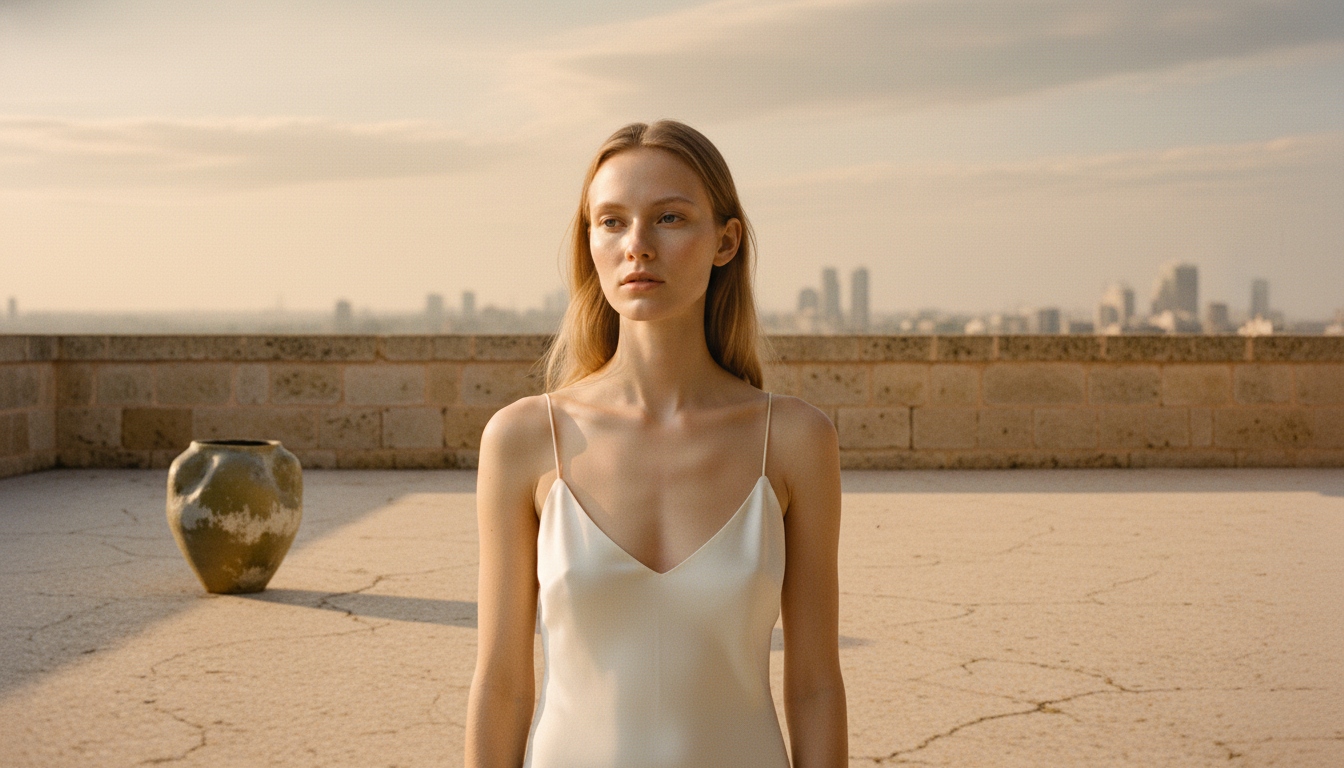
The fog that changes what you wear
Lima is the only major city in the Americas built on a coastal desert where it almost never rains but almost never stops being damp. The Humboldt Current runs north from Chile along the Pacific floor and cools the air above it. The result is the garúa: a fog so fine its droplets measure between one and forty microns across, too small to fall as rain, too persistent to call mist. In July and August, Lima receives less than one hour of direct sunlight per day. The sky is not dark. It is luminous and flat, the light arriving from everywhere and nowhere, diffused through a marine layer that sits on the city like a second atmosphere.
This changes what you pack. Lima is not a sundress city. It is not a sandals-and-linen city, though linen works if you layer it. The garúa dampens fabric without wetting it. Silk crepe feels heavier by evening. Cotton jersey holds its shape better than you expect. The temperature sits between fifteen and twenty-eight degrees year-round, which sounds mild until the eighty-percent humidity makes seventeen feel like twelve. You dress for a city that is cool, damp, and quietly elegant in a way that has nothing to do with tropical colour.
Barranco before noon
Barranco is the neighbourhood you come to after Miraflores has shown you the Malecón and the paragliders and the Pacific views that everyone photographs from the same cliff. Barranco is older and stranger. Founded in 1874 as San José de Surco, it takes its name from the ravine that cuts through its centre, the Bajada de los Baños, a steep path dropping from the plaza level to the shore below. The district was built as a summer retreat for Lima's wealthy, and the houses from that era are still here: Art Nouveau facades with ironwork balconies, painted in colours that the garúa has been softening for a hundred years.
Walk the Alameda Sáenz Peña in the morning, when the galleries have not yet opened and the cafés are setting out their first tables. The Casa Miró Quesada, designed in 1914 by the architect Claude Sahut, sits on Avenida Pedro de Osma. It is now Hotel B, and the lobby bar is one of the few places in Lima where the architecture and the cocktail list are equally serious. Further along Pedro de Osma, the Museo Pedro de Osma houses a collection of Viceregal art in what was once a private residence. The paintings are four hundred years old. The garden is the reason to linger.
At the edge of the Bajada, there is a plazuela with a monument to Chabuca Granda, the singer whose compositions about Lima's old streets and lost elegance were designated cultural heritage. She sang about a city that was already disappearing when she recorded it. The monument faces the ravine, as if she is still watching.
The bridge and the coast
The Puente de los Suspiros was built in 1876, destroyed during the Chilean occupation five years later, and rebuilt. It spans the ravine at the point where the Bajada drops steeply toward the water. The bridge is wooden, about thirty metres long, and comes with a legend: if you hold your breath for the entire crossing, your wish is granted. This is the most photographed point in Barranco and the one place where you will encounter a crowd regardless of the hour. Go early or go late. The bridge at night, with the gas-style lamps lit and the ravine dark beneath it, is a different structure than the one you see at midday.
Below the bridge, the path continues to Barranco's section of the Malecón, the coastal walkway that stretches south with far fewer people than the Miraflores section. The Pacific here is not blue. It is grey-green, the colour of the Humboldt Current itself, and on garúa days the horizon line between ocean and sky simply does not exist. The walk is flat, exposed to the coastal breeze, and the air carries salt and the smell of ceviche from the restaurants above. A jacket helps. Not for cold. For the damp that accumulates on bare shoulders over twenty minutes of walking.
The table at Pedro de Osma
Lima became the gastronomic capital of South America not by accident but by geography. The Humboldt Current that makes the fog also makes the fishing. The Andes behind the city provide altitude, and altitude provides ingredients that do not exist at sea level. Virgilio Martínez understood this before anyone else. His restaurant, Central, at Avenida Pedro de Osma 301 in Barranco, serves a single tasting menu structured by altitude. Each course represents a specific elevation: the Pacific floor, the coastal desert, the cloud forest, the high Andes, the Amazon basin. Gastronomy becomes geography. The research behind each dish is conducted by Mater, a connected initiative that works with indigenous communities, botanists, and artists to understand Peruvian ingredients in their ecosystems, not just their kitchens.
Dinner at Central begins at seven. The dress code is what Lima does best: considered without performing. Good trousers or a dress that holds its shape in humidity. Flat shoes that work on cobblestone. Nothing that announces effort. Limenas have a precision about evening dressing that reads as effortless from across the table but is, in fact, carefully built. The trick is fabric that cooperates with damp air: a silk blend that does not cling, a structured knit that does not collapse, a neckline that the garúa will not make heavy.
If the evening dress is backless or cut low, the base layer needs to disappear completely. Medical-grade silicone covers sit flat against skin even in Lima's humidity, where most adhesives fail within an hour. The edge is less than half a millimetre. In air this damp, anything with structure shows. The point is that it should not.
Two blocks from Central, Isolina serves traditional Peruvian cooking from a different century. José del Castillo's kitchen reconstructs recipes that Lima's grandmothers made and that the fine-dining revolution nearly erased. The portions are large. The dining room feels like a tavern that has been serving since before the word bistronomy existed. If Central is where Lima's future eats, Isolina is where its memory does.
What to wear in Lima
The city divides cleanly into day and evening, and the garúa is the reason for both. During the day, the light is soft and directionless. Saturated colours photograph flat. Neutrals gain depth. A good jacket, something with weight but not bulk. Closed-toe shoes for the cobblestone and the damp. A bag that tolerates humidity without darkening at the handles.
For evening, the register rises without becoming formal. Lima's restaurants do not require jackets. They require intention. The difference is a backless dress that was chosen for how it moves, not how it photographs. A silicone cover from Korea that makes the engineering underneath invisible. Good earrings. The kind of restraint that signals you have eaten at places like this before and dressed accordingly.
Lima does not reward the overdressed. It rewards the considered. The woman who understood, before she arrived, that this is a city where the fog decides the palette and the table decides the rest. There are not many cities in the world where the weather, the food, and the way people dress are governed by the same ocean current. Lima is one. If you dress for the Humboldt, you dress for everything.
Heading somewhere this summer? We will send you the packing checklist.


