
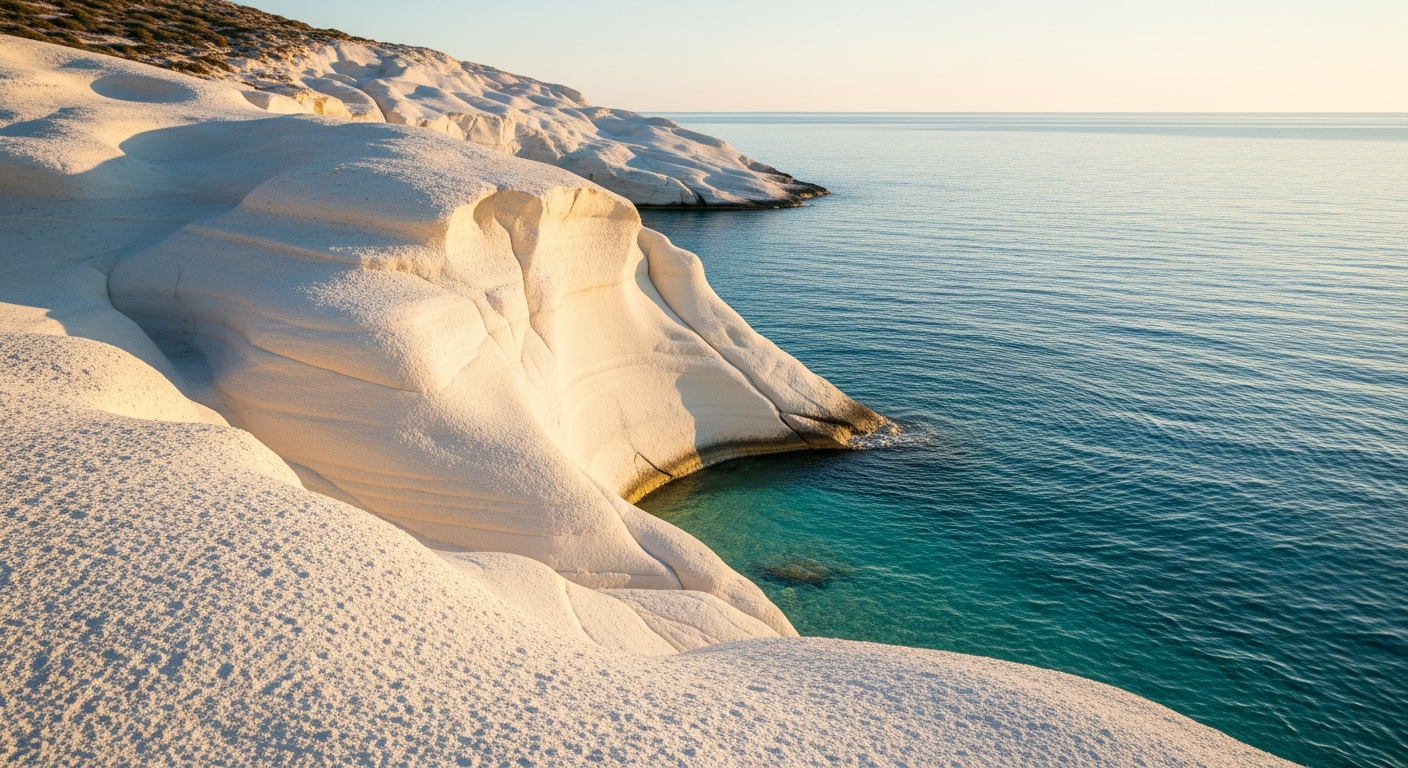
Milos does not look like anywhere else in the Cyclades. The island is volcanic, and the geology is visible at the surface in a way that you do not get in Paros or Naxos or even Santorini. At Sarakiniko, the white pumice rock curves up from the sea in shapes that look designed rather than eroded. There are no plants. There is almost no colour except the white of the rock and the deep blue-green of the water below it, both bright enough to send you drying off fast, into a linen shirt over a pair of silicone covers, nothing else.
Sarakiniko and What the Rock Actually Feels Like
The photographs of Sarakiniko that circulate on travel accounts are accurate in composition and completely misleading about the experience of being there. The rock is sharp. Not dangerously so, but rough enough that the texture is constant under your feet and under your hands when you lower yourself down to the water. The surfaces are worn smooth in the channels where people walk regularly, but step off the path and you are on raw pumice with the quality of coarse sandpaper.
Wear something you do not mind getting dusty white. The pumice dust transfers to everything it touches, and a pale linen dress will show it less than a dark one. Flat rubber sandals or water shoes are correct here. The drop from the rock to the water is not always gradual. Some of the most popular swimming spots require a small jump from a low ledge, which is easier than it looks but worth knowing before you arrive in something you cannot get wet.
Come early. By ten in the morning the site has crowds. By eight it is quiet enough that you can walk the outer edges of the formation without navigating around other people, and the low morning light is the best light the rock gets all day.
Klima and the Syrmata
Klima is a fishing village on the north coast of Milos, a row of syrmata: boat garages built directly into the rock with the sea at the back door. The ground floors open to the water so the fishing boats can come and go. The upper floors are the living quarters, painted in the primary colours that are specific to Milos: ochre, deep red, faded turquoise. The effect at midday, with the light reflecting off the water and back onto the buildings, is so saturated that photographs look processed when they are not.
Astakas, the one taverna at Klima, sets its tables almost in the sea. You eat what was on the boat this morning. There is no menu in the sense of choices. You drink cold beer or cold white wine and do not feel like you are missing anything. A cotton sundress and flat sandals is the register. Nothing formal, nothing precious.
Mandrakia, further along the north coast, is the same logic in a different cove: whitewashed houses, bright blue syrmas carved into the rock, the sea at the threshold. Medusa, perched at the edge of the cliff above Mandrakia, looks out over the Aegean from a position that makes the view part of the cooking.
Boat Tours to Kleftiko
The sea caves at Kleftiko are only accessible by boat. The tour operators leave from Adamas in the morning and the journey takes about an hour around the south coast of the island. The caves are large enough to swim inside, with the kind of light that comes through water and bounces off white rock walls in colours you cannot reproduce accurately in a photograph.
The boat is the one time in Milos when you are fully committed to being wet. The outfit for a Kleftiko day is decided by this: something that functions as swimwear and does not look unfortunate on a boat. What you wear over it for dinner that evening needs to be completely separate from what you wore on the boat: pack an evening layer in your beach bag before you leave. At Paliochori on the south coast, Sirocco serves fish baked in volcanic sand. The beach is thermal. The sand is hot enough to cook in.
Taverna Evenings at the Harbour
The harbour at Adamas or the smaller quay at Pollonia in the evening has the rhythm of a place that has been feeding people at the water's edge for a long time. Tables are set close to the water, the boats are moored ten metres away, and the service is unhurried in the way that is specific to Greek island evenings. Mikros Apoplous, near Adamas, is the step up from the harbour plastic-table taverna when the occasion calls for it: the seafood pasta is the reason people come back.
For dinner in Milos, the register is a step up from the beach but not a formal evening. A silk dress or a linen set reads correctly. If the dress has a low back or thin straps, the terrain of Milos means you have probably been active all day and the base layer needs to work as hard as the dress itself. Ultra-thin silicone covers, invisible under any fabric weight, are what makes that dress wearable through the evening without adjustment, which matters when you have walked Sarakiniko, been on a boat, and climbed the castro all in the same day.
Why Milos and Not Santorini
Santorini is a spectacle. Milos is a place. The distinction matters when you are deciding how to spend a week. Santorini is organised around the view. Milos is organised around the activity: swimming in geological formations, eating fish that was caught this morning, arriving at a village that is not sure yet what to do with you. The experience is more physical, more varied, and considerably quieter.
For how to pack a suitcase that handles both the active geology and the evening harbour, read the capsule travel guide. The principle on an active Cycladic island is that the change from day to evening needs to be minimal, fast, and look like you made an effort even though you did not. Milos rewards that approach.
Packed beside the linen. Designed to disappear.


