
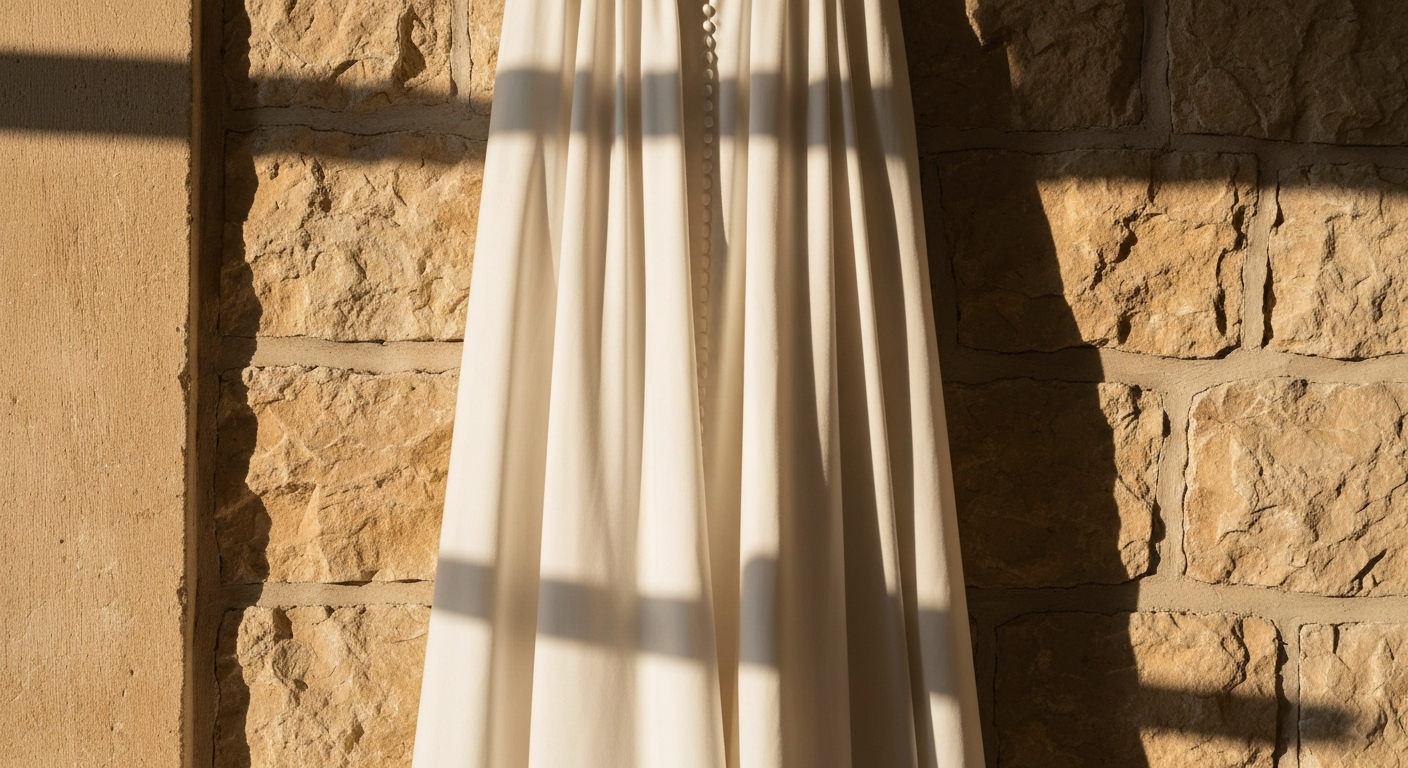
The short answer: matte silicone covers, whatever fabric the dress turns out to be. Mikado and heavy satin forgive almost anything underneath. Crepe and the house's silk blends cling and show a seam or a band immediately. Tulle overlays go sheer in sections and show a shadow the way a nude bra does. Ultra-thin silicone covers sit flat under all three and disappear where a bra would print through. Everything below is the longer answer: mikado, crepe, tulle and the silk blends, fabric by fabric.
Alberto Palatchi opened his first bridal boutique on the Passeig de Gràcia in Barcelona in 1922. He was selling a specific kind of dress to a specific kind of woman in a city that understood the social grammar of ceremony with unusual seriousness. Catalonia's textile industry, centred then as now in the mills around Barcelona and the interior towns of the Anoia region, gave Palatchi access to fabrics that most bridal designers outside Spain could not source. The house built its reputation on a relationship between material quality and construction precision that has persisted through multiple generational transitions, expansions, and the eventual acquisition by BC Partners in 2013.
What the Pronovias archive demonstrates, looked at as a technical document rather than a fashion history, is a sustained preoccupation with how fabric behaves on a moving body. The silhouettes have followed broad bridal trends: the pouf sleeves of the 1980s, the minimal slip gowns of the late 1990s, the return to structure in the 2010s. What has remained consistent is the weight and drape engineering of the primary fabrics: mikado, crepe, tulle, and the Pronovias-specific silk blends that form the foundation of the collection's mid-to-high tier.
Each of these materials creates different foundation requirements. The answer to what to wear underneath a Pronovias gown is not a single answer. It depends entirely on which fabric and silhouette you chose.
Mikado Construction and What It Asks
Mikado is a silk and synthetic blend with a slight sheen and a structured drape. In bridal construction, it is used primarily for A-line and princess silhouettes where the fabric needs to hold its shape across the hip and fall cleanly to the floor without bunching or walking out. Mikado does not cling. Its surface has enough body to maintain a gap between the outer fabric and the body beneath it. Small foundation choices under mikado are forgiving. A smooth microfibre brief, a low-profile hip solution: the fabric does not read them.
The bodice of a mikado gown is another matter. Pronovias builds the bodice of most mikado designs with internal boning, typically a combination of spiral steel and flat boning sewn into the lining channels. This boning structure means the bodice is providing its own support. The question for the bride is not what provides support but what provides coverage with no visible edge, and for a mikado bodice that relies on the fabric's surface sheen, that question is answered by the flat profile and matte finish of an adhesive cover rather than any garment with a fabric edge.
Mikado sweetheart necklines, which appear across many Pronovias collections, have a specific geometry: the neckline cuts across the bust in a shallow curve that is typically boned at the edge to maintain structure. Any foundation that extends above the neckline creates a visible problem. The solution must stay fully within the cup of the neckline, which adhesive covers do by definition.
Crepe and the Bias-Cut Challenge
Pronovias uses a double-faced crepe in several of its more architectural designs, and a lighter crepe de chine in the softer column silhouettes. Crepe behaves opposite to mikado in one important respect: it drapes closely, following the contour of the body beneath it rather than maintaining a structural gap. Crepe-cut columns and sheath silhouettes are among the most revealing fabrics in bridal construction, because the fabric reads the body it is covering with very little mediation.
This changes the foundation calculus significantly. Under a crepe column, the priority shifts from coverage to surface uniformity. The fabric will show any textural discontinuity from below, any edge that creates a local change in surface height. This is precisely the environment in which the edge geometry of an adhesive cover matters most. A circular edge under crepe will register its full circumference as a visible ring. An interrupted petal edge will not register because the fabric tension has no continuous boundary to trace.
Crepe also has a temperature-sensitive drape. In warm ceremony venues, a crepe column that fitted perfectly in a cool studio fitting will cling more closely once body temperature and ambient heat bring the fabric into closer contact with the surface beneath it. Foundation choices made at a fitting in February may need to be retested at the venue in July, in the actual thermal conditions of the ceremony.
Tulle Layers and the Transparency Problem
Tulle is the material that most complicates foundation planning in Pronovias designs, because tulle's visual properties depend entirely on how many layers are present and how they are positioned. A single layer of tulle is nearly transparent. Six layers, as found in a full Pronovias ball skirt, are opaque. The bodice overlay of tulle over a silk lining creates a surface that reads as covered but passes the outline of everything beneath it.
Pronovias ball gowns with tulle skirts and overlay bodices are structurally supported at the skirt by a crinoline underpinning and at the bodice by internal boning. The foundation question at the skirt is negligible: the crinoline and the tulle volume together create more than enough visual barrier. The bodice, covered in one or two layers of tulle over a silk base, requires a foundation that is smooth against the silk base layer, because it is the silk layer that reads through the tulle. The adhesive solution sits against the silk, and it is the silk's surface that the outer tulle reads. Any surface discontinuity at the silk level is amplified through the tulle rather than filtered by it.
The medical-grade silicone covers are thin enough at the edge to be worn against a silk lining without creating surface relief. The matte finish means the silk above them does not create the reflectance brightpoint that a glossy surface would produce under the tulle layer.
The Mermaid Silhouette
Pronovias has produced mermaid silhouettes continuously since the early 2000s, and they represent a specific construction challenge. The mermaid fit requires the fabric to follow the body closely from bust to knee before flaring. This creates an unusually long zone of close fit where foundation choices are visible. A gown that fits correctly in this silhouette has no tolerance for foundation bulk at the hip, at the lower abdomen, or at the upper thigh. Everything in the close-fit zone must be either invisible or absent.
The bodice of a Pronovias mermaid is typically boned and structured enough to function independently of any foundation support at the upper body, which directs the foundation conversation entirely toward the lower body. At the upper body, coverage without structure is what is needed, and an adhesive solution handles this without adding any of the bulk that a strapless bra or bodice garment would introduce.
The Fitting Question
Pronovias dresses are sold through a structured fitting process: a first fitting, a second fitting for adjustments, and in most boutiques a final fitting no more than two weeks before the wedding. The foundation decision should be made at the first fitting and confirmed at the second, not left to the final fitting or the morning of the wedding.
The specific point of confirmation is the coverage test in the venue's lighting conditions. If the ceremony is in a church with strong directional daylight, test in directional daylight. If the venue is a candlelit interior, test in warm artificial light. Fabric that passes the test under fluorescent boutique lighting may fail in the venue's actual lighting, and the inverse is also true.
The three-fitting window that Pronovias builds into its service is also the window for the rehearsal argument: wearing the foundation solution at the second fitting, and again in the final fitting, means arriving at the wedding morning with a tested foundation rather than an untested one. The dress has been fitted. The foundation should also be fitted. The morning is too late to discover they are incompatible.
The Material Argument for Silk
The higher tiers of the Pronovias collection use silk mikado, silk crepe, and silk organza rather than their synthetic equivalents. Silk behaves differently from polyester or acetate blends in one way that is directly relevant to foundation planning: silk holds static charge less aggressively than synthetics, so it clings less in warm and dry conditions. A silk crepe column will hang more freely from the body in a warm ceremony than its polyester equivalent.
This is a practical argument for choosing the silk tier if the wedding is in a warm environment. The dress that clings the least in July heat is the dress that is most forgiving of foundation choices, and the most forgiving dress is the dress that makes the morning easier. Fabric quality is not only an aesthetic variable. It is a thermal-mechanical variable with direct consequences for how the day unfolds.
A wedding dress choice made in a Barcelona boutique in January is making assumptions about fabric behaviour in July. The assumptions that matter most are the ones about how the material behaves against the body in the actual conditions of the actual day. For Pronovias brides specifically, who are choosing from a range of constructions that span from the fully boned and structured to the softly draped and bias-cut, the foundation answer is not uniform. It is derived from the fabric and silhouette selected, tested in the actual venue conditions, and confirmed at the second fitting before the final dress is made. For brides dealing with a fully open back, the specific considerations are covered in what to wear under a backless dress.
The back is open. What holds her disappears.


