
Tulum is the Riviera Maya after the Riviera Maya became too much of itself. After Cancun, which is about the resort strip. After Playa del Carmen, which is about the pedestrian zone. Tulum is about the jungle pressing against the coast, the cenotes beneath the surface, the ruins on the cliff where the Maya watched the sea. It is a place where the ceremony and the landscape belong to each other, and where the evening dress code is neither beach nor city but something the two places made together, starting underneath with a bridal kit instead of anything built for a single climate.
The Ruins Above the Sea
The archaeological zone at Tulum sits on a fifteen-metre limestone cliff directly above the Caribbean. The walls that ring the site on three sides date to the thirteenth century, when Tulum was a principal trading port for Coba, the inland city connected by a raised stone road called a sacbe that stretched ninety kilometres through the jungle. The main temple, El Castillo, is built at the cliff edge, and at certain mornings the sun aligns with a small window in the wall to cast a beam of light on the water below, a navigational signal for incoming canoes.
Walk the site early, before the tour groups arrive at ten. The stone is rough limestone, pale grey-white, warm in the first light. The sea below is the specific green of shallow Caribbean water over white sand. Bring flat shoes that grip. Nothing about this terrain is forgiving in a heel.
Cenote Zacil-Ha
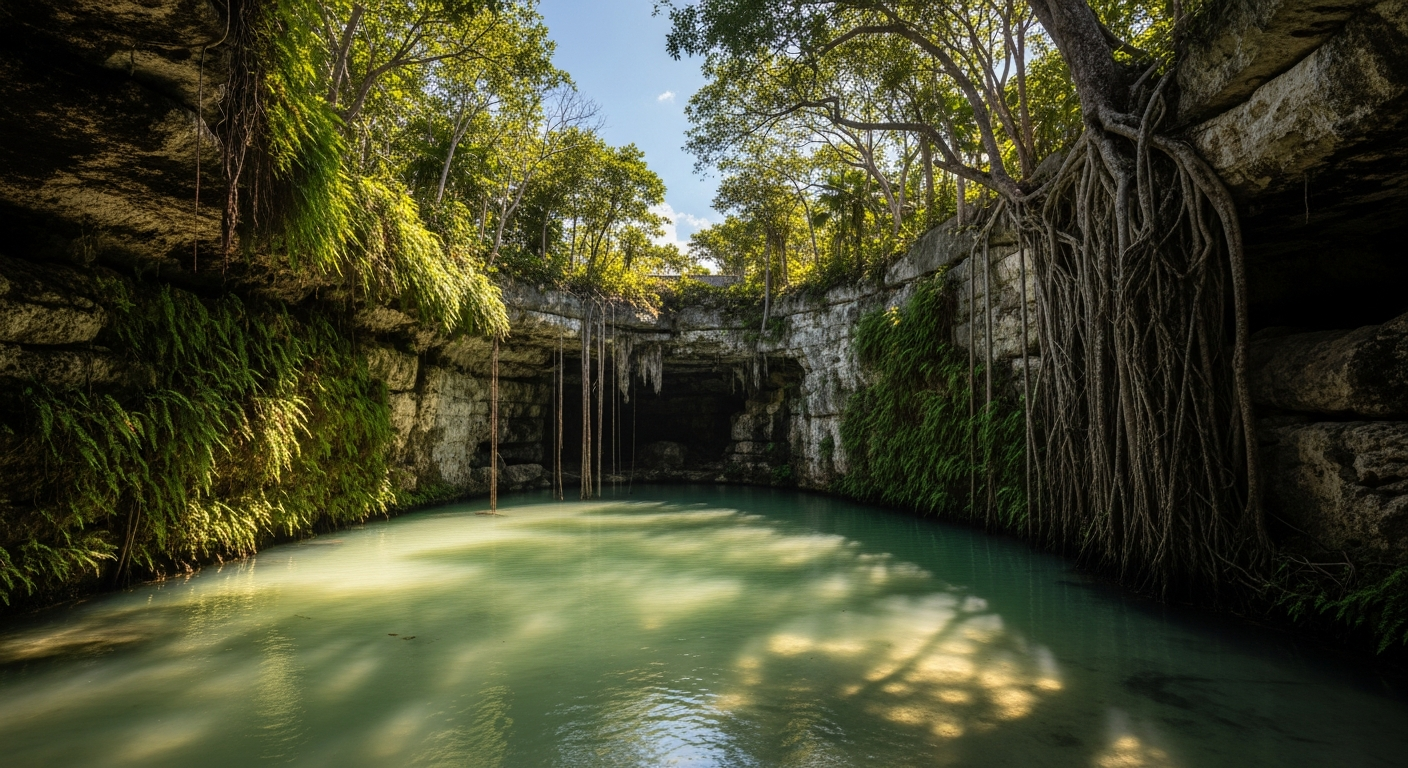
In the Maya language, zacil-ha means white water. The cenote sits eight kilometres north of the ruins on the road toward Coba, an open-sky pool about thirty metres across, the water a colour between turquoise and bone depending on the light angle and the hour. The Maya considered cenotes sacred, the entry points to Xibalba, the underworld, and used them for ceremony.
The practical fact: the water temperature holds constant at around twenty-four degrees regardless of the surface heat. In July, when the jungle is at its most humid and the air temperature reaches thirty-eight, the cenote is a genuine relief. The entry is a short ladder down a limestone wall. The swim is unhurried. The silence is total except for the occasional call from the jungle above the rim.
Some ceremonies take place at cenote edges for exactly this reason. The theatrical value of the setting is self-evident. The logistics are different from a beach ceremony: the ground is uneven, the shade is deep rather than bright, and the dress needs to work in an environment where the light is low and the humidity is complete.
Jungle Ceremony Sites
The jungle venues to the south of Tulum town, along the road toward the biosphere reserve at Sian Ka'an, share an aesthetic rooted in the building vocabulary of Tulum as it developed in the early 2000s: palm thatch, rough concrete, minimal electric light, the jungle allowed to press against the structure on every side. Kima, five kilometres south of town, sits on cleared ground surrounded by trees on three sides with a cenote on the fourth. Our Habitas, further south, built its main structure with a central Maya Cenote Garden and a rooftop that faces the jungle and, on clear nights, the sea.
The ceremony format that works in these settings is not the one that works in a European garden or a hotel ballroom. The jungle absorbs sound differently. The silence between musical phrases is filled with insect noise, with wind in the palms. The dress needs to function in complete heat, in authentic natural light, in a setting that will not photograph in the way a white church exterior photographs. The images will be green-heavy, dark, cinematic. Fabric that moves reads well. Structured fabric looks like it resisted the environment rather than belonged to it.
Evening in the Hotel Zone
The beach road, Carretera Tulum-Boca Paila, runs south from town through what became the hotel zone over twenty years of informal development: low-rise buildings behind thatched palapas, mostly open-sided restaurants, the sea invisible from the road behind vegetation and walls. The evening experience here is distinct from the ceremony experience. Dinner runs late. The tables are lit by candles or by the particular amber of incandescent bulbs strung through the palms. The sound is ambient rather than directed.
The register is elevated-casual, which has a specific meaning here. Nothing as minimal as a slip dress reads right against the lushness of the environment. Something with structure at the shoulder, or a fabric with a print that belongs to this palette of terracotta, sand, and deep green. For a backless or low-cut style, the solution has to be invisible because any alternative reads against the prevailing aesthetic of the place. Medical-grade silicone covers from Korea, ultra-thin at the edge, release cleanly at the end of the evening and leave no trace on the fabric or the skin. Good for fifteen or more wears. When the air is at thirty degrees and the dinner lasts three hours under a palapa, the foundation layer has to be one you do not feel.
For more on choosing what works under open-back styles in warm destinations, read the guide to dressing a backless cut.
What to Know About Tulum Weddings
Legal ceremony requirements in Mexico mean that most international couples complete the civil ceremony at a registry before or after, and the Tulum event is the symbolic ceremony that does the actual work. This removes several scheduling constraints and makes the timing more flexible. Ceremonies can begin at sunset, at the cenote at eight in the morning, or in the jungle by torchlight.
Chef Cesar Castañeda, who runs NU in the hotel zone, built a menu from Mayan ingredient traditions combined with contemporary technique, dishes that draw from the cenote region's history of cultivating corn, chile, and cocoa in the thin soil over limestone. The restaurant has held a position among the top five in Quintana Roo for several years. For a post-ceremony dinner of scale, the hotel-zone venues offer curated menus that reflect the same logic: indigenous ingredients, elevated treatment, no performed authenticity.
The Packing Logic
Tulum has its own temperature rules. The heat is not the dry heat of a Mediterranean summer. It is humid, close, constant. Everything breathable reads better. Linen over cotton, silk over polyester, nothing that does not move with the body. For a week that moves between cenote swims, archaeological sites, and evening dinners, the practical wardrobe is narrow: two good dresses that transition between lunch and dinner, one piece that works for the ceremony itself, flat sandals rated for uneven ground, a shawl for the cenote chill and the beach restaurant breeze at eleven at night.
The jungle and the coast and the ancient city on the cliff have been accumulating visitors for fifty years, each wave finding a version of the place that felt undiscovered. What has not changed is the limestone, the cenotes below it, and the particular quality of the Caribbean light at the moment it changes from afternoon to evening. If you build your days around those facts rather than the hotel zone's version of them, the place becomes something else entirely.
Packed beside the linen. Designed to disappear.

Matte and invisible under sheer.
€29,90€5,98 a pair
Korean silicone · 15+ wears per pair
“I carry them with me everywhere.”
Carol M.

