
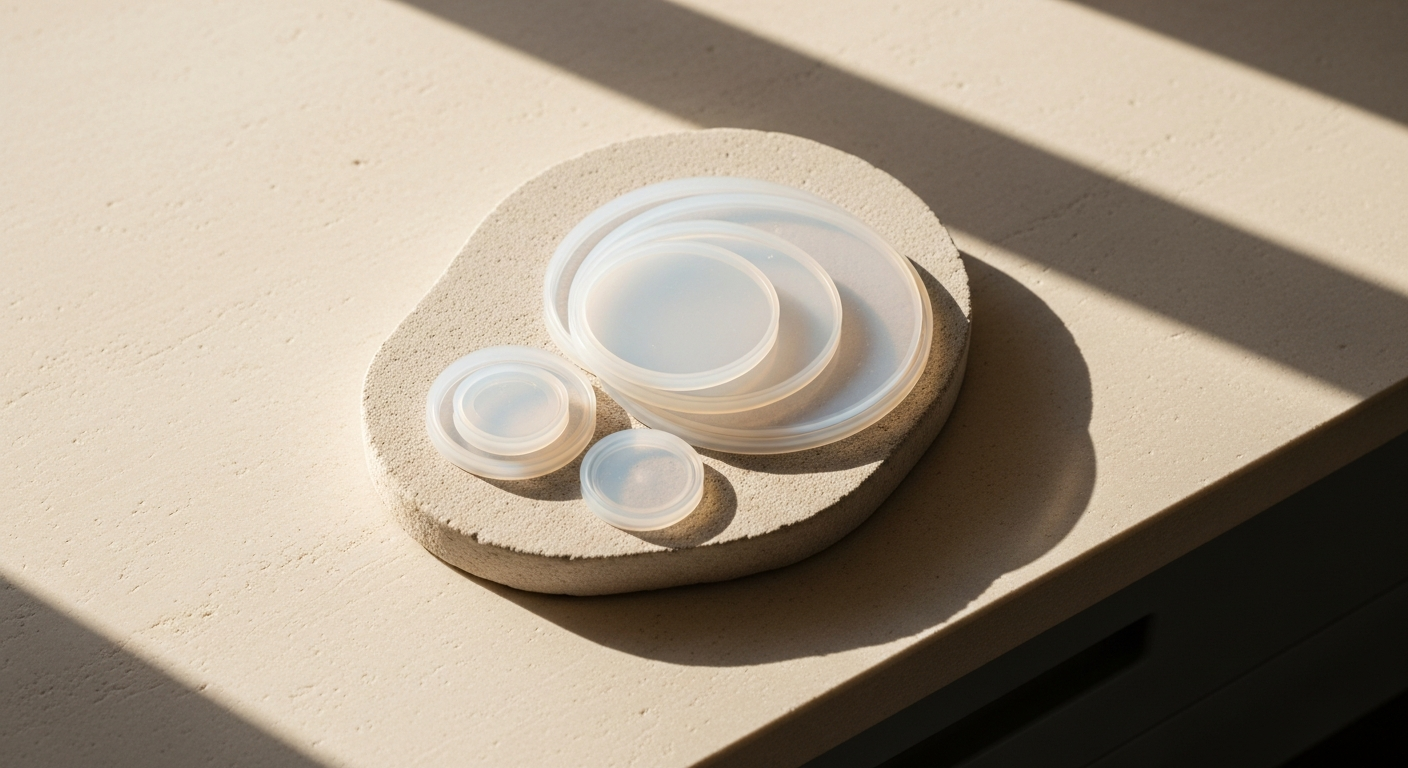
The short answer: the same word covers a kitchen sealant and a medical implant. The two are not interchangeable. Most commercial silicone is peroxide-cured. It is cheap. It leaves behind residue that can migrate out over time. Against a wall, that residue is irrelevant. Against skin for twelve hours, it is not. Ultra-thin silicone covers are made to medical grade, not the grade sealing a kitchen tile. Everything below is the longer answer: how the grades diverge, and what actually separates one from another.
Silicone is everywhere. It seals your kitchen tiles, insulates aircraft wiring, coats the inside of blood bag tubing, and lines the edge of a nipple cover that must hold for twelve hours against a dancing body. The word covers all four of these things equally, which is the problem. They are not the same material. They are not manufactured under the same conditions. They are not tested to the same standards. The same name applied to very different objects has created a confusion that costs people a lot of money and occasionally causes real harm.
The base chemistry is polydimethylsiloxane, abbreviated as PDMS. Its backbone is a chain of alternating silicon and oxygen atoms, the siloxane bond, which is more thermally stable and chemically inert than the carbon-carbon bonds that form the backbone of most plastics. Attached to each silicon atom are two methyl groups. This structure gives silicone its flexibility, its resistance to temperature extremes, its low surface tension, and its impermeability to water. All commercial silicones share this foundation. Where they diverge is in how they are cured, how thoroughly they are purified, and what traces the manufacturing process leaves behind.
The Curing Distinction
Curing is the process that converts liquid silicone polymer into a solid or semi-solid material. Two curing systems dominate commercial production. Peroxide curing uses organic peroxide compounds as initiators. It is effective, inexpensive, and widely used in industrial applications: door seals, pipe gaskets, construction sealants, electrical insulation. The problem is that peroxide curing is not clean. The reaction leaves behind residual byproducts, volatile organic compounds that can migrate out of the cured material over time. In a window frame, this is irrelevant. Against skin, particularly over many hours, it is not.
Platinum curing, formally called addition-cure or hydrosilylation, works differently. A platinum catalyst initiates a controlled crosslinking of the polymer chains. The reaction is complete. Nothing is left over. The resulting material has near-zero extractables, which is the technical term for substances that can migrate from the solid material into contact media. Platinum-cured silicone is optically clear, odourless, and stable across a wide pH range. It is the chemistry used in surgical implants, in the tubing that carries intravenous medication, in neonatal care equipment, and in any application where extended contact with living tissue is required.
Industrial-grade silicone may be either peroxide or platinum cured, but it is not tested for biocompatibility. The manufacturer's obligation ends at mechanical and chemical performance. The cured rubber must hold a seal, resist a temperature, or insulate a wire. What it does to skin is outside the specification.
ISO 10993 and What It Actually Tests
The biocompatibility standard that governs medical-grade silicone is ISO 10993, a multi-part document published by the International Organization for Standardization. The standard evaluates materials at several levels of biological interaction. ISO 10993-5 covers cytotoxicity: does the material damage living cells in direct contact? ISO 10993-10 covers sensitization and irritation: does repeated exposure trigger an immune response? The full testing battery includes tests for systemic toxicity, genotoxicity, and, for long-term implant materials, carcinogenicity.
Passing ISO 10993 requires not just a well-formulated base material but controlled manufacturing. Medical-grade silicone is produced in certified cleanroom environments, typically ISO 7 or ISO 5 classification, where particle counts per cubic metre are regulated to prevent contamination. The supply chain is documented, and each batch is traceable. The same standard applies whether the material is destined for a cardiac catheter or a skin contact product worn for a full evening.
Food-grade silicone adds a parallel consideration. FDA 21 CFR 177.2600 covers rubber articles intended for repeated food contact. EU Regulation 10/2011 covers plastic materials in food contact. Food safety certification tests for the migration of substances into food simulants, not for biological reaction in living tissue. A silicone that is food-safe is not automatically biocompatible and vice versa. The tests measure different things. A manufacturer that claims food-grade certification for a skin-contact product is not lying, exactly, but they are not answering the relevant question.
Why This Matters for Adhesive Products
Skin contact products that stay on the body for hours fall into a specific regulatory category. The extended contact time means any extractable has more time to migrate. Heat and moisture, which accumulate under anything worn against skin, accelerate migration further. A product worn under clothing through a formal dinner, a summer wedding, a full night of dancing, creates conditions that require genuine medical-grade materials to manage safely.
Medical-grade silicone covers from Korea, produced under the quality manufacturing standards that KGMP certification requires, use platinum-cured PDMS that has passed the biocompatibility evaluation. The adhesive releases cleanly. Nothing is left on the skin. Good for fifteen or more wears without adhesive degradation, because the polymer crosslink structure that makes the material biocompatible also makes it stable under repeated mechanical stress. These are connected facts, not separate selling points. The chemistry that makes it safe is the same chemistry that makes it last.
Ultra-thin at the edge, the material must be flexible enough to move with the body and thin enough to be invisible under fabric. Achieving both requires the tight polymer consistency of platinum-cured silicone. Industrial-grade material, with its residual byproducts and less controlled crosslink density, cannot hold the same dimensional tolerances.
The Grade Hierarchy in Practice
Industrial grade: tested for mechanical and chemical performance. No biocompatibility evaluation. Cost-optimised. Appropriate for construction, automotive, electrical insulation.
Food grade: tested for substance migration into food simulants under FDA 21 CFR 177.2600 or EU 10/2011. Not a biocompatibility standard. Appropriate for kitchen equipment, food processing components.
Medical grade: platinum-cured, ISO 10993 biocompatibility tested, manufactured under controlled conditions. Appropriate for any extended skin contact, medical devices, and implant applications. The certification is not a marketing label. It is the record of a battery of tests that the material passed before any product was made from it.
The grade of a silicone product is determined by its entire production history, not just its base chemistry. A platinum-cured silicone manufactured in an uncontrolled environment with an undocumented supply chain is not medical grade. The standard requires the process, not just the molecule. That distinction is why country of manufacture and manufacturing standards matter in ways that are not simply patriotic preference. Korea's medical device manufacturing sector operates under KGMP, the Korean equivalent of ISO 13485, which requires quality management systems equivalent to those used for pharmaceutical manufacturing. The precision that built South Korea's semiconductor industry did not stay in semiconductors. It moved into every precision manufacturing sector the country entered, including medical materials.
Understanding silicone grades is useful before you buy anything that touches your body for more than a few minutes. The question to ask is not what something is made of. It is how that material was processed, what testing it was subjected to, and what documentation exists to prove it. The chemistry starts with the same PDMS backbone every time. What happens after that determines everything that follows from it.
For more on the manufacturing standards behind the Korea story, and why the country became the destination for precision silicone production, the details of that particular industrial pipeline reward the attention you bring to them.
You've read about them. Now see them.

Matte and invisible under sheer.
€29,90€5,98 a pair
Korean silicone · 15+ wears per pair
“I carry them with me everywhere.”
Carol M.

