
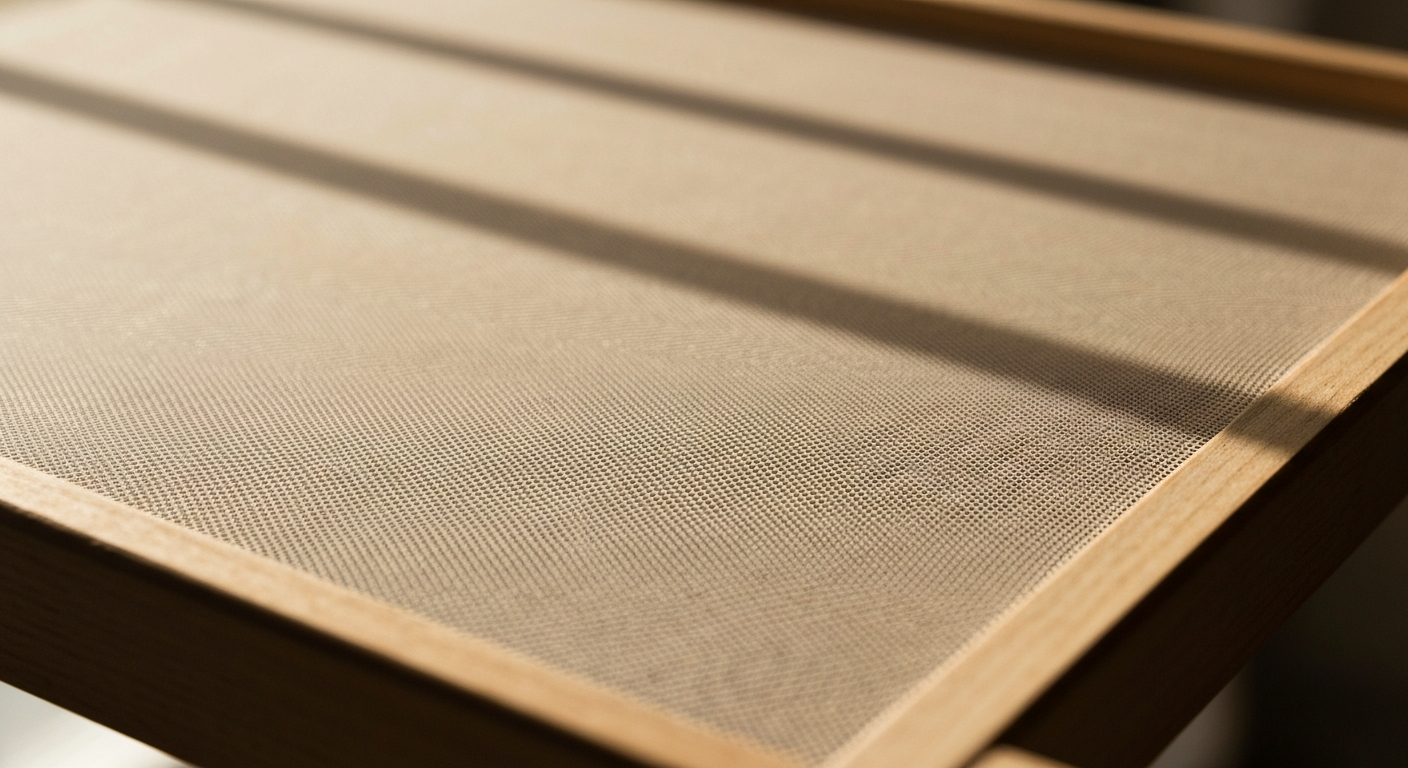
Mesh is a deliberate transparency. Everything beneath it is part of the composition whether it was chosen or not, and a conventional bra reads as a second garment competing with the one above it. Silicone covers provide coverage with no band, no strap, and no visible structure.
The short answer: it depends what you want seen. Matte silicone covers make mesh read intentional while keeping you covered; a deliberate bralette makes it read layered. What clashes is anything glossy, lacy, or banded. The longer answer below: colour, coverage, and the runway moment that defined how mesh is meant to be worn.
In October 2001, a model went down the runway at the Gucci Group presentation wearing what appeared, from the first row, to be nothing from the waist up. The top was constructed from fine silk organza, woven with a fil coupe technique: moonlight silk threads gliding over sheer organza, then cut away to leave delicate motifs floating over a transparent ground. The effect was not nudity. It was something more demanding: the complete visibility of everything beneath the fabric, framed and elevated by the craftsmanship of what was above it. The body was present, was the point, and the garment made it impossible to look away by making itself almost invisible.
What he understood, and what most designers who have worked with sheer fabric understand, is that transparency is not exposure. It is a controlled relationship between what is seen and what the garment instructs you to see. The fabric does not fail when it becomes transparent. It succeeds, if what is underneath it belongs to the image the designer was building.
This is the central fact about mesh and see-through tops. They are not garments that accidentally reveal. They are garments that deliberately reveal, and everything worn underneath them is part of the composition whether you intend it or not.
Is Mesh See-Through? Mesh vs Sheer
Yes. Mesh is see-through by construction: it is knitted with open holes, so skin and anything worn underneath show through the gaps. How much shows depends on the size of the holes, from half a millimetre to a centimetre in a tricot mesh and wider still in an open raschel, and on the light. A mesh that is forgiving indoors shows more in full sun.
Mesh vs sheer comes down to holes versus yarn. Mesh shows what is underneath directly, through its holes. Sheer has no holes: it is a woven or knit fabric of very fine yarn, such as organza, chiffon or a fine stocking knit, and what is underneath shows through it softened. Both show what you wear beneath them, so what works under one works under the other. Silicone covers the width of a human hair leave no edge for the holes or the yarn to give away.
How Mesh Actually Works
How each is built explains the difference, and it matters when you are deciding what to wear beneath them.
Mesh is constructed by forming deliberate gaps in the fabric structure. The two primary methods are warp knitting and weft knitting, and the results behave quite differently. Warp-knit mesh, produced on tricot or raschel knitting machines, creates a stable, run-resistant structure where the yarns interlock in a way that prevents unraveling. Tricot mesh has a smooth, consistent surface with holes ranging from half a millimetre to a centimetre across. Raschel mesh allows for more complex, open patterns with larger holes and more textural variation. Both are transparent through the geometry of their gaps rather than through the thinness of the yarns themselves.
Sheer fabric works differently. A sheer woven fabric, silk organza or silk chiffon or a sheer polyester, achieves transparency not through holes but through extreme fineness of the fiber. Denier is the unit that governs this: the weight in grams of nine thousand metres of a single fiber. A 15-denier fiber, the standard for sheer stockings, transmits light almost entirely. A 30-denier fiber gives semi-opacity. As denier rises past 40 toward the 100-denier range typical of heavier fabrics, opacity approaches completeness. What McQueen used in his most sheer moments was often below 20 denier, woven at very high thread counts: the transparency came from having almost nothing there, rather than from creating holes.
These two routes to transparency create different visual effects and require different thinking about what goes beneath them. Mesh with large holes shows what is underneath through those holes directly. Sheer fabric with fine yarns diffuses what is beneath it into a slightly softened, filtered visibility. The practical outcome is the same: what you wear under either type is visible, in whole or in part, and is part of how the outfit reads.
The Intentional Choice
The most important thing to resolve before choosing what to wear under a mesh or sheer top is what relationship between visibility and coverage the garment was designed to create.
Some sheer tops are designed to be worn over a camisole, a bralette, or a tank. The designer's intention was layering. The visible underlayer is the second layer of the composition. In this case, the question is not how to conceal what lies beneath but what visible underlayer completes the outfit. A fine ribbed tank in a tone close to the top's color, a satin slip that echoes the fabric weight of the sheer layer above it, a textured camisole that contrasts deliberately with the fine mesh: these are all valid answers to a question about layering, not about concealment.
Other sheer tops are designed to be worn as a single layer, with the body directly underneath. These are the constructions that come from McQueen's tradition, from the sheer bodice worn to a formal event where a camisole underneath would destroy the proportion and purpose of the garment. Here the question shifts. The designer's intention was skin as the second layer. What is needed is not another garment but coverage that has no garment presence.
Distinguishing between these two design intentions is usually straightforward. A sheer top cut in a relaxed, layering silhouette, with a high neck or structure that suggests clothes going over it, is likely designed for layering. A sheer top cut as a precise fitted bodice, with delicate seaming or hand-finishing and a design language borrowed from eveningwear, is likely intended to be worn as a single layer. The fit of the garment and the context of its origin tells you which question to ask.
The Bra Problem in Mesh
A conventional bra worn under a mesh or sheer top is visible, completely and unavoidably. The only question is whether that visibility is intentional. A black mesh top worn over a black lace bra is a styling decision with a long and legitimate history. The visibility is the point. The two garments exist in deliberate dialogue.
But in most contexts, the bra under a sheer top is visible in a way that was not planned: visible at the back band, visible at the straps, visible as a cup structure that creates a different surface underneath the outer fabric than the garment anticipated. The mesh or sheer layer was cut with a particular fit in mind. A bra cup under that fitting creates a shape that was not the intended shape. Even when the visibility is minimal, the structural interference is present.
The strapless bra is a partial improvement but carries its own problems. The band across the back, visible through any sheer fabric, is a horizontal line on a surface where the garment expected verticals or no lines at all. A strapless bra cup creates less structural interference than a strapped cup, but the cup structure is still visible through fine mesh as a rounded form where the garment expected flatness.
There is also a practical problem specific to mesh: mesh moves. The structure of a knit mesh, particularly a fine tricot with small holes, is flexible. It shifts with the body, stretches and recovers. A bra worn under mesh does not move in the same way. The two constructions have different elasticity. The mesh pulls independently of the bra, and the interaction is visible in motion as a slight discordance between the outer layer and the inner structure.
The Specific Solution for Sheer Occasions
The sheer or mesh top worn as intended, as a single layer over bare skin with coverage that has no structural presence, requires something that addresses the visibility question without adding anything to the construction equation. Medical-grade silicone covers from Korea, applied directly to the skin, sit flush against the body and follow its surface exactly. At 0.07 mm, the width of a human hair, the film leaves no ridge line that reads through fine mesh or sheer fabric. The adhesive holds through several hours of wear. The adhesive releases cleanly afterward. Good for fifteen or more wears.
Related problems appear with other sheer and structured garments. Sheer blouses in woven silk or chiffon follow the same denier logic, and backless dresses compound the transparency question with structural exposure. The fabric changes. The principle does not.
Under a fine mesh with small holes, the covers become effectively invisible because they are skin-colored, flat against the skin, and the mesh's own texture diffuses their edge. Under a sheer fabric like organza or chiffon, the slight opacity of the silicone reads as slightly warmer skin tone, not as a separate object. The effect is coverage without a garment, which is precisely what a sheer top worn as a single layer requires.
This is what McQueen was building toward in 2001, not in a commercial sense but in an aesthetic one. He was building an argument for the body as a presence inside the garment rather than a form to be contained by it. The transparency of the fabric was the frame. What was inside the frame needed to be present without being cluttered by the infrastructure of a conventional solution.
Mesh in Daylight
The evening sheer is one context. The daytime mesh top is another, and it operates under different conditions. A fine-denier mesh worn in daylight, particularly outdoors, is subject to light from multiple angles simultaneously. The edge-diffusion that makes a mesh top forgiving in low interior light does not exist in full sun. In direct light, a mesh top worn over a skin-color camisole will show the camisole's seams, its hem, its shoulder straps, even its texture through the outer layer. The camisole becomes legible rather than invisible.
This is why the daytime mesh outfit, as it appears on resort terraces or at summer events, resolves typically in one of two ways. The first is full visible layering: the camisole is a deliberate and visible element, chosen for its own visual contribution. The second is no layering: the mesh over bare skin, with coverage that has no garment presence of its own. The middle solution, a camisole intended to be invisible but read by the light anyway, fails in both directions. It is neither deliberately visible nor genuinely invisible.
What Transparency Requires
The see-through top is a garment that does not hedge. Its transparency is either a choice or a problem, and the difference between those two conditions is entirely determined by whether the person wearing it made a prior decision about what would be visible through it.
That decision is not complicated. It requires knowing what the garment was designed to be worn over, knowing whether the layering is meant to be visible or invisible, and then resolving the question before the outfit is assembled rather than after. The answer changes depending on the occasion, the light, the construction of the specific garment. It is available in advance, which is the only time it is useful.
McQueen put transparency at the center of his practice because he understood that the body inside a garment is not the embarrassing truth the garment conceals. It is the subject the garment is built around. The silk organza existed to be looked through. What it was looking through to mattered as much as the fabric itself. This is still the argument made by every mesh and sheer top in a wardrobe: whatever is underneath it is part of the composition. Dress accordingly.
Frequently asked questions
What should you wear under a mesh or sheer top?
It depends what look you want. Matte silicone covers make mesh read as intentional while keeping you covered. A deliberate bralette makes it read as layered instead. What clashes is anything glossy, lacy, or banded, since a bra's straps and band tend to show through mesh unintentionally.
Why can you see a bra through a mesh top?
Mesh is transparent through gaps in its knit, tricot holes run half a millimetre to a centimetre, raschel wider still, while sheer wovens like organza get their transparency from very fine denier yarn rather than holes. Either way, a bra's band, straps, and cup shape read clearly through the fabric.
Does a strapless bra work under a sheer top?
It's only a partial fix. The back band still shows as a horizontal line through sheer fabric, and the cup still reads as a rounded shape where the garment expected flatness. Mesh also stretches differently than a bra does, so the two layers move out of sync and the mismatch is visible.
What's the best solution for wearing a sheer top with nothing underneath?
Medical-grade silicone covers applied directly to the skin. A hair-thin film, so no ridge line reads through fine mesh or sheer fabric. The adhesive holds through several hours of wear and releases cleanly afterward, good for fifteen or more wears.
The dress decides what shows. The covers decide what does not.

Matte and invisible under sheer.
€29,90€5,98 a pair
Korean silicone · 15+ wears per pair
“They saved me from the semi-sheer fabric.”
Daria

