
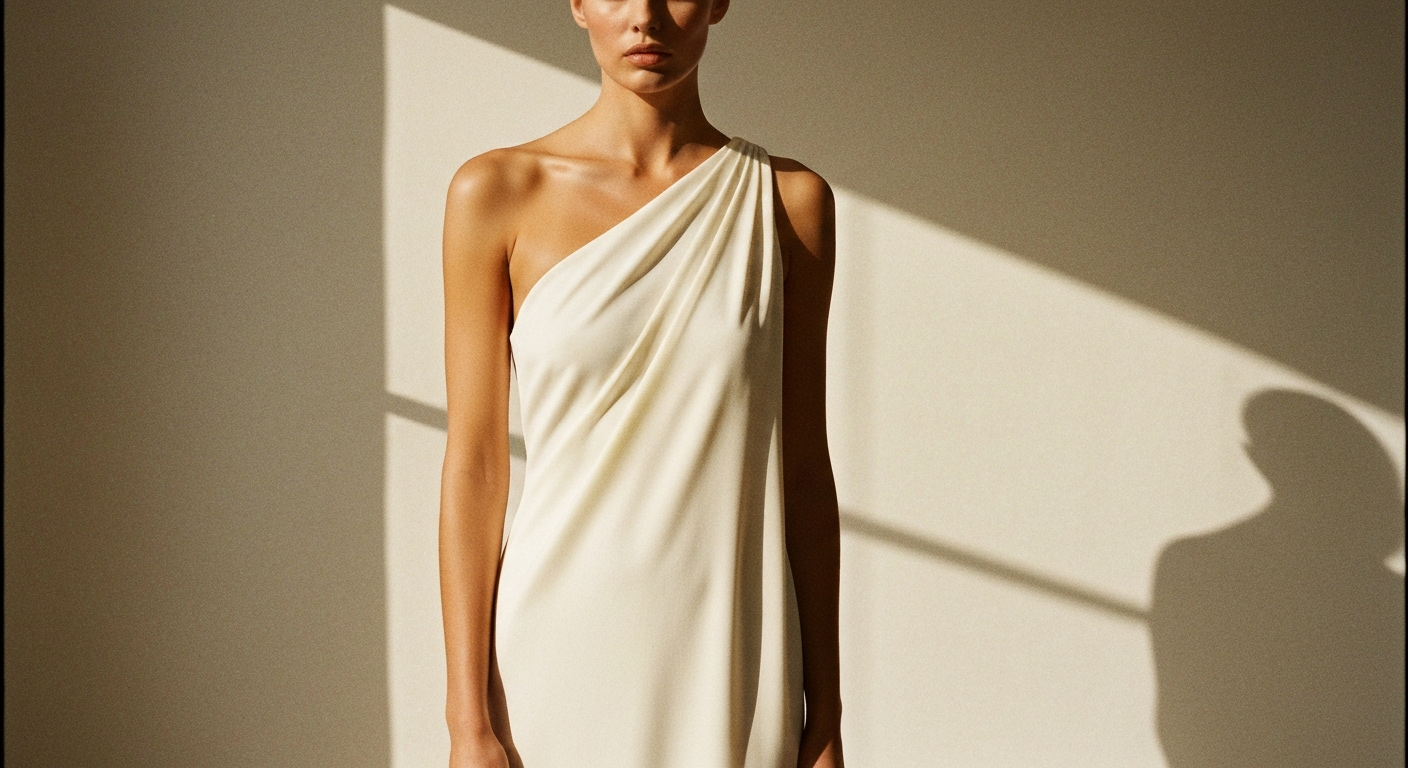
The one-shoulder neckline makes both straps of a conventional bra simultaneously visible. One at the shoulder, one where no strap belongs, cutting across the bare side the garment was designed to leave clean. Silicone covers remove both straps from the picture.
The one-shoulder dress arrived in Western fashion with a specific set of references. Greek and Roman draped garments, the exomis and the chiton, constructed by pinning fabric at a single point on the shoulder and allowing the cloth to fall, unsupported on one side, in whatever configuration the weight of the textile produced. The original garments had no seams. They were rectangles of fabric held in place by a single fastening and by the weight of the cloth itself distributed across the body. They worked because the fabric was heavy enough and the body was warm enough that the textile settled into a stable configuration and stayed there.
One bare shoulder changes the math: silicone covers go under it, the Confidence Set goes under the covered side for structure.
Halston worked with this logic in the 1970s when he built his column dresses on a one-shoulder principle, working in jersey and matte crepe, fabrics with enough weight to fall in a straight vertical line without the scaffolding of boning or structure. His one-shoulder gowns from that decade are among the most technically demanding garments in twentieth-century fashion not because they are complicated in construction but because their simplicity is absolute. A single seam, a single point of attachment, and the entire dress is either working correctly or it has failed. There is no middle position.
How the Single Strap Redistributes Weight
A conventional bra distributes the weight it supports across four contact points: two shoulder straps and the band that circles the ribcage. The band does the majority of the structural work, with straps providing positioning rather than support in a well-fitting bra. Remove two of these contact points, as the one-shoulder neckline requires, and the mechanical situation changes entirely.
A one-shoulder bra strap or a strapless bra with a single strap added on one side does not produce the same weight distribution as a conventional two-strap bra. The single strap point pulls upward and toward the shoulder on the covered side only. This creates an asymmetric upward force on the bra cup on that side, which tends to cant the cup slightly upward and inward. The uncovered side sits with only the band holding it, and without the stabilising downward component of the strap on that side, the band tends to migrate in the direction of the covered shoulder. The result is a bra that is neither level nor stable, and that corrects itself in a direction that is visible through the dress.
This is the reason that the one-shoulder dress has a reputation for being difficult to wear with any bra at all. The difficulty is not the neckline coverage question. It is the mechanics. A bra system engineered for symmetrical support becomes, when forced to operate asymmetrically, a system working against itself.
The Strapless Bra Solution and Its Limits
The strapless bra is the most commonly proposed solution for the one-shoulder dress, and it answers the strap visibility problem by eliminating straps entirely. The band grips the ribcage by friction, boning, and elasticity, and the cups hold their position in relation to the band. This works until it doesn't, and the conditions under which it fails are predictable: heat, dancing, any movement that changes the ribcage diameter through deep breathing or exertion, and any duration beyond two or three hours without manual adjustment.
A strapless bra under a one-shoulder dress also introduces the band visibility problem. The one-shoulder dress frequently has a low back or an open back on the uncovered side, because the design logic of the asymmetric neckline tends to extend to the back: one shoulder covered, one side open. A strapless bra band that crosses the back at mid-shoulder-blade level is visible through any dress with a low back opening on that side. The band line and the back opening compete for the same geography of the body, and the band loses in terms of what the occasion calls for.
The Greek Construction Principle Applied
What Halston understood, and what the original Greek textile workers understood before him, is that a one-shoulder garment achieves its visual intention only when the body underneath it appears to need no support at all. The dress that falls from a single shoulder point in a clean column or drape is making a claim about the body it is on: that the body is the structure, and the fabric is merely recording it. Any visible infrastructure beneath this claim contradicts it.
The asymmetric neckline draws the eye along its single diagonal line, from the covered shoulder across the collarbone to the uncovered shoulder. This diagonal is the design's primary gesture. Every element that lies beneath the covered-side shoulder, the strap if there is one, the construction of how the bodice attaches to the body, the lingerie decision underneath, is subordinate to that diagonal line remaining clean and uninterrupted.
On the uncovered side, the bare shoulder and arm create the contrast that makes the diagonal meaningful. What the viewer sees at the covered shoulder and what they see at the bare shoulder is the full statement of the garment. Any visible strap on the bare side, whether the strap of a conventional bra or the rerouted strap of a convertible one, adds a line that the dress did not intend to have there. The bare shoulder is meant to be bare.
What Actually Works
The solution that works for the one-shoulder dress is front coverage that has no strap component, no band component, and no back component. Coverage that sits flat against the skin at the chest with nothing extending to the shoulder, nothing crossing the back, nothing visible at the neckline from the front or from the uncovered-shoulder side.
Medical-grade silicone covers from Korea are constructed entirely as a chest-surface solution. They sit against the skin with no strap, no band, and no component that extends beyond the cover's perimeter. Ultra-thin at the edge, less than half a millimetre, they do not create the ledge effect at the edge that most adhesive cup products produce. The adhesive holds through heat and movement, the conditions that end the strapless bra's effectiveness within two hours. The covers hold for the duration of the occasion, including the dancing at the end of the wedding, including the taxi home at midnight when the temperature drops and the body cools.
Good for fifteen or more wears, the material's performance is not degraded by a single wearing. The adhesive releases cleanly at the end of the evening without inflammation or irritation at the skin. The one-shoulder dress comes off the way it went on: with the front coverage invisible, the bare shoulder bare, and the diagonal of the neckline exactly as the dress intended it.
The Positioning Question
For the one-shoulder dress in particular, the positioning of the covers relative to the neckline requires attention before the dress goes on. The one-shoulder bodice frequently has a sweetheart or diagonal cut on the front, following the neckline's asymmetric line from the covered shoulder down to a lower point on the uncovered side. The cover's position needs to be below the neckline edge on the covered-shoulder side by enough margin that the cover is not visible when the bodice sits against the body. On the uncovered side, the same margin is needed, but in a different orientation because the neckline descends lower on that side.
The practical approach: dress on first to establish where the neckline sits. Dress off. Covers placed at the positions marked by the neckline geometry. Dress on again. No adjustments needed mid-evening.
The Single Shoulder as a Design Commitment
The one-shoulder dress asks the wearer to commit to an asymmetry that most garments avoid. Two sleeves, two straps, two collar points: most clothing is bilaterally symmetrical because the body is bilaterally symmetrical, and the default is to reference that symmetry in the garment's construction. The one-shoulder dress refuses this reference. It makes the asymmetry the point.
This is why the one-shoulder dress reads as a formal choice rather than a casual one even in relatively simple constructions. The garment is making a decision that took Greek textile workers thousands of years to arrive at as a codified form, that Halston translated into the clean-lined jersey column, and that contemporary designers return to when they want to make a single line do the work of an entire outfit.
The bare shoulder, the diagonal neckline, the column of fabric falling to the floor on the covered side and to wherever the hem falls on the uncovered side: these are not accidental. They are a complete compositional choice. The logic here is close to the backless dress, which also asks for coverage that does not interfere with the garment's primary structural gesture. The wedding context is where the one-shoulder dress most often demands this precision, because the photographs will record, over many years, exactly what was visible beneath the diagonal line.
What is required underneath the one-shoulder dress is a decision made before the dress goes on, executed with enough care that it does not need to be revisited during the occasion. The bare shoulder remains bare. The covered shoulder is covered. The diagonal holds. The column of fabric falls exactly where Halston and the Greeks before him understood that it should fall: from a single point of attachment, clean, downward, and uninterrupted.
Frequently asked questions
Why is it hard to wear a bra under a one-shoulder dress?
A conventional bra relies on four points, two straps and a band, for support. Removing two straps for the one-shoulder neckline creates an asymmetric upward pull on one side, causing the band to migrate toward the covered shoulder rather than sit level and stable.
Does a strapless bra work under a one-shoulder dress?
It removes the strap visibility problem but fails under heat, dancing, or deep breathing, and needs adjustment after two to three hours. Its band can also show through the low or open back that one-shoulder dresses often have on the uncovered side.
What's the best thing to wear under a one-shoulder dress?
Front coverage with no strap, band, or back component. Medical-grade silicone covers sit flat against the chest with an ultra-thin edge under half a millimetre, hold through heat, movement, and dancing, and release cleanly without irritation, good for 15+ wears.
How do you position nipple covers under a one-shoulder dress?
Put the dress on first to see exactly where the neckline sits, take it off, place the covers below the neckline edge on both the covered and uncovered sides according to that line, then put the dress back on. No adjustments should be needed during the evening.
The dress decides what shows. The covers decide what does not.


