
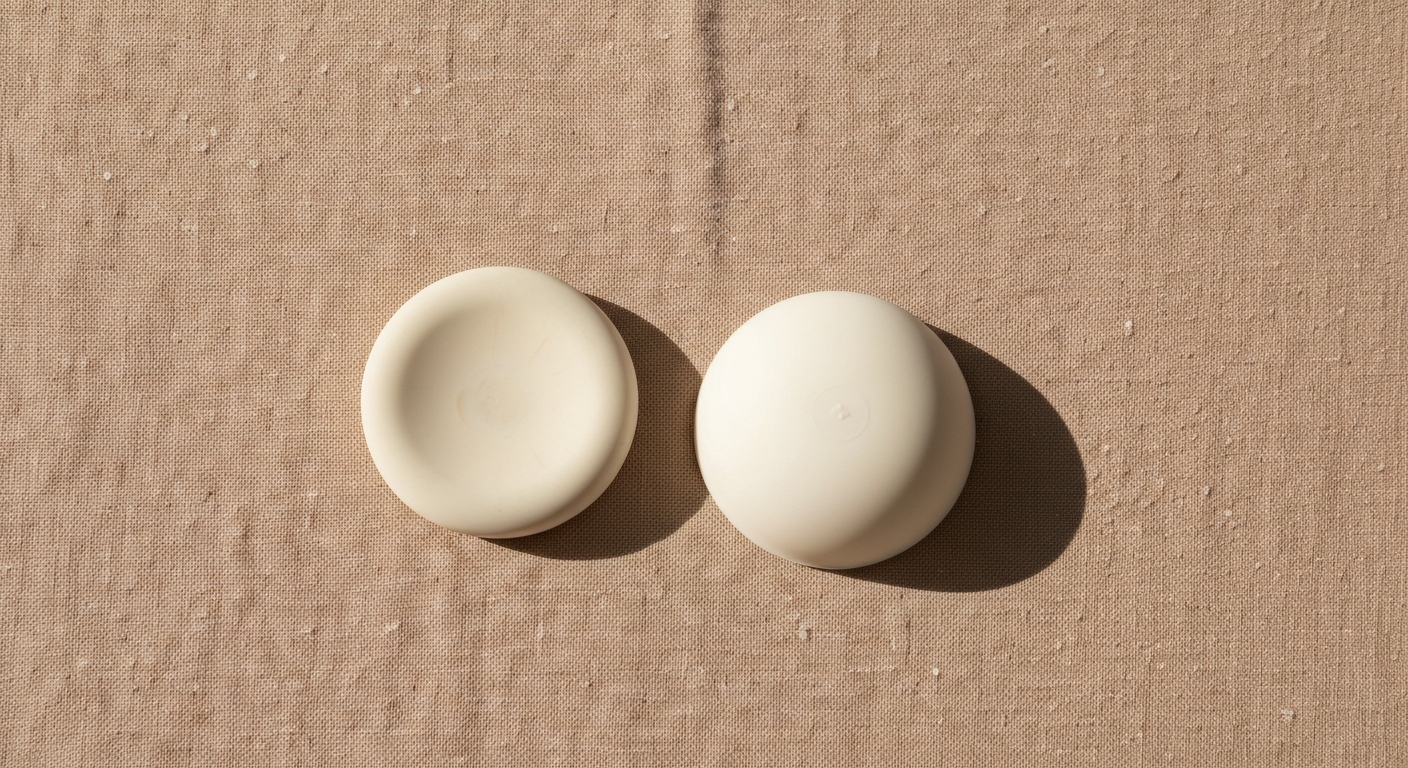
The short answer: a duller, tackier surface that grips lint before it grips skin, a shorter hold time than the pair had a month ago, and any visible tear or thinning at the edge. Any one of these alone is normal wear. Two together mean the pair is close to done. Fifteen or more wears is roughly the life of a set of silicone covers, and the honest fix once a set crosses that line is a fresh pair, not one more evening pushed out of a tired one. Everything below is the longer answer: what is actually happening to the adhesive at the molecular level, and how to read the signs before an important night, not during one.
Adhesive does not fail like a battery. It does not go from working to not working overnight.
It gives you signals. The signals are consistent and readable. Learning to notice them before you need the covers for an important occasion is the only way to avoid the moment when you reach for them and find that something has changed without your having noticed when.
The lifecycle of a reusable silicone adhesive is a curve, not a cliff. Understanding what drives that curve, and where on it you are, gives you the information to make a straightforward replacement decision rather than a stressful one.
What the adhesive is doing when it works
Medical-grade silicone covers adhere to skin through van der Waals molecular contact, a distributed electromagnetic attraction between the polymer surface and the proteins in your skin. This is not a chemical bond. It is a physical one: it depends entirely on the quality of contact across the full adhesive surface. When that surface is clean, undamaged, and pressed against clean dry skin, the cumulative force of millions of contact points is substantial enough to hold the cover through heat, movement, and hours of wear.
The adhesive surface is soft, slightly porous at the microscopic scale, and conformable. These properties are what make it work. They are also what makes it susceptible to accumulation: sebum, residue from body products, environmental particles, and textile fibres all lodge into the pores through the same physical mechanism. The surface that held perfectly through a twelve-hour dinner in its first month holds less certainly in its sixth because it is not the same surface it started as. Even with careful cleaning, each use deposits a residue layer that is not fully reversible.
The first signal: seating behaviour changes
A cover in good condition draws onto skin. You press it into place and it adheres before you have finished pressing, conforming to the curve of the skin surface almost as fast as you apply pressure. There is a resistance to repositioning, a soft grip that engages immediately.
As adhesive capacity declines, the cover seats rather than draws. You press it into position and it sits there, held by contact pressure rather than active adhesion. It can be repositioned easily. It does not resist movement in the same way. This shift is subtle in the beginning and becomes more obvious over time. If you pay attention to how the cover feels at application, you will notice this change before it causes any visible problem.
This early change does not mean the cover is useless. A cover that seats rather than draws will still function adequately for a shorter wear period in controlled conditions. It is telling you that the adhesive surface is in its later phase of functional life, not that it has ended.
The clearest signal: edge lifting
Edge lifting is the most legible sign of declining adhesion. The edges of the cover lift away from skin before the centre, because the edges have the smallest ratio of adhesive contact area to silicone mass at that point. When total adhesive force drops, the edges are the first to be overcome by the weight and movement tension of the cover itself.
Assess timing and conditions. An edge that lifts after eight hours of normal wear is within expected performance. An edge that lifts within two hours, in non-extreme conditions without heavy sweating, is telling you something about the adhesive surface. An edge that lifts before the end of the first hour, on clean dry skin, with normal ambient temperature, has passed the point where the surface can do what you need it to do.
The location of lifting also carries information. Lifting at the very tip of a petal or lobe shape, where the silicone is thinnest and the geometry is most curved, is different from lifting around the full perimeter. The first is geometry-driven and can happen even on a relatively fresh cover if the bust shape does not suit the cover shape. The second is adhesion-driven and is a direct reading of the surface condition.
Body chemistry and why wear numbers are conditional
Medical-grade silicone covers from Korea are designed for multiple uses, with fifteen or more wears as a realistic expectation under normal conditions. That figure is conditional. It reflects median performance with correct cleaning on skin with average sebum production, no interfering body products, and consistent storage in the clean case between uses.
Your body chemistry is specific to you. Skin that runs warm and oily, producing more sebum per hour of wear, deposits more residue per use and reaches the point of irreversible surface loading faster. Skin that runs dry and cool, with lower sebum production, can sustain more wears from the same covers. This is not a product inconsistency. It is normal variation in human biology that no material specification can account for in advance.
The same covers, worn by two different people following identical care protocols, will have different lifespans. Neither person is using them incorrectly. They are simply different. The meaningful comparison is not your wear count against an advertised number. It is your current performance against what these covers did for you at the beginning.
When to clean versus when to replace
The care protocol matters most in the early-to-mid phase of a cover's life. Thorough washing with a mild surfactant after each wear removes the majority of sebum and surface contamination that is still in the outer pores. At this stage, a cover that has lost some grip after several wears will often perform close to original after proper cleaning and full air-drying.
In the later phase, cleaning becomes less effective. The residue has worked into the deeper pore structure of the silicone and the cross-linked surface has absorbed more than it can release through washing. At this point, cleaning maintains hygiene but does not meaningfully restore adhesive function. The cover will still seat and hold in some conditions, but the reliable all-day performance it had at the beginning is no longer available.
The test is consistent and practical: clean the covers thoroughly according to the protocol at how to care for silicone covers, allow them to air-dry completely, then apply them to clean dry skin the following day. If the seating behaviour and hold through the first few hours is close to what you experienced in the first month, the covers are still in usable condition. If performance after cleaning is not meaningfully different from before cleaning, you are in the replacement phase.
Signs that are not about adhesion
Physical damage to the silicone surface is a separate category from adhesive decline. Tears, notches, or deformation at the edge of the cover compromise the profile under clothing regardless of how much adhesive function remains. A torn edge creates a ridge visible under fitted fabric. A deformed petal tip that no longer sits flat creates a visible outline.
Discolouration that does not wash out is another indicator. Silicone absorbs very little. But certain formulations in self-tanning products, some spray tans, and pigment-heavy oils can stain the surface in ways that cleaning does not resolve. The discolouration itself does not affect adhesion, but a visibly stained cover defeats the function of a skin-toned product.
For dress planning that depends on covers performing reliably, particularly for the guide at what to wear under a backless dress, the replacement assessment is worth doing well before the occasion. Not at the last fitting. The adhesive surface gives clear signals across weeks of use. It rarely fails completely without having communicated, several times, that it was in decline.
The replacement decision
There is no single number that applies universally. There is an honest observation of how the covers perform now compared to how they performed at the beginning. The curve from new to worn is gradual, and most people who use covers regularly develop a feel for where on that curve they are. The edge lifting timing, the seating behaviour, the persistence of grip through a long evening: these are the actual indicators.
The new covers at skindelle.com are the same medical-grade silicone from the same Korean manufacturer as your current pair. The starting point of that curve is familiar. The question is only whether you are still on it, or whether you have reached the end of this pair's useful life and are ready to begin it again.
The covers. Designed to disappear under everything.

Matte and invisible under sheer.
€29,90€5,98 a pair
Korean silicone · 15+ wears per pair
“Skin did not pull so it did not hurt.”
Catarina B.

