
Bali is not the island for people who want Asia at a distance. Ubud is not a spa retreat with rice terrace views. Tanah Lot is not a sunset backdrop. The island has been a site of continuous Hindu ceremony for five centuries, and the architecture, the agriculture, and the social structure of the place were built in full awareness of that. The ceremonies that take place here now, whether temple offerings at dawn or destination weddings in the late afternoon, inherit a landscape shaped by religious intent. The best version of a Bali celebration is one that acknowledges this, down to a bridal kit built for a ceremony that runs from a dawn blessing to a late-afternoon vow, not a change of clothes in between.
Ubud and the Ayung River
Ubud sits in the central highlands at an elevation of approximately three hundred metres above sea level. The temperature is consistently five degrees cooler than the coast, and the light at four in the afternoon has a quality that the coast cannot replicate: filtered, green, arriving from an angle that makes every shadow long and every stone surface warm. The Mandapa resort occupies a riverside site above the Ayung River, its ceremony decks positioned directly over the water, with the forest canopy on both sides. The Four Seasons at Sayan, designed in part around a floating elliptical building above the forest floor, sits adjacent to rice paddies that are still actively farmed.
The fabric that works in this environment is not what works on a beach. The green of the surrounding vegetation is so saturated that strong colour in a dress competes rather than complements. Ivory, pale blush, warm white, and any neutral that reads gold in certain light are the logical palette. Balinese batik uses natural dye in patterns drawn from the local environment: frangipani, lotus, the wingspread of the garuda. It is a logic that explains why these fabrics photograph consistently well against this landscape.
The Tegallalang Terraces
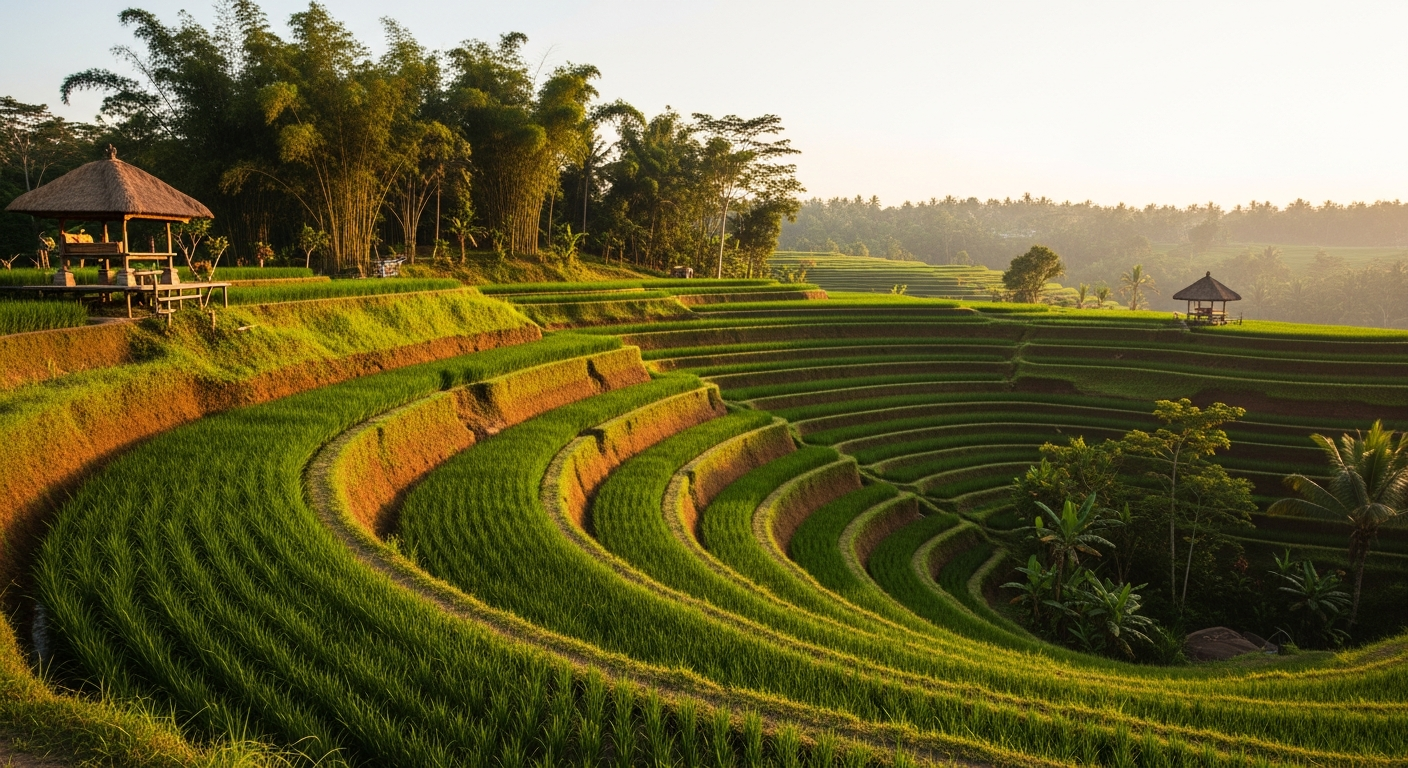
The rice terraces at Tegallalang, twenty minutes north of Ubud, were built using the subak irrigation system, a cooperative water management method developed in Bali around the ninth century and inscribed on UNESCO's list of cultural landscapes in 2012. The subak system is governed by a network of water temples that regulate the flow of water between paddies using religious ceremony as the mechanism of coordination. The result is a terraced landscape that is still functionally productive and several centuries old simultaneously.
Walking the terrace paths is not a photographic exercise, though the photographs are inevitable. The path is narrow, the drop on one side can be two or three metres, and the mud at the base of the paddy walls is the specific mud of irrigated agricultural land. Flat shoes with some grip, hemlines that clear the ground, nothing too pale to survive the walk.
Tanah Lot at the Turn of the Tide
The sea temple of Pura Tanah Lot was constructed in the sixteenth century on a coastal rock that becomes an island at high tide and reconnects to the mainland at low. The building is attributed to Nirartha, a Javanese Hindu priest who is credited with establishing several of Bali's sea temples in the same period. The architecture is tiered, black stone, the pagoda style of Balinese Hindu temple construction, and the silhouette against the sunset has been reproduced in enough images that it has almost become abstract. In person, at the actual hour of low light, it is still compelling in a way that the photographs do not fully communicate.
The most direct access to the temple base requires crossing a low rock formation that is slippery with seawater and algae. Bare feet or rubber-soled shoes only. The ceremony area closest to the entrance is accessible throughout the day. The inner temple is restricted to observant Hindus. Both facts are posted; respect for both is expected.
Seminyak and the Evening Register
Seminyak is Bali's adult resort district in the practical sense: the beach clubs are more controlled, the restaurants more designed, the service infrastructure built for international guests with specific expectations. Ku De Ta's beachfront terrace occupies a position where the sun drops directly into the ocean at the horizon line rather than behind land, which is rare on this island. Da Maria, designed by Carl Pickering of Lazzarini Pickering Architects, brings the blue-and-white tile logic of an Italian coast restaurant to a Balinese street corner in a way that is deliberate rather than incongruous.
Evening dress in Seminyak follows the logic of the beach club circuit: elevated from daytime, not formal, never overdressed for the heat. The temperature at eight in the evening runs between twenty-six and twenty-nine degrees throughout the year. A backless dress in a light fabric reads correctly in this environment. The underpinning has to be as invisible as the design intends. For a wedding or ceremony evening, medical-grade silicone covers from Korea, less than half a millimetre at the edge, hold through a dinner that begins at sunset and ends after midnight in the specific combination of heat and sea breeze that defines a Seminyak evening. The adhesive releases cleanly. Nothing transfers to the fabric.
The Ceremony Itself
Balinese weddings, the traditional version, are administered by a pemangku, a temple priest, and involve purification rituals, offerings, and a formal exchange of betel nut whose symbolism traces to pre-Hindu Austronesian tradition. International destination weddings on the island exist alongside this tradition rather than in replacement of it. The venues that handle them well are the ones that design around the local ceremonial logic rather than importing a European format into a Balinese setting.
The Kayon Jungle Resort in the hills above Ubud built its ceremony structures in bamboo, the traditional Balinese building material, and positions the main pavilion so that the rice fields are visible on three sides. Tanah Gajah, a grand estate surrounded by working paddies, operates differently: the scale is more formal, the grounds more manicured, but the paddies are real and farmed. Both read authentically because they are authentic in different registers.
What to Pack
The island's activities require a range across a single day: temple visits require covered shoulders and a sarong over the lower body, which every entrance provides for a small fee. The ceremony setting may be jungle, cliff, or rice terrace, each with its own temperature and terrain logic. The evening, in Seminyak or at a hillside restaurant in Ubud, requires something considered. The packing logic that works: two dresses that read for evening, one piece that works as ceremony guest attire with a shawl addition, a sarong that doubles as a beach and temple cover, good flat sandals that cope with uneven stone.
Bali is five hours ahead of mainland Europe on the same international circuit of destination wedding locations. It costs more to reach and requires more time to justify. The couples who choose it over the Amalfi Coast or the Algarve choose it because they want the ceremony to mean something specific: a place where ceremony itself is embedded in the landscape rather than hosted by it. If that is the intention, the island is extraordinarily good at delivering it.
Packed beside the linen. Designed to disappear.


