
The short answer: before hair, before makeup, first. Silicone covers and an adhesive bra need warm, dry skin and about twenty minutes of stillness to bond fully. Put them on right after the shower. Do it before anyone touches your hair. Placed later, in the rush before the photographer arrives, the adhesive never gets the time it needs. The foundation goes on first. The rest of the morning follows from that. Everything below is the longer answer: the order that actually works, hour by hour, and why most checklists get it wrong.
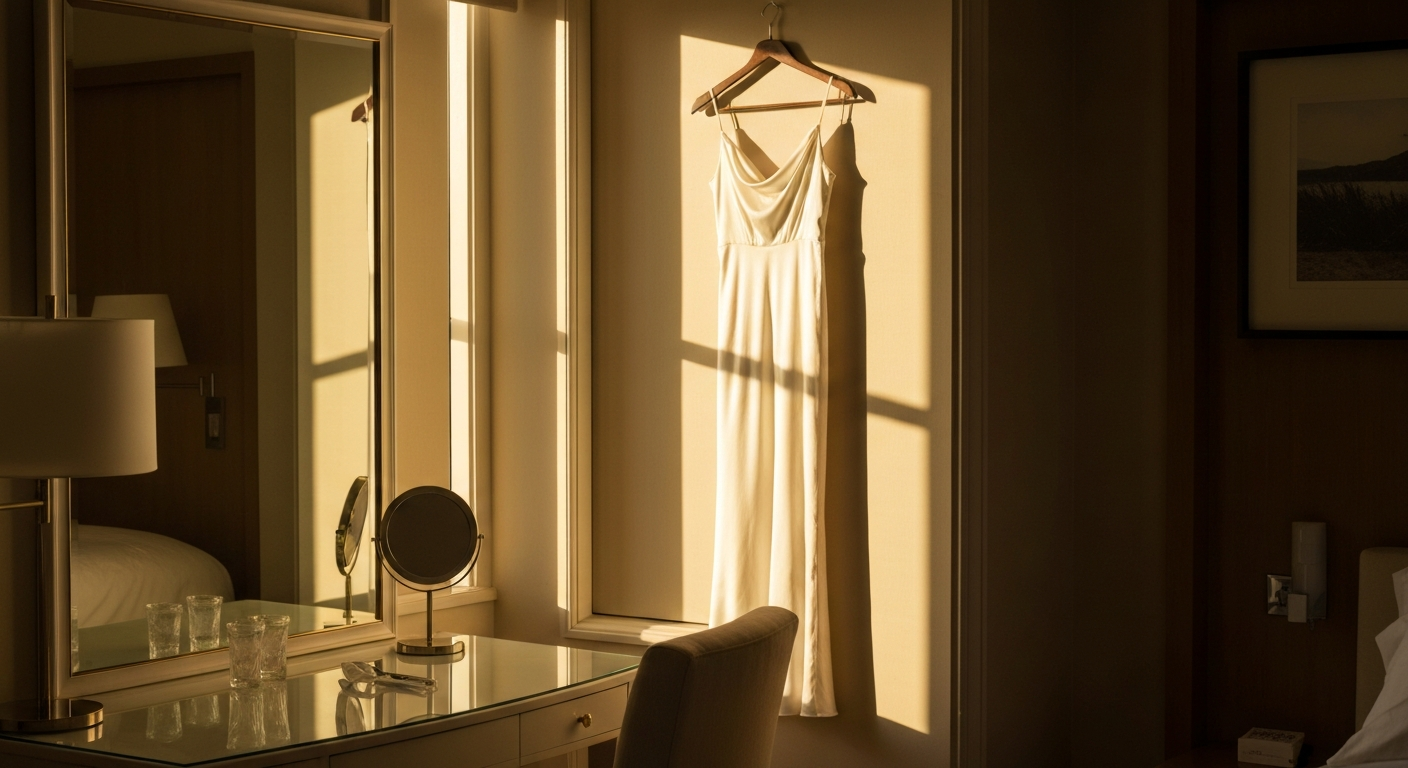
At seven in the morning in a hotel suite in Cascais, the light comes through the east-facing window in a way it will not come through any window for the rest of the day. It is low and direct and golden, and it falls across the dressing table and the dress on its hanger and the faces of the women in the room before anyone has decided to be photographed. The photographer, Ana Roquette, who has been working weddings in this stretch of the Estoril coast for fifteen years, arrives at seven-fifteen specifically for this light. She photographs the dress first. Then the table. Then the people at the table, in whatever state they are in, before the performance of getting ready has fully begun.
What she captures in those forty minutes before eight o'clock is, by her account, consistently the best work of the day. The light is not repeatable. The faces in the morning, before the makeup is complete and the hair is set, have a quality that the finished photographs cannot fully replicate. The private hour before the public one is where the real images live.
The Sequence That Actually Works
A wedding morning has a shape that most checklists distort by flattening into a list. The list treats all items as equivalent: hair, makeup, dress, bouquet, veil. But these items are not equivalent in their demands on time, in their sensitivity to order, or in their relationship to the photography that is happening throughout.
The sequence that works begins with the foundation, before hair, before makeup, before anything that requires arms overhead or fabric near the face. The reason is practical: foundation application on a wedding morning requires twenty minutes of stillness and another twenty minutes for the adhesive to reach body temperature and activate fully. An adhesive foundation placed after hair and makeup is placed in a rush, with someone managing the dress and someone managing the veil and the photographer in the doorway. The placement under those conditions is approximate rather than precise.
Foundation first, when there is nothing else competing for attention, sets the base that everything follows from. If the foundation is correct, the dress goes on over it cleanly. If the foundation is incorrect, the correction happens before the dress is involved, which is the only point at which correction is actually possible.
What the Photographer Needs From the Room
Ana Roquette's preparation instruction, sent to every couple three weeks before the wedding: clear the surfaces. Not permanently. Not for the whole morning. For the forty minutes she is there before the main work begins. The vases of flowers, the bags, the bottles and cards and gift boxes that accumulate in hotel suites before a wedding, all of it moved to the bathroom or the corridor for forty minutes, returns the room to a version of itself where the dress and the light and the people are the subject rather than the background.
The photographer is not asking for a styled room. She is asking for negative space. The dress on the hanger in front of the window. The shoes on the floor below it. The table with three things on it rather than thirty. The photographs from these forty minutes, consistently, are the ones the couple orders reprints of two years later.
After forty minutes the room can return to what it was. The morning continues. But those forty minutes, protected from the accumulation that happens naturally in a shared space on a charged morning, produce images that the afternoon cannot replicate regardless of how beautiful the venue is or how correct the light becomes at golden hour.
Time as a Material
The getting-ready schedule on a Portuguese or Spanish wedding is almost always running fifteen minutes behind by eight in the morning and forty minutes behind by ten. The buffer is not optional. It is the design condition. A schedule with no buffer has no capacity for the one thing that will go differently than planned, and something always does.
Maria Tavares, who coordinates weddings across the Alentejo and the Algarve, builds forty-five minutes of dead time into every morning schedule. Not time assigned to a task. Time assigned to nothing. The forty-five minutes exists to absorb the delay that will happen without being able to predict where it will happen. The florist arrives ten minutes late with the bouquets. The photographer is delayed leaving Evora. The seamstress who was supposed to arrive at nine for final adjustments is there at nine-twenty. None of these are failures. They are the texture of a morning shared by twelve people across two counties.
The forty-five minutes absorbs them without the morning becoming a recovery operation. Without it, the recovery begins at ten and does not end until the ceremony, and the photographs made during recovery look different from the photographs made during calm.
The Foundation Window
Within the getting-ready sequence there is a specific window for foundation placement that most mornings do not protect. It is the twenty-minute interval between the completion of hair and the beginning of makeup, when the hands are free, the face is clear, and there is no competing demand on attention or assistance.
This is when the silicone covers go on. Before the dress. Before the veil. Before the stylist returns for the final check. In this window, with the light from the window and no one else in the bathroom, the placement is done correctly once: centred, at the right height for the dress's neckline, with the full twenty minutes of warmth-activated adhesive that the instruction says is required and that the instruction means literally. The adhesive releases cleanly at the end of the night. It holds through everything in between because the application window was protected when it needed to be.
Medical-grade silicone covers from Korea, ultra-thin at the edge, less than half a millimetre at the perimeter, are not visible under fabric of any weight. The architecture depends on placement done under conditions of attention rather than conditions of rush. The twenty-minute window is not a luxury. It is the condition the product requires to do what it is designed to do. Find it in the schedule and protect it. The full placement protocol, including how to confirm positioning before the dress goes on, is in the wedding day lingerie guide.
What Goes on the Table
The getting-ready room accumulates objects the way a kitchen accumulates dirty dishes during a long meal: continuously, without intention, until the surfaces are covered. The morning before a wedding is a particular version of this: gifts from the wedding party, cards from family, the bouquet, the veil in its box, the shoes, the clutch, the emergency kit that every bridal checklist includes and that actually contains, on most mornings, a safety pin, a stain pen, a painkiller, and some tape that someone found at the venue office.
Two things belong on the table during the photography window. The shoes, if they are important to the story. The jewellery, if it has meaning. Everything else should be somewhere else until the photographs of the table are done. This is not about creating a styled surface. It is about creating a surface that the camera can read without the eye having to work against the clutter to find the subject.
The Hour Before the Ceremony
In the hour before leaving for the ceremony, the morning changes character. The private part ends. The performance part begins. The hair is complete. The makeup is complete. The dress is on. The room, which has been a working space for four hours, is now a stage set for the final photographs before the exit.
This is when the full-length photographs happen. The veil, the bouquet, the dress in movement. The photographer is looking for one or two images from this section that summarise the morning: the dress from behind, the shoes on the threshold, the hands holding the flowers against the fabric of the skirt. These images require the room to have returned to the ordered state it was in at seven-fifteen. Whether it has depends entirely on whether anyone thought to return it.
The most reliable instruction for this: assign one person in the room to manage the surfaces. Not the person doing hair. Not the makeup artist. Not the mother. One person whose only job in the last hour before the exit is to move things off surfaces and into bags. This person is invisible in the photographs and responsible for the quality of the photographs more than anyone except the photographer herself.
What Cannot Be Planned
Every wedding morning has one moment that was not in the schedule and cannot be planned for and is, in most cases, the moment that the day is remembered by. Not the ceremony. Not the first dance. The morning moment: the grandmother who arrives without warning and sits down on the end of the bed and says something true that she has been keeping for this day. The sister who starts crying while trying to fasten the veil and cannot stop and the room holds still around her. The late-arriving bouquet that turns out to be more extraordinary than the sample.
These moments happen in the space between the scheduled items. They require the schedule to have been loose enough to contain them. A morning with no buffer, where every minute is assigned to a task and every task is already running late, has no capacity for the unplanned moment. The morning with forty-five minutes of nothing has exactly enough capacity.
The getting-ready hours are the most photographed interval of the day and the least controllable. The work of planning them is not the work of controlling them. It is the work of creating the conditions where the unplanned things that matter have room to happen, and the photographer is present when they do.
The back is open. What holds her disappears.


