
The City That Schedules Around the Heat
Barcelona is not about the morning. The city runs a schedule calibrated to its climate: lunch at two, siesta through the afternoon, dinner at ten or later, then the streets that fill after midnight and empty around three. In July and August, when the temperature sits between thirty and thirty-five degrees until nine in the evening, this is not a cultural affectation. It is the only schedule that makes sense. Whatever gets worn to dinner at ten, and to the streets after it, keeps the same silicone covers underneath, nothing else decided yet.
The tourists who arrive with northern European timing, who eat dinner at seven and wonder why the restaurants are empty, are eating in a city that has not started yet. The Barcelona that the city considers itself operates four hours later than this. You adjust, or you spend the week in the wrong city.
The Gothic Quarter: The Oldest Part of the Grid
The Barri Gòtic was built on the site of the Roman city of Barcino, founded in the first century BC. You can see the Roman walls in the basement of the Barcelona History Museum on Plaça del Rei, where the foundations of the original city are preserved at the level of the original ground. Above them, the Gothic Quarter accumulated its current form through the medieval period, with the cathedral of Barcelona, properly called the Cathedral of the Holy Cross and Saint Eulalia, begun in 1298 on a site that had been used for worship since Roman times.
The streets of the Gothic Quarter are too narrow for cars. The lanes in the tighter sections are too narrow for two people walking with bags on each side. Shift anything you are carrying to the front. This is useful information. The narrowness is also the point: the buildings block the sun until late afternoon, the stone retains the cool of the night, and by seven in the evening the quarter is the most comfortable outdoor space in the city.
Where to Eat, and When
Bar la Plata, on Carrer de la Mercè in the Gothic Quarter, has been serving the same four dishes since 1945. Pescadito frito: small fried fish from the nearby port, eaten standing or at one of the few small tables, with house wine in a ceramic glass. The bar is the size of a corridor. There is no menu beyond what is written on the wall. It has been this way for eighty years and shows no interest in changing. This is the kind of establishment that makes all other information about Barcelona restaurants supplementary.
Sensi Tapas, on Carrer Avinyó, offers the more contemporary version of the same logic: squid-ink paella, octopus confit, oxtail croquettes in a space that leans into the tropical warmth of the summer evenings without abandoning the Gothic Quarter's stone seriousness. The patatas bravas here use a sauce that has been adjusted over years to something precise. You notice the adjustment without being able to name what was adjusted.
La Alcoba Azul, the flagship location of the Alcoba group since 2007, operates on the principle that the best dining room in the Gothic Quarter is the one that understands it is competing with the street for the guest's attention. The solution is to make the interior feel like an extension of the outdoor evening rather than a refuge from it: stone walls, low light, the music at the correct volume, the service without hurry.
Gaudí and the Eixample
Antoni Gaudí was born in 1852 in Reus, seventy kilometres south of Barcelona, and died in 1926 when he was struck by a tram near the site of the Sagrada Família. He worked on the basilica continuously from 1883 until his death, and it remains unfinished today, 143 years into construction, with a projected completion sometime in this decade. Seven of his buildings in and around Barcelona are UNESCO World Heritage Sites.
Casa Milà, known as La Pedrera for its limestone facade, was Gaudí's last private commission, completed in 1912. The rooftop, which he called the garden of warriors, is populated with chimneys shaped like armoured figures. The Sagrada Família's towers are visible from it, two kilometres northeast. Gaudí designed the building's structure without a single load-bearing interior wall, using columns and vaulted ceilings, which meant the apartments could be configured in any way the tenants wanted. This was 1912.
Casa Batlló, on the Passeig de Gràcia, was completed in 1906. Gaudí covered the facade in trencadís, a mosaic technique using broken ceramic tiles, in blues and greens that read as scales from a distance. The building was a renovation of an existing structure; what Gaudí produced from it bears no visual relationship to what was there before. The Passeig de Gràcia block that contains Casa Batlló and two other significant modernisme buildings, Casa Amatller and Casa Lleó Morera, is called the Manzana de la Discordia: the block of discord, named for the argument that three significant architects effectively had, in stone, over the same city block.
The Rooftops
Barcelona's rooftop culture runs from May to October. The best ones are not the ones with the most direct Sagrada Família views, which are crowded and priced accordingly. La Terraza del Central, at the Hotel Arts in the Barceloneta, has a pool and a view of the sea on one side and the city on the other. The crowd here is the crowd that knows the city well enough to have opinions about it.
Brummell Hotel's rooftop, in Poble Sec below Montjuïc, looks north across the city at a height that flattens the grid of the Eixample into something legible from above: the long diagonal of the Avinguda Diagonal, the density of the Gothic Quarter, the green of the Parc de la Ciutadella in the northeast corner. The terrace fills at eight and stays full until midnight.
What Summer Evenings Here Require
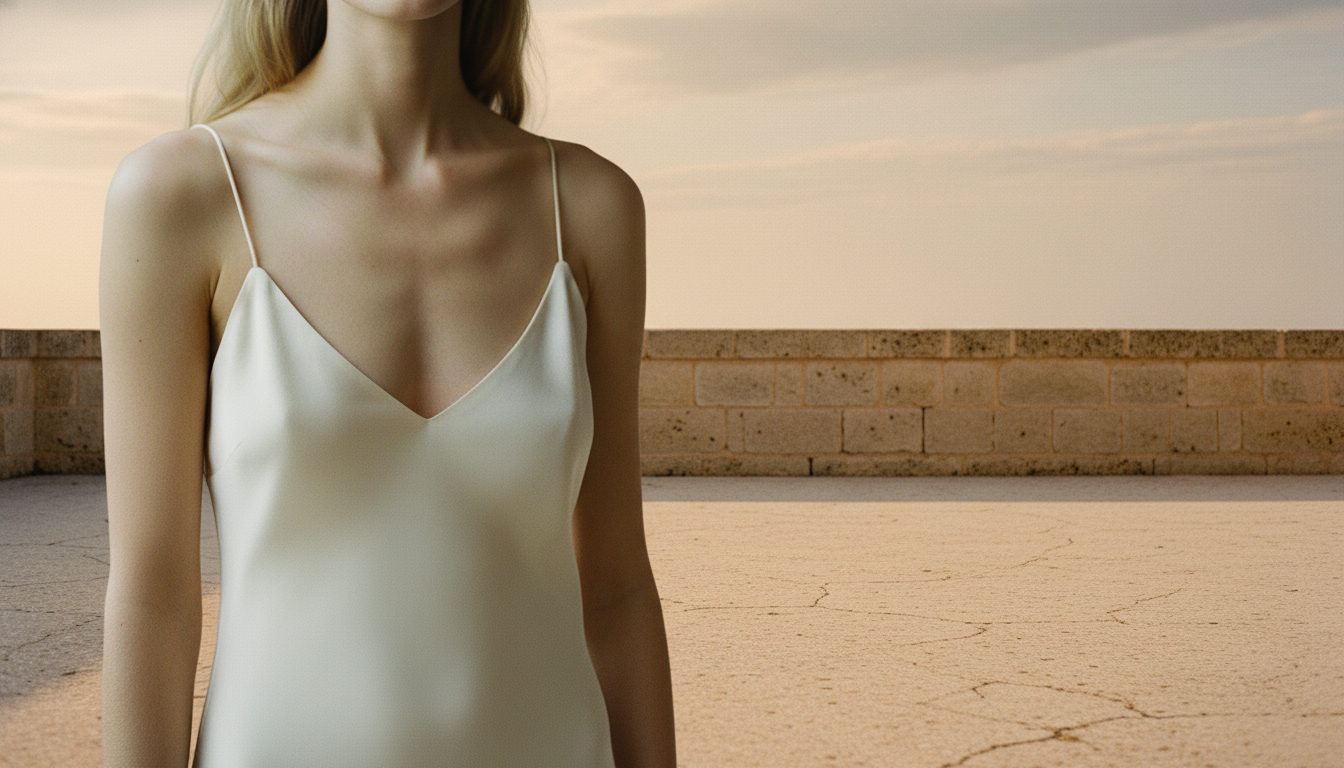
The Barcelona summer wardrobe is built around a specific problem: you are outside from eight in the evening until two in the morning, in temperatures that stay above twenty-five degrees, on stone terraces or in the narrow streets of the Gothic Quarter, with a sea breeze arriving sometime around midnight. The dress that works is light, has some structure, and does not fight the heat.
What works underneath it, for a dress with a bare back or a deep neckline at a rooftop table or a Gothic Quarter dinner that goes past midnight, is invisible by design. Medical-grade silicone covers, Korean-made, less than half a millimetre at the edge. Good for fifteen or more wears. The adhesive holds through the evening and releases cleanly afterward. The dress can do what it is supposed to do. Nothing interrupts it.
For practical guidance on foundations for summer evenings like this, see what to wear under a backless dress. The ultra-thin silicone covers are the version designed for exactly this kind of warmth and length of occasion.
The Timing of Things
There is a moment in the Gothic Quarter, sometime around eleven on a July night, when the temperature has dropped to something close to comfortable and the streets have filled to the point where the noise becomes continuous and the light from the bars spills across the stone lanes and the city is entirely in the present tense. It does not feel like tourism. It feels like living in a city that has been figuring out how to make a summer evening worth staying for across several hundred years, and has arrived at something close to correct.
You eat late. You stay later. You sleep past nine. The city is still there when you wake up, the Gothic Quarter emptier at ten in the morning than it will be at midnight, the cathedral of Santa Eulalia catching the first light, the Roman foundations below it in the dark.
Packed beside the linen. Designed to disappear.


