
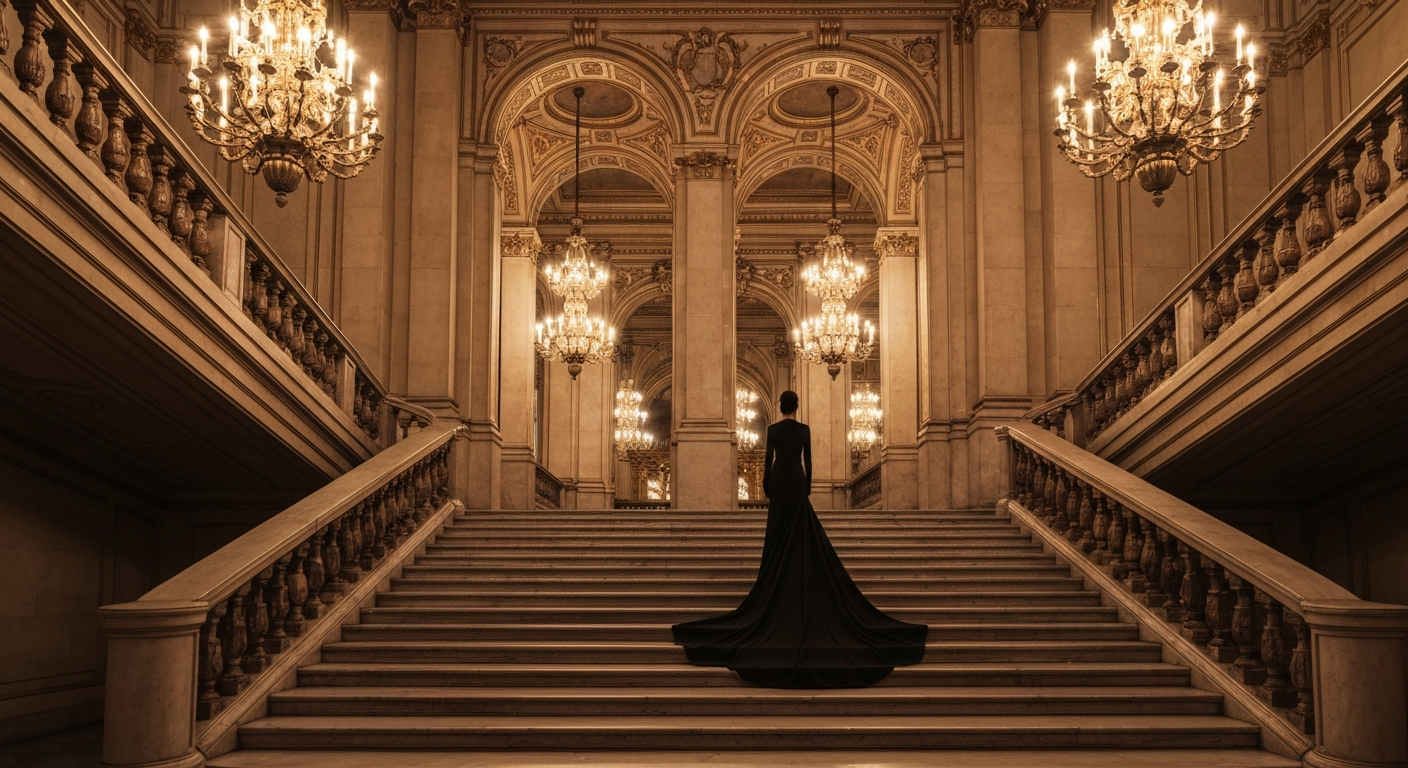
The short answer: it depends on the cut. For most black-tie gowns, silicone covers are the whole answer. A structured column or a boned bodice already does the holding. Covers just keep things quiet underneath. A backless halter or an unboned strapless needs more than that. The Confidence Set adds the lift a bra would give, if the gown had anywhere to put one. Nothing shows. Nothing shifts across a seven-hour night. Everything below is the longer answer: which construction needs which, gown by gown.
The Vienna Ball season runs from November to March. At its height, in January and February, the Wiener Staatsoper hosts the Opernball, and the Musikverein hosts the Philharmonikerball, and the Hofburg holds the Kaffeesiederball and the Juristenball and twenty others in the calendar weeks surrounding them. These are formal occasions with a dress code that Vienna's old families have observed for two hundred years. The women who attend them have dressed for black-tie dozens of times. They have opinions about what works.
The Vienna Opernball runs from ten in the evening until five in the morning. The gown is on for seven hours. The woman who arrives at the Staatsoper at ten and is still dancing in the marble foyer at three has not managed a seven-hour structural achievement by accident. She solved the underwear question before the gown went on. She has been solving it, across different gowns and different occasions, since the first time she got it wrong.
What a Formal Gown Requires
A black-tie gown is a different object from an evening dress. The construction is deliberate, the lines are considered, and the fabric choices are made to serve a specific silhouette. The gown might be a structured column in a heavy satin, a draped Grecian in matte crepe, a backless halter in a silk with a liquid finish, a strapless ballgown with a boned bodice. Each of these has a structural logic that the undergarment either serves or undermines.
The strapless ballgown with a boned bodice is the most forgiving undergarment scenario: the bodice provides its own structure and a good fitting bra stays in place. But even here, the visible line at the top of the cup, the straps that are not quite hidden, the seam that shows through a lighter-weight taffeta, are the difference between a gown that looks as it was designed and one that carries the evidence of what it took to hold it up.
The backless gown is the hardest structural problem. The back opens below the point where any conventional undergarment operates. The result, for most women who have not solved this in advance, is one of three choices: no undergarment, which works for some body types and not others; a bra with the straps removed, which solves one problem and creates two; or an adhesive solution that holds through the evening without interrupting the line of the back. The third option is the one that the gown was designed to work with.
The Four-Hour Test
Black-tie occasions have a duration that formal dinners and theatre evenings do not. The Opernball does not end at midnight. A charity gala dinner at the Savoy in London runs from the cocktail reception at six-thirty to the final auction at eleven. A wedding reception in a country house in the Cotswolds, with its after-dinner speeches and first dance and evening guests, runs until midnight or beyond. The gown is on for four to seven hours depending on the occasion, and the underwear question that was answered at six has to hold its answer through all of it.
Medical-grade silicone covers from Korea hold through exactly this duration. Good for fifteen or more wears. Ultra-thin at the edge, less than half a millimetre, so the neckline sits exactly as the dressmaker intended. The adhesive holds through dancing, through the heat of a crowded ballroom, through the temperature change between the main room and the outdoor terrace where the late guests gather. It releases cleanly at the end of the evening without effort. The gown remains intact. The back remains clean. The structural achievement holds.
The Specific Gowns and Their Demands
The deep-V gown, which the Valentino and Versace archives have produced in every decade since the 1960s and which appears on every black-tie invitation as the choice of the woman who has decided against hesitation, requires a covering solution that sits below the point where the V opens. The lower the V, the lower the solution needs to sit. For a V that opens to the sternum, the standard positioning works. For a V that continues past that, the placement needs to be lower and the coverage narrower. The asymmetric single-shoulder gown, a silhouette from Givenchy's 1950s work that has never left the formal dress vocabulary, requires the solution on one side only, with nothing visible on the side that is bare.
The strapless fitted column in a heavy-weight silk or satin carries its own structure well enough that the undergarment question is lighter than it appears. The fabric itself holds the shape. What is needed is coverage that does not add volume where the gown has none. The covers that sit completely flat under fabric weight, with no cup structure and no vertical seam, serve this silhouette better than any molded undergarment designed to add shape rather than disappear.
The Dress Rehearsal
For a gown that is worn once or twice, the dress rehearsal is not optional. The gown goes on at home, before the occasion, for two hours. You sit in it. You walk in it. You check the back at a distance, not a hand's-width from the mirror. You discover, at home, whether the solution you chose holds through the full range of movement. If it does not, you have time to adjust. If you discover it at the venue at eight, you have forty minutes until dinner is served and no options.
This is the preparation that the women at the Opernball perform and that women arriving at a first formal occasion do not. The dress rehearsal is not vanity. It is engineering. The gown is a complex structural object. You are the person responsible for making it work for four to seven hours in a public room. The rehearsal is the testing phase.
The Back of the Room
Black-tie occasions are the moments when the back of a dress receives as much consideration as the front. The receiving line, the seating chart, the procession to the table: these are occasions when the back is visible, often at a distance, to a large number of people simultaneously. The clean back of a backless gown at a formal dinner is not an aesthetic detail. It is the structural proof that the preparation was done.
At the Kunsthistorisches Museum's gala evenings in Vienna, in the main hall under Klimt's ceiling decorations and the Flemish masters on the upper floor, the light comes from above in a way that makes the back of every gown visible from across the room. In the Hall of Mirrors at Versailles, at the formal dinners that the French state hosts for visiting heads of government and that the press photographs the length of, the backs of the attending women are as public as their faces. These are extreme examples. The principle holds in every formal room: the back needs to be as prepared as the front.
The guide to formal occasion underwear covers the full range of gown structures and their specific requirements. The covers that make the backless gown work are the same ones that have been on the backs of women at formal occasions from Lisbon to Vienna for fifteen wears and more without the adhesive giving out.
The Opernball ends at five in the morning in the traditional observance. The last waltz is played, the chandeliers are at full, the marble floors of the Wiener Staatsoper hold the assembled couples of six hundred years of formal dancing tradition. The women in the long gowns who are still there at five, who arrived at ten and stayed, have been wearing the same undergarment choice for seven hours. It held. The evening was possible because the morning preparation was thorough. Nothing less and nothing more is required. That is what black-tie asks, and that is how it is answered.
The hours are long. The covers outlast them.


