
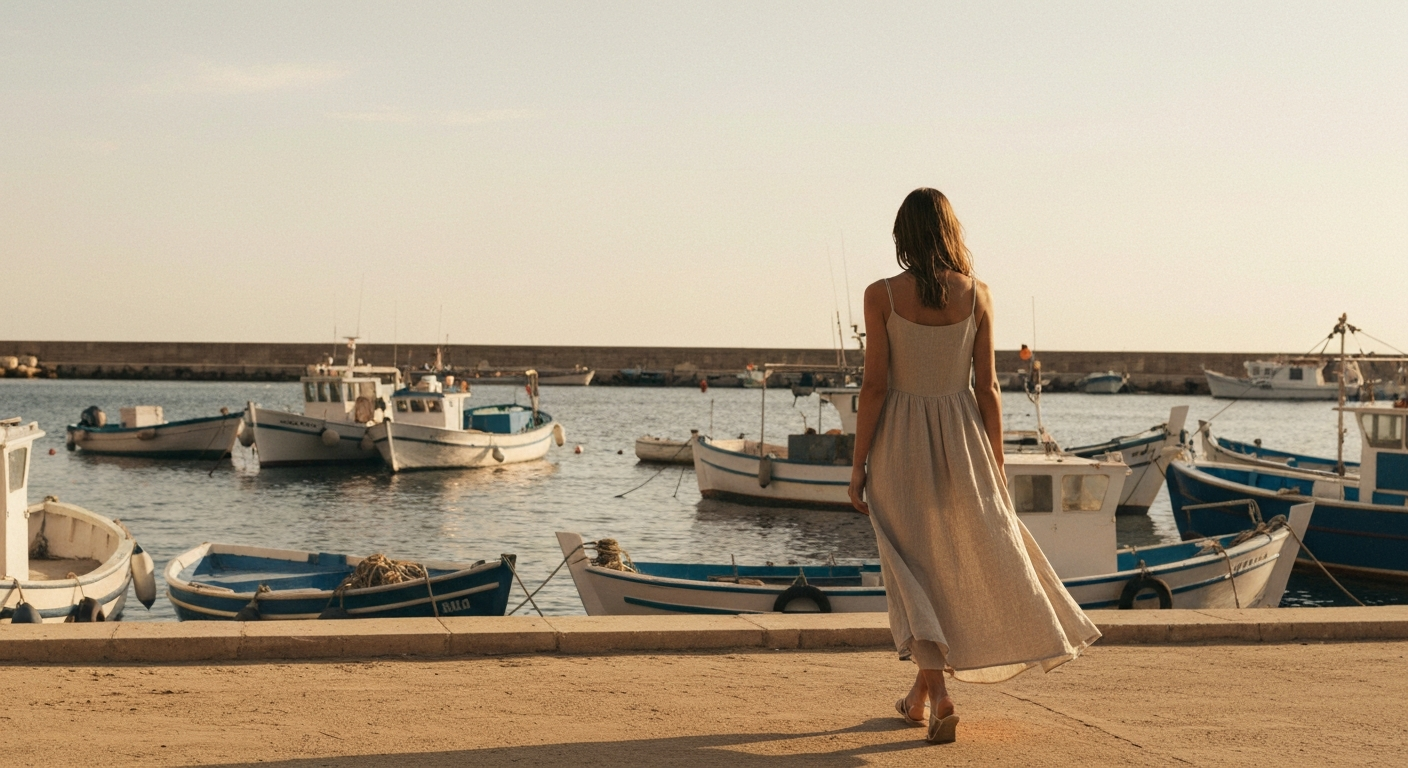
The boat docks at Parikia harbour at five-thirty. You have been in the Aegean for four hours. Salt has dried in your hair and left a faint mineral film on your arms, the way it does nowhere else in the world. Dinner is at nine at a table you booked three days ago at a place on the waterfront in Naoussa, which is forty minutes north by bus and is, in August, the most beautiful restaurant in Greece. You are not going back to the room. There is no logic to going back to the room. The question is what you put on at the dock, and increasingly the answer starts with a pair of silicone covers going on dry before anything else does.
The beach-to-dinner transition is one of those problems that sounds trivial until you have solved it wrong. Getting it wrong looks like this: a damp towel folded over a bag that is now also damp, flip-flops on a restaurant floor where the other guests are wearing silk, a dress that would have been fine this morning but has spent the afternoon in a beach bag and has opinions about it. The woman who got it right did not solve the problem at the dock. She solved it before she left the hotel room in the morning.
What the Day Asks of the Garment
A Mediterranean summer day is not a single occasion. It is three or four occasions wearing the same clothes. The morning is a market or a boat or a walk on stone paths above a bay. Midday is direct sun at a temperature that makes you feel the weight of every fabric choice. The afternoon is either the sea or a long lunch that has become an afternoon. The evening is a table at a place that earned its reputation.
Linen handles this range better than anything else, which is why every woman in Antiparos and Positano and the hill towns above Dubrovnik's old city has been wearing it since the ferry arrived. Not linen as a trend. Linen as physics. The fabric breathes through direct midday heat, takes the shape of the body without insisting on it, and carries into an eight o'clock dinner without declaring itself beach clothes. In natural tones, a pale bone or warm sand, it photographs against whitewashed stone the way the light intended.
The cut matters as much as the fabric. A slip dress in bias-cut linen does everything: it packs without protest, dries quickly if it catches spray from the bow of a water taxi, and at a candlelit table at nine it reads exactly right. The Cyclades have an informal but clear dress logic: good quality, nothing performing, nothing requiring. The guests at Barbarossa in Naoussa, or at the harbour restaurants in Spetses town, are dressed for an evening that matters to them. They are not dressed for a camera or a room or anyone else. The garment serves the person. It does not introduce itself.
The Neckline Question
The dresses that make the beach-to-dinner transition most cleanly tend to share one structural characteristic: they are not built around a bra. The most useful summer dress is low-backed or low-fronted or both. The underwear logic has to be solved in advance. A visible bra strap at a good restaurant in the evening is a choice that reads as not having thought about the evening. A bra that goes on after the water and stays through beach walking, salt air, and the boat ride back, and then disappears under the dinner dress without marking the neckline or the back, is a different level of preparation.
Medical-grade silicone covers from Korea sit flat under any weight of linen, hold through salt, heat, and the long walk from the dock to the restaurant, and release cleanly at the end of the evening. Good for fifteen or more wears. At a harbour table at nine, with the reflected light from the water playing on faces, the dress is doing all the work. What's underneath serves the dress. That is the correct sequence.
For more on how the neckline logic works across different dress cuts, the guide to what to wear under a backless dress covers the full range. The ultra-thin silicone covers that make the transition possible are worth understanding before you pack.
The Bag Logic
The bag that works for a beach day and a dinner is a specific object. It is not a beach bag. A beach bag cannot go to dinner. A dinner bag cannot hold the day. The object that bridges both is a medium-sized structured tote in canvas or waxed cotton that looks intentional at both ends of the day. Into it goes everything: a linen layer for the evening breeze, the covers in their pouch, a lip colour and a heel that folds flat if the restaurant has stone floors.
The logistics of the change itself take four minutes. At the dock, or at a cafe bathroom, or at the back of the bus to Naoussa: rinse salt off skin, apply the covers, step into the dress, run fingers through hair, add the heel if the floor warrants it. The woman who walks into dinner having spent the afternoon on a boat in the Aegean is not a woman who looks like she spent the afternoon on a boat. She looks like she has been on an island for three days and has the rhythm of it.
What Not to Pack
The single most common packing error for a Mediterranean summer is solving for every possible occasion separately. The woman who brings a beach outfit, a day outfit, a lunch outfit, a dinner outfit, and a going-out outfit has packed five problems and will still stand in front of the case at six in the evening not knowing what to wear. The constraint is not moral. It is physical: the ferry from Piraeus limits you to what you can carry up a gangplank at eight in the morning, and nobody who has done it twice brings more than they can carry.
The Italians have a word for this, sprezzatura, which gets mistranslated as effortlessness and really means the deliberate concealment of effort. The woman in a bias-cut linen slip dress at Barbarossa at nine, who was on a sailing boat at four, has not made the transition effortlessly. She made it in advance. The effort happened in the packing, not at the dock. The result, when the evening light hits the table and the wine arrives cold and the fish is from the sea you spent the afternoon in, is that there is nothing between her and the evening.
The Evening at the Table
The best restaurant tables in the Mediterranean share one characteristic: they are outside and they are at the edge of something. A harbour, a cliff, a square where the evening foot traffic passes at a distance. The tables at Naoussa's waterfront are close enough to the water that the reflected light from the Aegean plays on the faces of the people sitting there at nine. The service is unhurried. The fish arrived that morning from boats you can still see.
This is the experience the clothes are in service of. Not a photo. Not an appearance. An evening in a specific place with specific light and a specific table and a meal that will take two hours because nothing here is built for speed. The dress is not the point. The dress allows the point.
Naoussa in August is as crowded as any beautiful place that has been found. It is still worth finding. The light comes in from the sea at the end of the day at an angle that makes the whitewashed buildings look like they are lit from within. The village was a fishing village before it was a restaurant town, and there are still mornings when the boats come in early and the catch is sorted on the dock before the cafes open. The evening version of that place, candlelit at the water's edge at nine, is the reason people come back to the same island for twenty years.
The transition from the dock to that table is short in distance. Solve the clothes problem in advance and it is short in time too. That is the only logistics question worth answering before you leave.
The hours are long. The covers outlast them.

Matte and invisible under sheer.
€29,90€5,98 a pair
Korean silicone · 15+ wears per pair
“I carry them with me everywhere.”
Carol M.

