
The short answer: silicone covers, and nothing structured. An elopement dress is chosen to travel in a carry-on and fall against the body without help. A bra band interrupts exactly the line the fabric was cut to show. Ultra-thin silicone covers add coverage without adding a strap, a band, or a millimetre of bulk. They pack flat inside the same bag as the dress. The whole point of the dress is that nothing else is doing the work. The underpinning has to agree. Everything below is the longer answer: why elopement fabrics are chosen the way they are, and what that choice rules out underneath.
The legal paperwork for a Santorini elopement is submitted to the Civil Registry Office in Fira at least forty days in advance. On the Oia cliff at half past six in the evening, when the caldera turns copper and the light moves down the white walls in a way that no description fully prepares you for, none of that is present. What is present is the photographer, the celebrant, the two of you, and the decision that a wedding was never about the guest list.
Elopement culture has been quietly recalibrating for the better part of a decade. The couples choosing it are not running from something. They are running toward a specific version of the day, one that does not require a year of logistics management, a seating chart, or the social performance of a two-hundred-person event. They are choosing scale deliberately, and the packing logic, the dress logic, everything follows from that choice.
The Suitcase as Brief
An elopement couple travelling to Santorini or Lake Como arrives with carry-on luggage or a single checked bag. The dress goes into a garment bag that fits in overhead storage or folds into the case in a way that produces minimal creasing on a two or three-hour flight. The dress that requires a separate transport case, the cathedral train, the structured bustle, the twelve-kilogram ball gown that needs its own dedicated storage at the hotel: none of these are wrong choices for a wedding. They are wrong choices for an elopement.
What works for an elopement is a dress that travels. A liquid-surface silk creases but recovers with steam from a shower. Chiffon folds into almost nothing. Fine jersey is the easiest to transport and the most forgiving in coastal heat. These fabrics share another property: they require nothing underneath them that adds structure or bulk. They are designed to fall against the body as it is, without assistance. The underpinning must be invisible by absolute necessity rather than preference.
Santorini: The Caldera and Its Logic
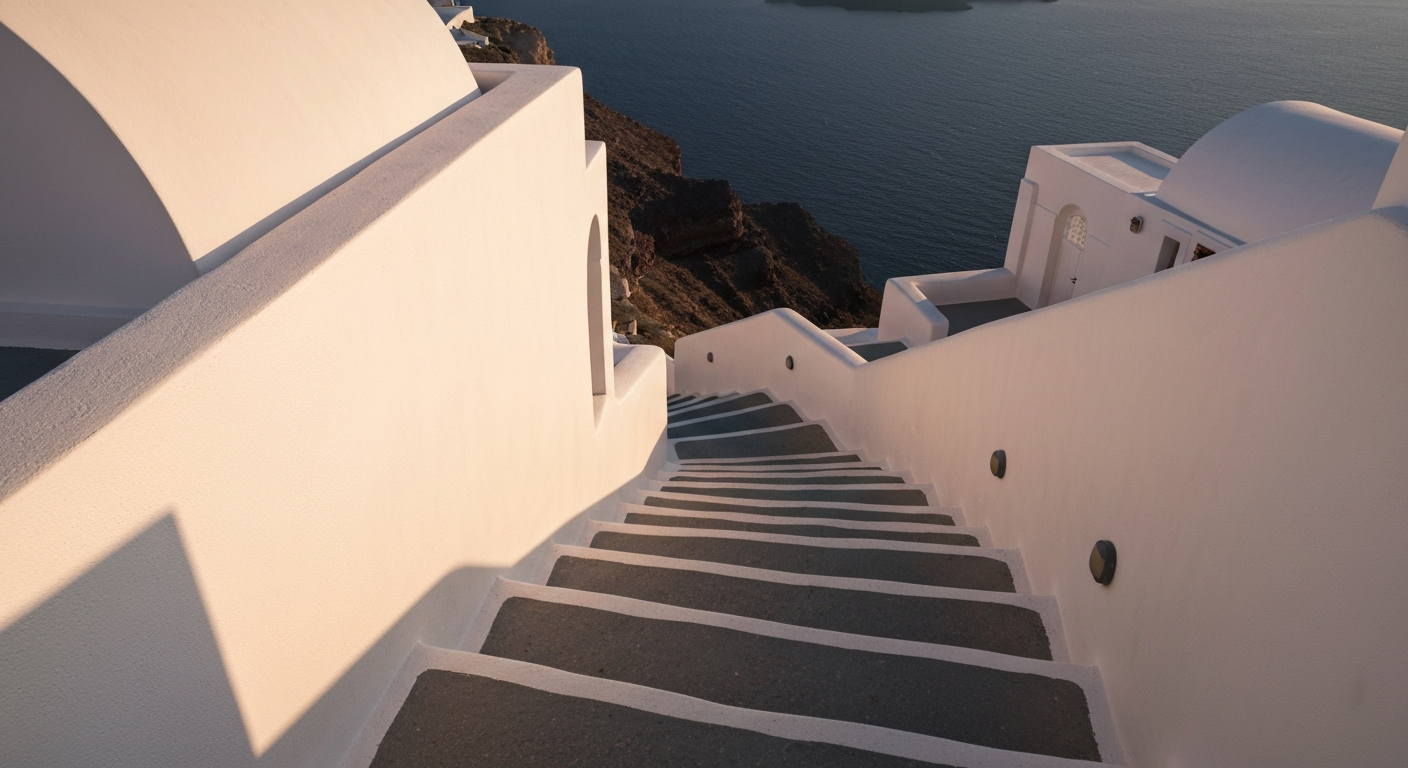
Santorini is three islands arranged around the remnant of a volcanic caldera. The towns of Oia and Imerovigli sit on the rim of the caldera wall, their buildings cut into the pumice cliff and whitewashed to a specific blue-white that absorbs and reflects Aegean light simultaneously. The famous stairways descend several hundred steps from the road to the waterfront. The paths between photo locations in Oia are narrow and uneven underfoot.
A Santorini elopement photographer will typically move the couple through three or four locations: a whitewashed terrace for the ceremony shot, a clifftop position for the caldera view, a staircase for the descent photograph, and a water or cave position for the final images. That sequence involves walking on pumice, stone, and marble-smooth steps for approximately two hours. In July, in the afternoon, the temperature on the cliff face is thirty-two degrees.
The dress that works in this environment is the dress that moves without resistance across a geography that is not designed for formal wear. The underpinning works on the same principle. Nothing that requires adjustment mid-movement. Nothing that shifts on a long staircase descent. Medical-grade silicone covers from Korea, less than half a millimetre at the edge, hold through a two-hour location circuit in Aegean summer heat because the adhesive was designed to maintain contact with human skin across sustained temperature variation. The adhesive releases cleanly at the end. It travels, weighs nothing, and takes up no space in the case.
Lake Como and the Villa Circuit
Lake Como is a different kind of elopement from Santorini. Where the Greek island offers a dramatic natural stage with the caldera as backdrop, Como operates through its built environment. The villas are the landscape: Villa del Balbianello on the Lenno promontory, its terraced gardens and loggia visible from the water; Villa Carlotta in Tremezzo, its camellias and azaleas in full bloom from March through May; Villa Erba on the Cernobbio waterfront, the largest private villa on the lake and now a hotel. The ceremony sits within that architectural context.
The logistics of a Como elopement often involve a boat. The villa access requires a water taxi from Bellagio or Varenna. The dress goes from hotel to boat to villa and back. On the water in April or May, before the summer heat arrives, the temperature is fourteen to eighteen degrees. A wrap or shawl is a practical requirement rather than an optional accessory for the boat transit. At the villa in the afternoon, the terraced gardens are sheltered and warm. The temperature range between boat arrival and ceremony site can be eight degrees.
Lake Como couples with a photographer who knows the villa circuit will typically spend four to five hours on location, moving between exterior terraced positions and interior loggia settings. The dress must work in both. The underpinning must work in both, from the cold of the boat to the warmth of the garden to the cool of the loggia.
The Scottish Highlands: A Different Calculation
Gretna Green has been receiving runaway lovers since 1754, when Lord Hardwicke's Marriage Act raised the legal age for marriage in England without parental consent to twenty-one. Scotland had no such restriction. The Famous Blacksmith's Shop in the village has conducted weddings under the same roof for over two hundred and fifty years. It is now a licensed venue with a registrar rather than a blacksmith presiding, but the legal framework that made Gretna famous remains: Scotland requires fewer advance formalities than England or most European countries for an international elopement.
The Highlands proper, the mountain and loch landscape north of Inverness, is a different proposition from Gretna. An elopement at Eilean Donan Castle on Loch Duich or at Glencoe under the Three Sisters ridge involves weather that a Mediterranean elopement does not. The wind comes off the loch without warning. Rain arrives horizontally. The temperature in May in Glencoe is nine degrees and there is no guarantee it stays there. A Highland elopement dress is a dress that photographs beautifully in full backlighting during the twenty minutes when the sun breaks through, and survives the other three hours with grace.
The packing calculation for a Highland elopement adds one element absent from the Mediterranean brief: a change of outfit for the weather windows. The ceremony outfit is for the ceremony. The walking outfit is for the walk to the ceremony. The transition between the two happens in a car or a venue changing room. The lingerie worn through that full sequence needs to function through both, without requiring its own preparation or adjustment as the day changes.
What an Elopement Photographer Sees
An elopement photographer shoots differently from a wedding photographer. Without a hundred and fifty guests, a receiving line, a table plan, and a six-hour reception to cover, the photographer has time. She uses it on the details: the dress in wind, the hands in close-up, the back during the ceremony, the fabric catching the last light. These are the images that distinguish an elopement archive from a wedding archive. They require a subject who is free of the considerations that crowd a large-scale event.
The photographs from a Santorini caldera sunset or a Lake Como villa terrace are predominantly backlit. The photographer places the couple between the lens and the light source, which at golden hour is low on the horizon. In that configuration, the dress becomes translucent at the hem, the silhouette becomes the subject, and any construction element underneath the dress is visible as shadow or shape to a camera with a wide aperture at fifteen metres. What the dress contains determines what the photograph contains.
The One-Bag Standard
The elopement packing list that survives the carry-on constraint and the two-week itinerary requires a discipline that large-scale wedding planning does not. Every item is evaluated against the question: does this do one thing or two things? A shawl that crosses between ceremony layer and warm layer on a Como boat does two things. A structured boning piece that requires its own storage and serves no purpose beyond ceremony does one. It does not make the list.
Good for fifteen or more wears means the product is not single-use. It goes in the bag before the destination, survives the trip home, and is available for the anniversary dinner in Como two years later when the same dress comes out of the wardrobe for the first time since. The elopement is the day. The dress is the day. The objects that enable the dress to work as designed are the infrastructure of the day. Infrastructure travels light.
After Oia
The photographs from the caldera shoot are ready within a week. The couple is in the images in a way that a hundred-and-fifty-person wedding rarely produces: present, immediate, unmanaged. The light in the final frame is the light that falls on Santorini every evening in July. The dress is the dress that arrived in a garment bag and left in the same one. The background is the caldera, six hundred metres below and a thousand years deep.
There are worse ways to spend a Tuesday in July than standing on that cliff with one person, a photographer who knows the light, and a suitcase that closes without argument.
The back is open. What holds her disappears.


