
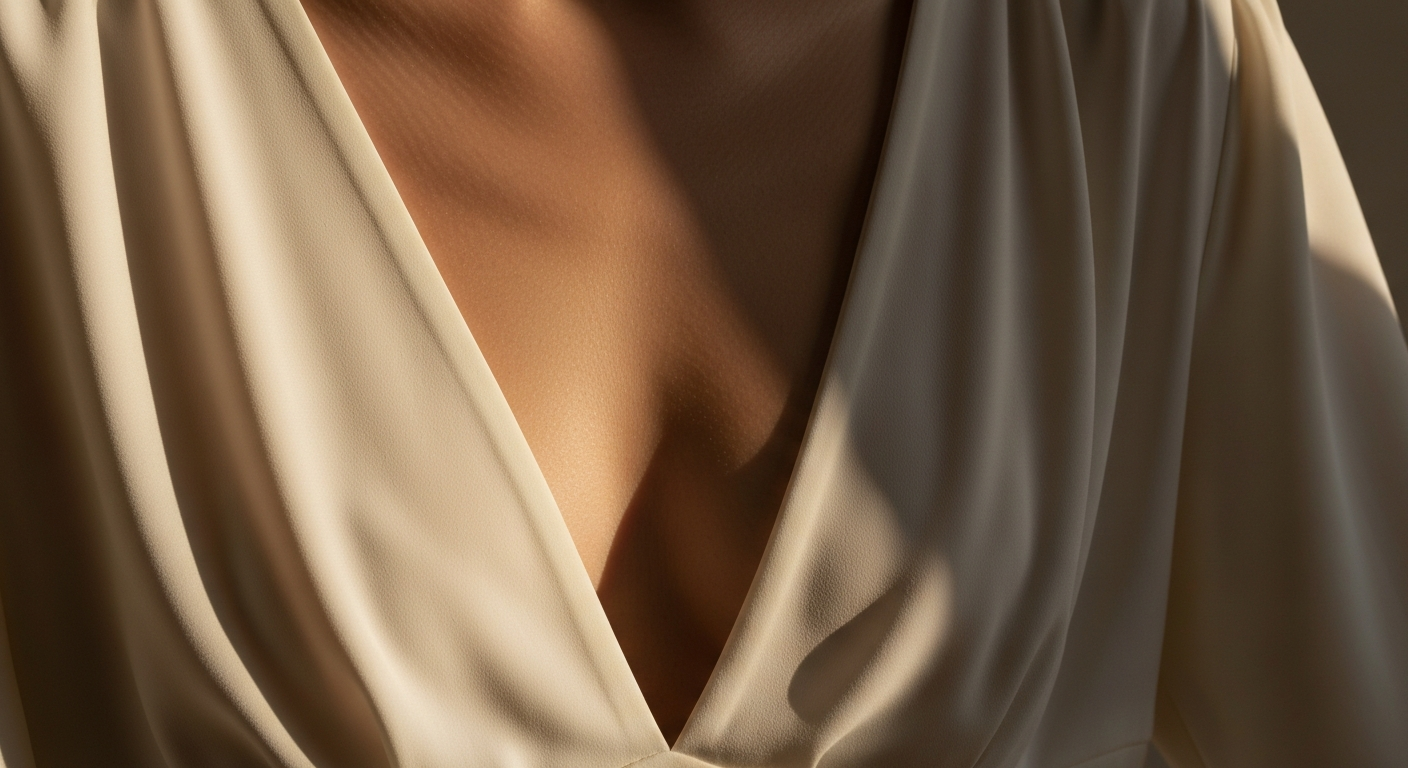
The short answer: silicone covers, placed just inside the edge of the V, not at the centre. A deep V opens past the sternum. Anything with a strap, a band, or lace shows the moment the fabric moves. Ultra-thin silicone covers sit flat against the skin and hold their position through the evening. The V stays clean at any angle the fabric takes. There is no seam to catch the light and no strap to adjust at dinner. Placement is the only real decision left. Everything below is the longer answer: how the geometry of the cut determines where the cover goes, and how far a V can drop before the rules change.
In 1967, Yves Saint Laurent showed a tuxedo dress with a V-neckline that descended past the sternum almost to the navel. The fashion press called it scandalous. Women called it elegant. Both were correct: the deep V is a neckline of contrasts, simultaneously the most dramatic and the most architectural cut in a dress vocabulary that includes the cowl, the halter, the boat neck, and the empire. It creates a clean vertical axis through the centre of the body. It draws the eye down along a line that the silhouette then supports. It is, when it works, one of the most flattering cuts available, because the geometry is doing most of the work.
The deep V has been present in every decade of modern dressing. Diane von Furstenberg built a fashion house on the wrap dress, whose defining characteristic is a soft V that opens as it descends. Tom Ford's years at Gucci produced deep-V evening gowns in silk jersey that became totemic images of 1990s maximalism. The Valentino couture collections of the 2010s under Maria Grazia Chiuri produced deep-V silhouettes in Italian silk crepe that managed to be simultaneously conservative and extreme. The cut is endlessly available because the geometry is endlessly correct.
The Geometry of the V
A deep-V neckline is defined by its lowest point. The critical measurement is where the V terminates on the sternum or abdomen. A V that ends at the centre of the sternum, roughly at the lower edge of the clavicle, is a standard V: elegant, open at the chest, but not architecturally extreme. A V that ends at or below the base of the sternum, approaching the solar plexus or lower, is a deep V by any definition, and the technical requirements are different in kind, not just in degree.
The width of the V at the top matters as much as its depth. A narrow V that descends steeply creates a column of exposed skin framed by close-together fabric edges. A wide V that opens gradually is a different architecture, one that exposes the upper chest broadly before descending. Each has a different effect on the silhouette and a different set of needs beneath it.
The seaming at the edges of the V is the third variable. A V with finished, clean edges in a firm fabric holds its line with precision. The fabric stays where it was cut to stay. A V cut into a bias-grain silk, where the fabric is deliberately cut to move on the diagonal of the weave, has a different relationship with gravity. It drifts. The V widens or narrows depending on how the body moves and how the garment responds to heat. These garments are the ones that require the most attention to both the underlying solution and the fit of the garment itself.
Conventional Bras: The Three Problems
The deep V eliminates the conventional bra with complete efficiency. The neckline descends to the zone where bra gore and centre front sit. Even a plunge bra, designed specifically for lower necklines, reaches a floor below which it cannot descend and still remain functional. Most plunge bras have a centre gore that sits at mid-sternum. A deep V that ends at or below mid-sternum will expose that gore directly. The bra is visible. The architecture is interrupted.
The second problem is the bra cup's inner edge. The triangle of fabric that forms the inner edge of a plunge cup is always visible through an extreme V neckline when the wearer bends forward or turns to the side. The cup is present. The garment is asking you to ignore something that cannot be ignored.
The third problem, which applies to all V necklines and becomes critical as the V deepens, is that a conventional bra changes how the fabric drapes. The V neckline drapes from the shoulder down to its lowest point in a line that is determined by the fabric weight and the cut. A bra cup underneath the fabric at the chest creates a lifted, rounded shape that is inconsistent with the V's intended drape. The fabric that was cut to fall in a specific way falls differently because the bra is creating a different shape at the chest. The V fights the bra. The bra fights the V.
Adhesive and Silicone: What Works at Extreme Depth
The deep V requires front-only coverage with no component that rises to or above the neckline's lowest point. Anything that does will be visible in the V. This means the solution is positioned at the nipple and the immediate tissue surrounding it, and nowhere else.
Adhesive silicone covers positioned correctly on the breast sit below the lowest point of a deep V with significant margin. The covers occupy a zone that the neckline's fabric edges are not near. This is the geometry that makes them right for this problem: medical-grade silicone covers from Korea, ultra-thin at the edge, with an adhesive that holds through the length of an evening and releases cleanly afterward. The V behaves as designed. The drape is uninterrupted. The line from shoulder to the neckline's base is exactly what the garment intended.
Skin tone becomes a factor in the deep V context that it is not in garments with more coverage. In a standard dress, a millimetre of misalignment between skin tone and cover tone is invisible. In a deep V, the upper chest and the inner edges of the breast are in full view, and any visible edge on the cover is in a prominent position. This is worth attending to in advance: natural light testing with the garment on, checking that no edge is visible from the angles you will be seen in.
The Wrap Dress Version
The wrap dress is the deep V's most democratic form. The DVF wrap, which Diane von Furstenberg introduced in 1974 and sold 5 million of in its first two years, is a jersey V-front garment where the neckline depth is partially adjustable by the position of the tie. The genius of the design is that the V can be worn conservatively, with the front panels overlapping high, or extremely, with the panels opened to the level of the tie and no further. The wearer controls the architecture.
The wrap dress has a specific additional characteristic: it is a garment with minimal internal structure. The jersey is self-supporting in the sense that it stretches and conforms to the body without needing construction beyond the seams, but there is no boning, no internal stays, no channel that holds the neckline in position. The neckline position is maintained entirely by the tie and the tension of the jersey against the body.
This means the wrap dress is a garment that rewards the right undergarment choice more than almost any other deep-V garment, and punishes the wrong choice more severely. A conventional bra under a jersey wrap reads through the fabric, the band visible through the jersey even when not visible at the V. The breast shape the bra creates is inconsistent with the jersey's natural drape over the body. The garment looks like it is sitting on top of a bra rather than on a body. The silicone cover approach here allows the jersey to drape correctly. The shape is the body's own. The garment is at ease.
The Deep V in Different Fabrics
Fabric changes the practical requirements of the deep V significantly. Silk charmeuse, the liquid-surface fabric that reflects light the way water does, is the most demanding version. The surface is so responsive to touch and movement that any edge, whether of a bra cup or a poorly positioned cover, will be visible through the fabric as a line of different texture. The adhesive surface of silicone covers should be positioned with particular care in silk charmeuse: the cover's edge needs to be genuinely below the fabric edge of the V, not close to it.
Crepe, either silk crepe or the wool crepe used in tailored evening garments, is more forgiving. The texture of the fabric diffuses any line that might show through from underneath. A deep-V dress in a wool crepe, the fabric that Azzedine Alaia used for his body-conscious silhouettes throughout the 1980s and 1990s, can absorb the edge of a cover without showing it. The physics of texture versus smoothness are relevant throughout the decision.
Jersey is the middle ground: more forgiving than charmeuse, less forgiving than crepe. The DVF wrap in its original matte jersey has enough surface variation to absorb minor imperfections. The same design in a higher-sheen jersey, or in the ponte fabric often used for contemporary versions of the wrap, reads more precisely. The closer the fabric approaches a smooth, reflective surface, the less margin for error in the positioning of whatever is underneath it.
The Point at the V
The lowest point of a deep V is a design decision, and different designers make different choices about what that point communicates. In the 1967 Saint Laurent version, the lowest point was a deliberate provocation, the V ending at a place that challenged the period's boundaries. In contemporary luxury fashion, the deep V's lowest point tends to be stabilised with a small hook or interior snap that prevents the neckline from opening further with movement. In mass-market versions, the V often has no such stabilisation, and will open as the garment moves.
The stabilised V is the easier garment to wear because the architecture is fixed. The unstabilised V is the garment where the evening involves managing the neckline, and where body tape applied vertically from the inside of the garment to the chest wall at the point of the V makes a meaningful difference. The tape anchors the lowest point of the V to the sternum and prevents the neckline from opening further than intended. This is a five-minute preparation step that removes a recurring distraction from the rest of the evening.
Jewellery and the V's Architecture
The deep V creates a specific channel for jewellery that no other neckline offers in quite the same way. The exposed sternum and the V shape together form a natural frame for a pendant on a long chain, the pendant descending into the V and landing at or near the lowest point of the neckline. This is a placement that works because the V's geometry directs the eye to its terminus, and the pendant continues that eye movement in the same direction before the garment's fabric takes over.
Necklaces worn at the throat, choker length, compete with the V rather than working with it. They create a horizontal interruption across the vertical axis that the V is establishing. The deep V does not need a necklace. If it has one, it should follow the V's logic rather than contradict it.
Bare is the other correct answer. A deep V on a woman with notable collarbone architecture or good chest proportions needs no jewellery at all. The neckline is the jewellery. Adding to it is addition where subtraction was already the right move.
The Evening Context
The deep V is an evening garment in the fullest sense. It was not designed for the midday meeting or the afternoon appointment. It belongs to the hour when the light is directional, when the table is set, when the company is chosen. In a restaurant with good light and warm walls, a silk charmeuse deep-V in ivory or champagne performs at a level that daylight cannot produce. The fabric reflects the warmth. The neckline frames the face from below. The line from shoulder to the V's lowest point is an axis that the rest of the silhouette orbits.
There is a moment, in the right light, when a well-worn deep-V dress on a woman who has chosen it correctly for the occasion looks like the most complete decision she has ever made. The dress is not performing. It is doing exactly what it was made to do. The engineering is invisible. That invisibility is the point.
For garments where the architectural requirements extend to the back as well as the front: what to wear under a backless dress.
The deep V has been continuous in fashion because it remains correct. The geometry does not date. The line from shoulder to sternum, open to the air, framed by fabric that knows where it is going, is a human silhouette at its most assured. Wear it at the table where the light is right. The rest will follow.
The dress decides what shows. The covers decide what does not.

Matte and invisible under sheer.
€29,90€5,98 a pair
Korean silicone · 15+ wears per pair
“I carry them with me everywhere.”
Carol M.

