
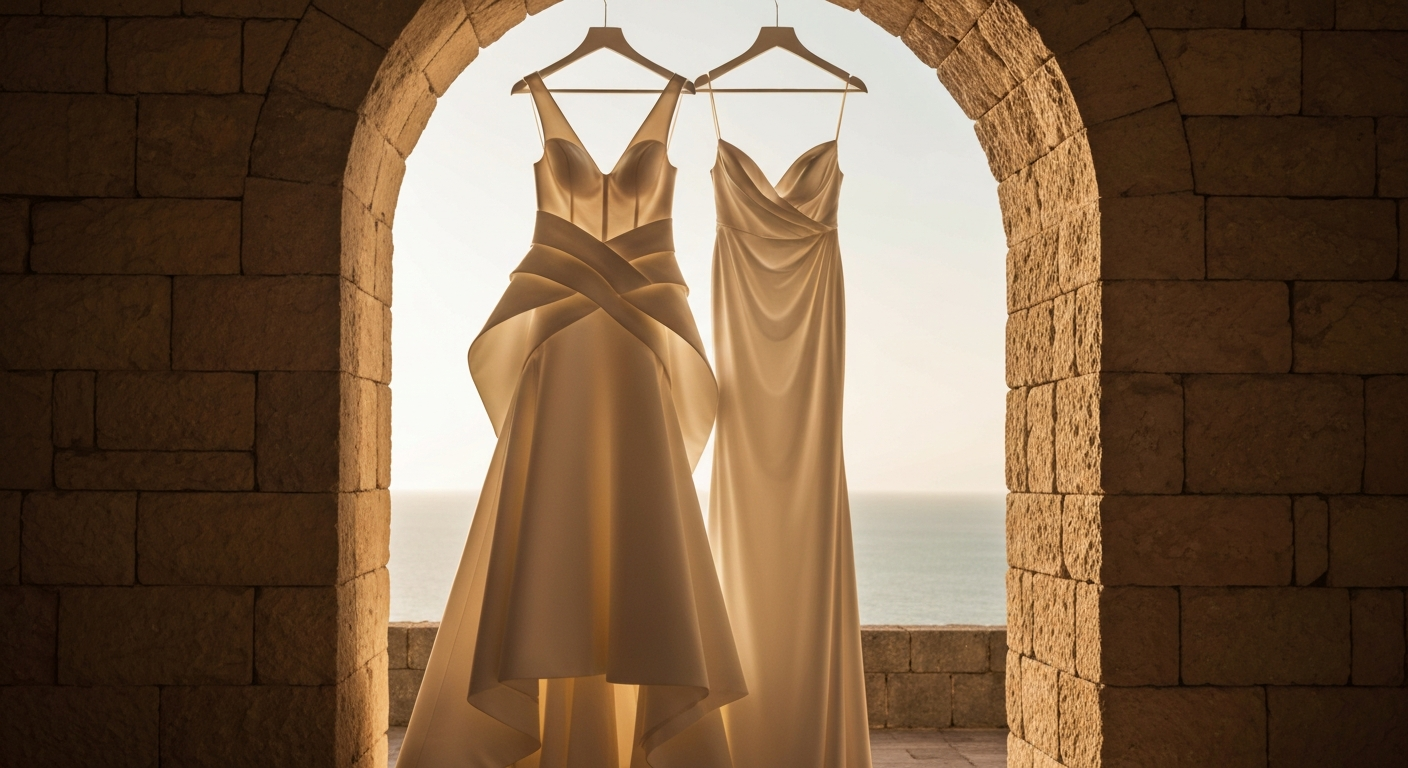
The short answer: covers either way, for different reasons. A structured Rosa Clará gown already has boning built into the bodice; anything more underneath just fights the dress's own foundation. A fluid, bias-cut gown has no structure at all, and the drape shows a seam or a band the moment it catches the light. Ultra-thin silicone covers work under both. Under the boning, they add no extra layer to fight. Under the drape, they print through nothing the fabric can catch. Everything below is the longer answer: what the structured construction already contains, and what the fluid one asks for instead.
Rosa Clará Valls founded her label in Barcelona in 1995 after twenty years working in bridal retail, first as a seamstress and then as a buyer who understood, from the floor up, which constructions actually worked on bodies and which worked only on mannequins. The knowledge she arrived with was not theoretical. It was accumulated from fitting rooms where a gown that had looked flawless on a size-34 sample was being worn by a woman who was not a size-34 sample, and who needed the dress to work for a fourteen-hour day rather than for thirty minutes on a runway.
This background explains the single most distinctive feature of Rosa Clará design: the refusal to commit to a single construction philosophy. Where most bridal designers develop a house signature, a recurring silhouette or fabrication approach that defines their identity, Rosa Clará has consistently produced two opposing architectures that coexist in the same collection. One is sculptural: heavily structured, architecturally precise, using the density of the fabric itself to create a shape that holds without requiring the body beneath it to hold anything. The other is fluid: draped, bias-cut or softly gathered, relying on the natural fall of silk or lightweight crepe to create a silhouette that is about movement rather than stasis.
These two architectures create completely opposite foundation requirements. What works under the structured construction fails under the fluid one, and vice versa. Understanding which category your Rosa Clará dress belongs to is the first decision. The foundation decision follows from it.
The Structured Construction: What It Contains
Rosa Clará's architectural gowns are built from the inside out. The foundation garment of such a dress is the dress itself. A typical structured Rosa Clará column or A-line gown in mikado, compact satin, or a heavy satin contains spiral steel boning in the bodice side panels, flat boning at the front and back centres, a boned waistline seam, and a built-in petticoat layer in the skirt with a horsehair hem to control the sweep. The outer fabric layer in these gowns is under significant structural load. It is not draped over a body. It is architecturally placed at precise distances from the body by the internal structure.
The consequence for foundation planning is counterintuitive: a heavily structured Rosa Clará gown requires the least foundation. Because the dress is providing all structural support, the only remaining question is coverage. The boned bodice holds itself in position regardless of what is beneath it. It does not need to adhere to or be supported by anything worn under it. The woman's body is essentially a form inside the dress rather than a participant in the dress's structural system.
Coverage in this context means one thing: nothing visible at the neckline. A structured Rosa Clará gown with a sweetheart neckline cut to two centimetres above the natural bustline requires a foundation that stays entirely within that two-centimetre margin. An adhesive cover is the only solution that achieves this without either visible edge at the neckline or visible back fastening. The dress is doing all the work. The foundation needs only to be absent.
The Fluid Construction: What It Reveals
The bias-cut and draped gowns in Rosa Clará collections are built on an entirely different engineering premise. A bias-cut silk gown has no internal structure. The bias orientation of the fabric, cut at 45 degrees to the grain, creates a material that stretches diagonally, drapes with unusual weight and fluidity, and follows the contour of the body beneath it with an accuracy that straight-grain fabric does not approach. The drape of a bias-cut gown is entirely determined by the body wearing it. The body is not inside the dress. The dress is on the body, reading every surface it contacts.
This is the construction where foundation choices are most consequential, and where the most common errors are made. Women who are accustomed to wearing structured gowns, where the dress holds itself in shape, arrive at the first fitting for a fluid Rosa Clará in a standard strapless bra or a light body-shaper and discover that the dress reads both of them clearly through the fabric. The top band of the strapless bra creates a horizontal line across the torso that the bias silk amplifies. The seam lines of the body-shaper are visible through the fabric. The underwire, even worn correctly, creates a local change in surface height that the draped fabric traces.
The solution for bias-cut and draped Rosa Clará gowns is the inverse of the structured gown solution: not the absence of a foundation but the elimination of anything with a perimeter, a seam, or a structural edge. The only foundation that passes this test is an adhesive solution applied directly to the skin, creating no perimeter under the fabric, no edge for the bias silk to trace, no seam line to amplify. The medical-grade silicone covers applied to clean, dry skin satisfy this requirement precisely because they have no perimeter that the fabric can read: the petal edge tapers below the threshold of fabric detection.
Reading Your Dress
The practical question is how to identify which construction category a specific Rosa Clará dress belongs to. The category is not always apparent from the showroom appointment, because many Rosa Clará gowns present as simpler than they are. A gown that appears minimal in construction can be heavily engineered internally. A gown that appears structural can be surprisingly fluid once worn.
The most reliable test is to pick up the bodice of the dress without wearing it and observe whether it holds its shape independently. A boned, structured bodice will hold its shape when unsupported. A fluid bodice will collapse immediately into the fabric's natural drape. This is not a styling observation. It is a structural one, and it directly predicts the foundation requirement.
The second test is to look at where the seams are in the bodice. A structured Rosa Clará bodice will have princess seams or panelled seams running from the shoulder or the neckline to the waist or hip, creating the shaped panels that boning requires. A fluid or draped bodice will have minimal seaming, because the bias cut or the draping creates the shape without structural intervention. Few seams in the bodice means fluid construction means adhesive-only foundation.
The Rosa Clará Lace Consideration
Rosa Clará uses lace in several distinct ways across its collections, and each use creates a different foundation situation. Full lace gowns, where the outer layer from bodice to hem is lace over a silk lining, present the transparency challenge: lace is a structure of holes, and what is beneath it is partially visible through those holes. The matte finish of an adhesive cover against the silk lining reads through lace as uniform skin rather than as a separate surface, because the matte finish approximates the diffuse reflection of skin.
Lace panels used as bodice overlays over structured construction are more forgiving, because the boning beneath the lace is doing the structural work and the lace is aesthetic. In these constructions, the lace is not reading the body beneath it. It is reading the boned lining beneath it, and the boned lining is independent of what is worn under the dress.
The most complex situation is the lace gown with no internal structure, a design that Rosa Clará produces across its softer collections. In this case, the lace is acting as the primary fabric layer in a fluid construction, which combines the transparency challenge with the zero-seam requirement. Here the adhesive solution is mandatory, not optional, and the placement against clean skin must be precise enough that the skin beneath the lace reads uniformly through the holes in the pattern.
The Temperature Variable
Barcelona in October, where Rosa Clará holds its primary runway presentations, is not Barcelona in July or August, which is when a substantial proportion of destination weddings that Rosa Clará brides attend take place. The thermal behaviour of the fabric under summer conditions is a variable that the showroom appointment does not test.
Bias silk in a warm ceremony room will cling more closely to the body as both the room and the fabric warm. A bias-cut Rosa Clará gown that was perfectly calibrated at a February fitting at fifteen degrees may behave differently at the same body in a thirty-degree stone church in July. Foundation solutions that were adequate in the cool of the boutique may be insufficient in the thermal conditions of the actual day.
This is an argument for testing the foundation in conditions that approximate the venue's thermal environment, and for doing that test more than once. The second fitting in a Rosa Clará structured-gown scenario is a confirmation. The second fitting in a Rosa Clará fluid-gown scenario is a thermal stress test, and the results deserve to be taken seriously. The morning of the wedding is not the right moment to discover that the July warmth of a Mediterranean stone church changes how a bias-cut gown reads.
The structured and fluid categories are genuinely opposite problems. The relief of knowing which category you have chosen is the relief of knowing which problem you are solving, before you are standing in a fitting room on the morning of the day itself. The foundation timeline that covers when to test, how long to test, and what to do with the results is laid out in full in the wedding day foundation guide.
The back is open. What holds her disappears.


