
The Swiss Alps are not the destination for the couple who wants to be seen getting married. They are the destination for the couple who has already decided that the setting should do all the announcing. Tuscany is about warmth and abundance. The South of France is about light and proximity to a certain kind of social life. The Swiss Alps are about altitude and precision, and both words apply to more than the geography. That precision reaches underneath the dress too, choosing a set of silicone covers over anything less exact.
Gstaad in December
Gstaad in winter operates as a village that has been refined over generations into something almost theatrical in its perfection. The Gstaad Palace sits above the village on a hill, its towers visible from the valley floor, open from December through March. The building was constructed in 1913 and has been run by the Scherz family since 1938. The evening dress code in Le Grand restaurant requires a jacket after seven o'clock. The truffle fondue at La Fromagerie arrives in a pot that has been warming since midday. These details are not incidental. The whole apparatus of the place runs on the understanding that elevation takes effort.
The village itself is small enough to walk entirely in twenty minutes, but that walk changes depending on the hour. At midday in January it is skiers in technical gear moving between the slopes and the lunch terraces. By six it is the same people transformed: wool coats, good boots, a considered piece of jewellery. Gstaad does not have a sign that says dress for evening. It does not need one.
Zermatt and the Ceremony at Altitude
Zermatt sits at 1,608 metres at the base of the Matterhorn, and the Matterhorn is not backdrop. It is presence. The peak reaches 4,478 metres and its profile is recognisable from a hundred photographs, but no photograph accounts for the scale of looking at it from the floor of the valley. The mountain fills the view in a way that is physically disorienting the first time you see it.
The village bans private cars. Movement is by electric taxi, horse-drawn carriage, or foot. This constraint, imposed since 1963, has the effect of making the village feel genuinely unhurried in a way that alpine resorts with their normal traffic do not. Wedding ceremonies in Zermatt happen in the Church of St. Mauritius, a fourteenth-century building with a small graveyard attached containing memorials to climbers who did not come back from the Matterhorn. The proximity of that graveyard to the ceremony space is not cheerful, but it is honest about the place and what the mountain demands.
The Logic of a Mountain Wedding
The alpine wedding has a specific pressure point that other destination weddings do not. The ceremony and reception happen in the same contained geography, often over multiple days, because the logistics of altitude mean guests who have travelled do not leave after the dinner. The wedding becomes a long weekend. The morning after the ceremony involves a shared breakfast and possibly skiing, or at minimum a walk through a village in significant cold. The dress problem is not singular. It is sequential.
The ceremony dress is formal, floor-length by convention in Switzerland, structured enough to hold its shape through the outdoor sections when the mountain wind finds the terrace. The evening is warm inside the chalet or hotel dining room. The dress needs to work under its own terms without a heavy layer underneath. What evening requires at this altitude is a base layer that creates no visible line beneath the fabric and leaves the skin undisturbed through a long seated dinner. Medical-grade silicone covers from Korea solve the problem cleanly: ultra-thin at the edge, less than half a millimetre, invisible under any fabric weight, good for fifteen or more wears. The adhesive releases cleanly. The dress does what the dress was made to do.
For everything that touches the wedding day from foundation to fabric, read the complete guide to invisible lingerie for the wedding day.
Chalet Dinners
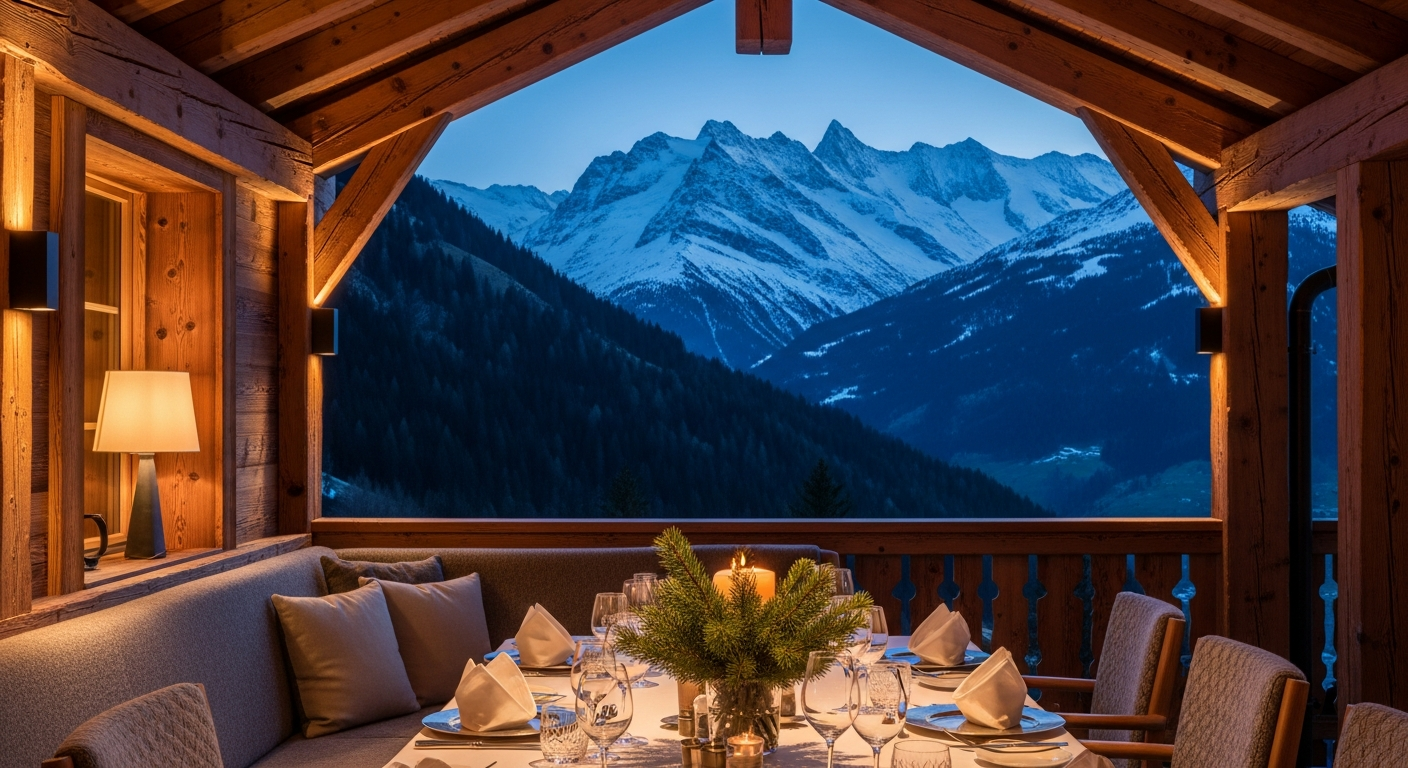
The chalet dinner, as distinct from the hotel restaurant, operates on different rules. The space is usually owned by the family hosting or rented by a group for the week. The table is long. The food comes from a kitchen ten feet away. Someone lights candles at seven and nobody has moved by midnight. This format is the actual Swiss Alps social occasion: not the hotel gala but the private table inside a building that smells of pine and woodsmoke, where the conversation runs long and nobody is watching the clock.
The Alpina Gstaad operates two Michelin-starred restaurants within its building, both accessible to guests, and the wine list runs to over 1,700 selections. But the Alpina is also a hotel that understands the chalet aesthetic well enough to build it into the room design. The distinction between public dining and private chalet collapses in the better alpine establishments. The fire is real. The wood is structural. The mountain outside the window is not decoration.
What the Season Demands
The ball season in Geneva, the January Haute Couture shows whose clients winter in the mountains, the Zurich art crowd who drive up on weekends: the Swiss Alps in winter are not isolated from the European social calendar. They are a particular point on it. The women who come here know how to dress for cold exteriors and warm interiors, for the transition between the two that happens three times a day. The pieces that travel are the ones that read correctly in all three registers: the ski lunch terrace, the hotel lobby at six, the chalet table at ten. Nothing excessive. Nothing that requires attention. The mountain is already attending to that.
The snow in February on the Wasserngrat above Gstaad is undisturbed before nine in the morning. At that hour the light comes sideways across the valley and the village below is still in shadow. It is worth the early start. It looks, for about twenty minutes, like nothing that has been managed or designed.
Packed beside the linen. Designed to disappear.

Matte and invisible under sheer.
€29,90€5,98 a pair
Korean silicone · 15+ wears per pair
“I carry them with me everywhere.”
Carol M.

