
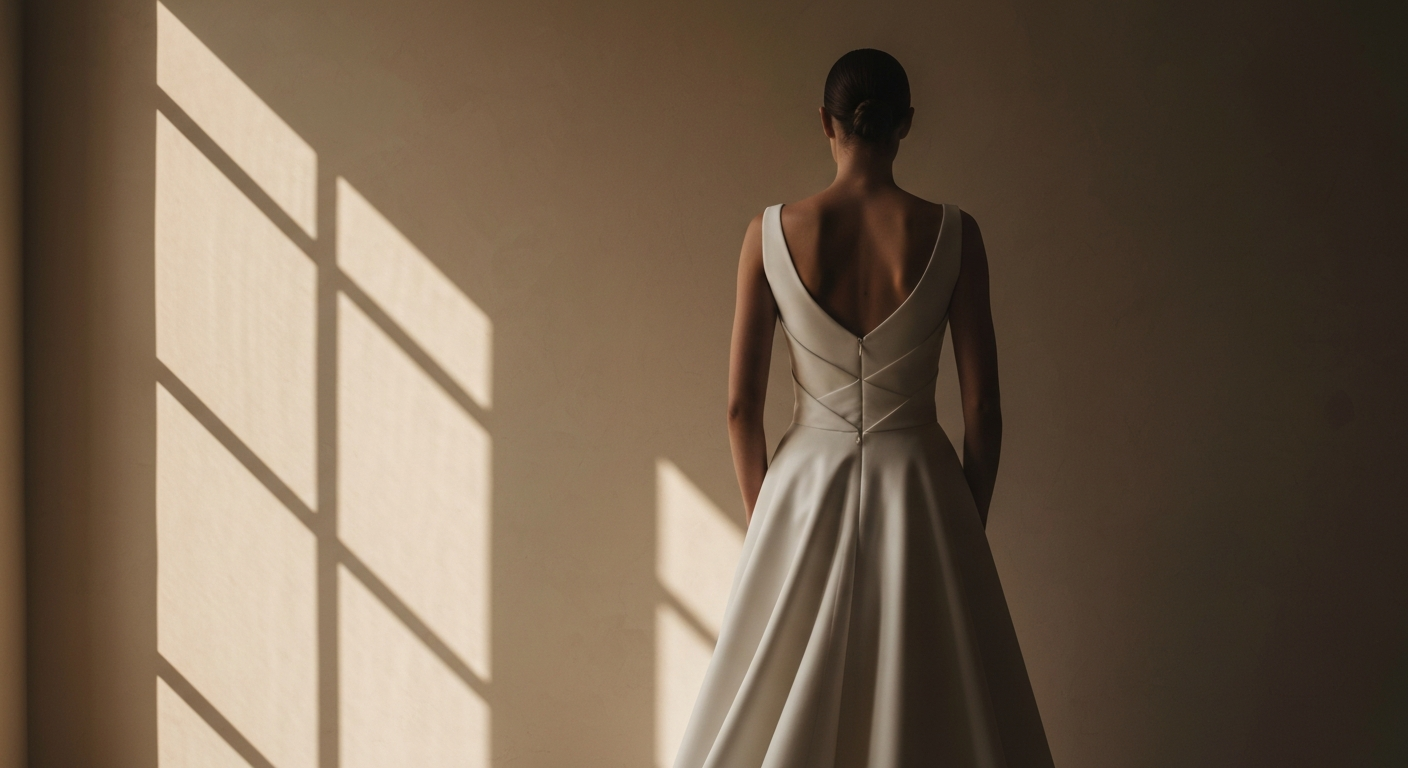
The short answer: silicone covers, then judge the gown itself. A Wang bodice can be heavily boned, raw-edged, draped or cut on the bias. No two solve structure the same way. What every construction shares is skin at the edges that has to read as nothing. Ultra-thin silicone covers do that under any of them. A fully boned column needs nothing more. A draped or raw-edged gown, built from ready-to-wear logic rather than bridal convention, usually needs a fitting first. That confirms what the construction is not providing. Everything below is the longer answer: how Wang's unconventional choices change the foundation question gown by gown.
Vera Wang began her career as a figure skating competitor at competitive level, then spent sixteen years as a fashion editor at Vogue, then two years as design director at Ralph Lauren accessories. She was forty years old when she founded her bridal label in 1990, after she could not find a wedding dress for her own wedding that matched what she understood fashion to be capable of. That biography matters because it explains the design logic of the house with unusual directness. Wang was not a bridal designer who had spent years in the category absorbing its conventions. She was a fashion editor and a former athlete who arrived at bridal with the perspective of an outsider and the resources of a insider, and who found the conventions inadequate.
The result, over thirty-five years, has been a bridal collection that has contested nearly every assumption the category rests on. Black wedding dresses, from the 2012 Fall collection, when black had been unthinkable in bridal for generations. Asymmetric hems at the peak of princess-gown dominance. Raw, unfinished edges when the industry was fixated on precision boning and ball-gown volume. Structured bodices with deliberately distressed surfaces. Draped gowns with construction choices that had never appeared in bridal because they came from ready-to-wear design theory, not from the bridal construction tradition.
The foundation implications of these design decisions are correspondingly unusual. A Wang bride is not solving the standard bridal foundation problem. She is solving a problem specific to the gown she chose, and that problem may have no precedent in the conventional bridal lingerie conversation.
The Deconstructed Silhouette
Wang has returned repeatedly to deconstructed construction across her career. The deconstructed Wang gown typically uses visible structure, raw edges, and deliberate architectural incompleteness as aesthetic elements. A gown where the lining is exposed, where the seam allowances are intentionally visible, where the internal boning channels are part of the surface rather than concealed by it, creates a foundation situation where the normal rules are inverted.
In a conventionally constructed gown, the foundation problem is to prevent the foundation from showing. In a deconstructed Wang gown, the construction itself is showing. The question shifts from hiding the foundation to understanding which elements of the visible construction are intentional and which are not. An unfinished seam on the bodice exterior is a design decision. An adhesive cover edge visible through the bodice interior is not. These are different problems, and conflating them produces the wrong solution.
The deconstructed Wang gown typically has exposed or visible construction at the exterior and requires the same foundation discipline as any other gown at the body-gown interface. The exposure is at the surface, not at the interior. Nothing about showing the construction of the gown exterior changes the requirement that the foundation stays invisible where the skin is the relevant surface.
The Dark Fabric Variable
Wang's black and deep-toned wedding dresses from her 2012, 2016, and subsequent collections changed the photography physics of the foundation problem entirely. In white and ivory bridal, the primary risk is that the foundation creates a visible element against a light ground. Against a dark fabric, the risk reverses: the skin itself is the light element, and any gap between the skin and the dark fabric above it is a window through which the contrast between skin tone and gown reads as visible layering.
For a black Wang gown, the foundation must eliminate not the edge imprint of a circular cover, which is the light-ground problem, but the light-leak problem: the zone around the cover where the skin is uncovered, adjacent to the darker surface of the covered area, creates a visible contrast gradient through the dark fabric above. The solution is a cover with the maximum possible coverage area relative to its visible perimeter, and with a matte finish that minimises the reflectance differential between covered and uncovered skin areas.
This is an argument for understanding that the matte-finish choice has consequences across a wider range of fabric colours than the standard bridal white discussion acknowledges. Against a dark Wang gown, the foundation choice is as technically specific as against a sheer one, but the optical mechanism is different.
The Column and the Minimal Silhouette
Wang has been associated with the minimal column silhouette throughout her career, and some of her most influential gowns have been among the structurally simplest: a bias-cut column in heavy silk charmeuse, a slip-dress silhouette in silk satin, a gown that relies entirely on the weight and quality of the fabric to create its effect without internal structure beyond the minimum necessary for fit.
These minimal Wang gowns are the most demanding in the foundation category because they provide no mediating structure between the foundation and the outer fabric. The gown is reading the body directly, and the foundation is part of the body it is reading. The bias-cut charmeuse column that Wang has used in multiple collection cycles is among the most revealing fabrics in bridal: it is heavy enough to drape cleanly, light enough to follow contour closely, and has a surface that amplifies rather than filters what is beneath it.
Under this construction, the medical-grade silicone covers need to meet three simultaneous requirements: no edge perimeter that the bias fabric can trace, no reflectance differential between covered and adjacent skin, and consistent adhesive hold through the full duration of wear including the sustained skin warmth of a long reception. The bias fabric's thermal behaviour means that surface conditions change over the course of the day in ways that static construction does not.
The Architectural Bodice: Structure Without Convention
Wang's more architectural bodice constructions, particularly from her Spring collections in the late 2010s and through the 2020s, use structural elements borrowed from ready-to-wear tailoring: canvas interlining, precision dart construction, and seam engineering that creates a three-dimensional bodice form without boning in the traditional bridal sense. These bodices hold their shape not through steel but through the structural interaction of their seaming, interlining, and the inherent body of the outer fabric.
The foundation requirements for these tailored-architecture Wang bodices are similar to those for a structured bridal construction in that the bodice is self-supporting, but different in one important respect: the tailoring precision means that the interface between the bodice and the body is exact. There is no tolerance built in for a foundation layer that adds volume or surface texture at the interface zone. A strapless bra, even a minimal one, adds material at the interface and changes the relationship between the bodice and the body. An adhesive cover adds no material at the interface because it has no profile above the skin surface that the boned or tailored bodice would contact.
This distinction matters in a Wang architectural bodice more than in a conventionally boned bridal bodice, because the tailoring precision means the fit was calculated against the body, not against the body plus a foundation layer. The tailored Wang bodice was fitted to the shape of the body it will be worn by. That shape should not change between fitting and wearing.
The Non-Traditional Ceremony Variable
Wang's influence on non-traditional bridal has been extensive enough that her name is now shorthand for a certain category of bride: one who is not planning a white-church-wedding and who is as interested in the reception as in the ceremony. The typical Wang bride context is not a religious ceremony with specific coverage requirements. It is a venue, an event, a night that may involve movement and dancing in ways that a more ceremonial context does not.
Duration and movement are foundation variables that change the ranking of solutions. An adhesive cover that holds for four hours under the conditions of a ceremony may need to hold for fourteen hours under the conditions of a reception that continues into the early morning. The platinum-cure adhesive used in medical-grade covers maintains its hold through sustained skin warmth, perspiration, and movement over this duration in ways that non-medical-grade alternatives do not. This is not a claim that requires special emphasis. It is the direct consequence of the material specification, and it is why the material specification matters rather than being a technical footnote.
The Avant-Garde Silhouette and the Photography Argument
Wang's most avant-garde constructions, the asymmetric hems, the off-shoulder deconstructions, the deliberately unconventional proportions, are also the constructions most likely to appear in editorial and fashion photography rather than purely in ceremony documentation. A Wang bride is statistically more likely than other bridal clients to have professional editorial photography as part of her wedding documentation, and editorial photography means flash photography at close range, multiple angles, and deliberate use of directional light to highlight fabric surface.
The flash photography argument for matte-finish adhesive coverage applies to all bridal contexts, but it applies with particular force to the Wang context because the probability of intensive editorial photography is higher. The matte finish that prevents a glossy adhesive surface from creating a brightpoint in flash photography is not a refinement for perfectionist brides. For a Wang bride whose wedding photographs may be published, it is a technical requirement.
The Starting Point
A Wang gown is a specific design problem, not a category of problems. The deconstructed gown from 2023 requires different analysis than the bias column from 2019. The black gown from 2016 requires different analysis than the architectural tailored bodice from 2021. The practice of mapping each gown individually to its construction type, its fabric behaviour, and its specific foundation-relevant architecture is the same practice that Wang herself applies to design: identify the actual problem before proposing the solution.
What is consistent across all Wang constructions is that the conventional bridal foundation answer, the strapless bra, the light body-shaper, the convertible solution, is wrong for all of them for different reasons. The deconstructed gown does not accommodate the volume. The bias column reads every edge. The dark fabric amplifies the light-leak. The architectural bodice was fitted without it.
The consistent answer, adapted to each construction's specific requirements, is an adhesive solution positioned with precision. For some Wang gowns that is simple. For others it is the most technically demanding foundation decision in the bridal category. But it is always, across the full range of the collection, the right question to start with: what does this specific construction actually need, and why does the conventional answer fail it?
Wang spent her career asking exactly that question about bridal design. The brides who choose her work should apply the same discipline to what they wear beneath it. For the full foundation planning framework from first fitting to wedding morning, the wedding day foundation guide covers every construction category.
The back is open. What holds her disappears.


