
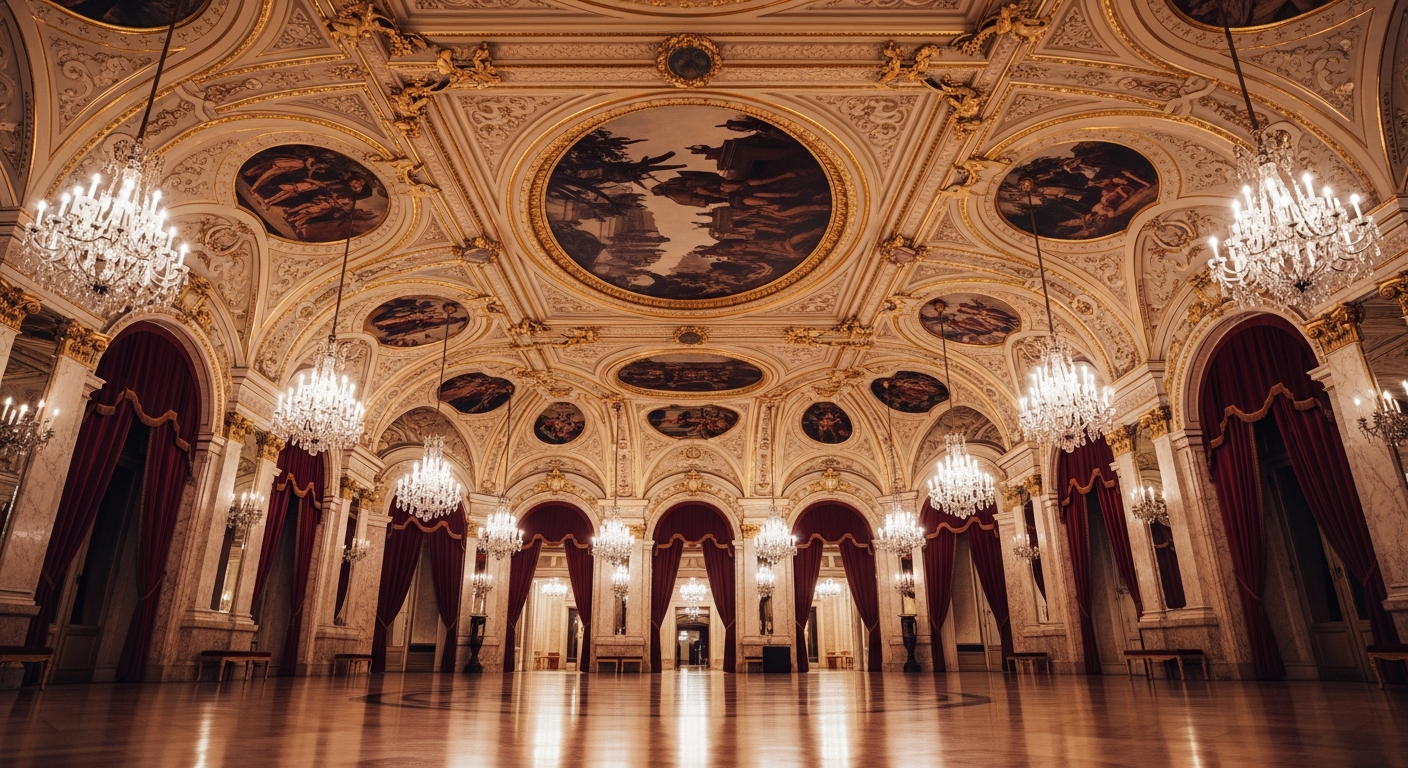
Vienna is the city that institutionalised pleasure. Not hedonism, which is a different thing, but pleasure as civic discipline: the opera season, the concert calendar, the ball season that runs from November through February and comprises, in a normal year, approximately 450 events. The rest of Europe dances occasionally. Vienna dances with a schedule.
The Ball Season and Its Logic
The season opens on November 11th and runs through Shrove Tuesday in February, with the Opera Ball as its undisputed close. The structure is not casual. Each ball belongs to a professional guild or civic institution: the Pharmacists' Ball, the Lawyers' Ball, the Coffeehouse Owners' Ball, now in its 67th year. The Medical Ball, the Hunters' Ball, the Firemen's Ball. The city's entire social architecture is organised around the convention that at certain points in the winter, you put on a floor-length gown and spend eight hours dancing in a room that was designed three centuries ago to receive exactly this use.
The Hofburg, the imperial palace complex at the centre of the first district, hosts many of the major balls in the Redoutensale, the ceremonial halls remodelled in 1748 by Jean Nicolas Jadot de Ville-Issey under the direction of Empress Maria Theresa. The stucco ceilings, the mirrored walls, the floors that were built for waltzing: all of it is exactly what it appears to be. It has been hosting this function for two and a half centuries.
The Opera Ball
The Wiener Staatsoper opens its floor once a year. The building was inaugurated in 1869 under Emperor Franz Joseph I and designed by architects August Sicard von Sicardsburg and Eduard van der Null, who died by suicide before it opened, having read a newspaper review that called the building too low. The Opera Ball takes place on the Thursday before Ash Wednesday, fills the stalls with 5,000 guests, and begins with a polonaise performed by 180 debutante couples who have auditioned months in advance for their Viennese waltz technique. The debutantes wear white gowns. The men wear white tie and tails. The orchestra plays Johann Strauss, Joseph Lanner, Carl Michael Ziehrer. The dancing continues until five in the morning.
The dress code is explicit: floor-length gowns only for women, white tie and tails for men. This is not a suggestion. The Opera Ball committee enforces it at the door. The floor-length requirement has an architectural logic: the staircase of the Staatsoper, the lobbies, the boxes, all of it was designed with the silhouette of a floor-length dress in mind. A shorter dress at the Opera Ball does not read as modern. It reads as not understanding the room.
The Floor-Length Gown and Its Demands
A ball gown that works for eight hours of dancing has specific requirements distinct from a dinner dress that works for three. The back is typically lower, because waltzing generates heat and the design allows for movement. The neckline is either strapless, halter, or deeply V-cut, because the shoulder strap interrupts the line of the gown when the arms are raised. The fabric must hold its structure through sustained physical activity: duchesse satin, structured organza, heavy crepe. The body underneath must be equally considered.
What a Viennese ball gown requires at the bodice is a base that creates no visible line, holds through eight hours of waltzing, and disappears entirely under the fabric. Medical-grade silicone covers from Korea, ultra-thin at the edge, give the gown its intended structure without anything visible beneath or above the neckline. The adhesive releases cleanly at the end of the evening, good for fifteen or more wears. The dress does what the dress was designed to do, which is dance.
For a complete guide to invisible foundations under formal evening wear, read the guide to invisible lingerie for formal occasions.
Vienna Outside the Ballroom
The Wiener Werkstatte, the design workshop founded in 1903 by Josef Hoffmann and Koloman Moser, produced textiles, jewellery, and fashion until 1932. The workshop's output saturated Viennese society in the early twentieth century in a way that still reads in the aesthetic of the city: the geometric patterns, the flat planes, the discipline of ornament. The Backhausen company, which supplied textiles to the Werkstatte, still produces from the original designs. The fabric is available by the metre in a workshop off the Karntnerstrase.
The Cafe Landtmann on the Ringstrasse opened in 1873 and has been Sigmund Freud's preferred coffee house, the preferred meeting point of the Austrian political class, and the breakfast room for anyone staying near the Burgtheater. The Melange arrives in a silver pot. The Apfelstrudel is made in the kitchen at the back and served warm with vanilla sauce. The newspapers arrive on wooden reading sticks, which is a system that was practical before the internet and remains charming after it.
The Ringstrasse in Winter
Emperor Franz Joseph I commissioned the Ringstrasse in 1857, demolishing the old city fortifications to build the grand boulevard that now circles the first district. The buildings were constructed between 1860 and 1890 and represent every major historical style of the nineteenth century simultaneously: the Parliament in Greek Revival, the Rathaus in Gothic, the Kunsthistorisches Museum and Naturhistorisches Museum in Renaissance, the Opera in early French Renaissance. Standing at any point on the ring and turning 360 degrees produces a kind of compressed architectural history lesson that is disorienting if you think about it and spectacular if you do not.
In January, when the season is at its height, the Ringstrasse is lined with ice sculptures that melt slowly over the month and are replaced. The trees are bare. The buildings, which are large and pale and lit from below at night, are more visible without the summer foliage softening their edges. This is when the city looks most like itself. The cold helps. Everything is cleaner in the cold.
The Naschmarkt, the open-air market along the Wienzeile, runs from Monday to Saturday. At nine in the morning in February it is full of Viennese residents who have not yet transitioned to the ball calendar of the evening. The Styrian pumpkin oil, the Turkish spice stalls, the Viennese sausage stand at the north end of the market: these are the city's other register, the one that exists at the same time as the one that dresses in white tie and dances until five.


