
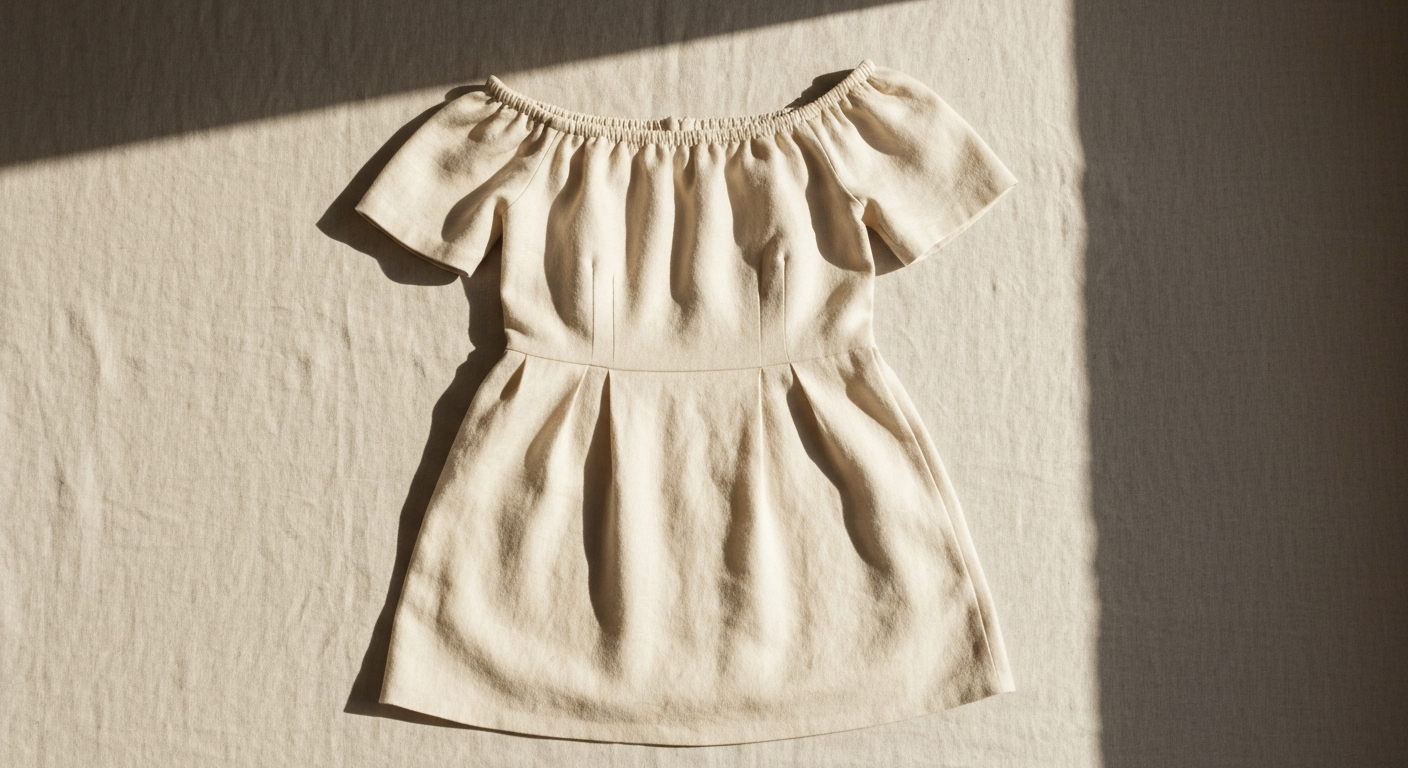
The off-shoulder neckline appears in nearly every culture's festive dress history. The Regency-era gown in Jane Austen's England wore its neckline at the shoulder; the peasant blouse of southern Spain dropped it further, to the upper arm. The Bardot neckline, named for Brigitte Bardot who wore it constantly in the late 1950s and made it synonymous with a particular kind of unhurried Mediterranean femininity, is the modern version: elastic-stabilised or boned, cut to sit at or just below the shoulder, framing the collarbone and the upper chest without covering the shoulder itself. The shoulder is the point. The shoulder is exposed, and the neckline exists to hold everything below it in position.
The short answer: the Confidence Set solves the off-shoulder problem with no strap to hide.
The construction is either very clever or very demanding depending on what you bring to it. When the garment is right and the solution is right, the off-shoulder neckline is one of the most flattering cuts in dressing. It lengthens the neck visually. It frames the face from below. It communicates ease in a way that a higher neckline cannot, because the shoulder is one of the areas that reads most immediately as relaxed or tense on a body. Bare, well-positioned, it signals exactly the kind of effortless that requires a great deal of preparation.
The Structural Logic
The best option under an off-shoulder dress is silicone nipple covers. The off-shoulder neckline sits below the shoulder joint, making every bra strap visible at the neckline edge. Avoid strapless bras with a back closure: the band sits at the same height as the dress's boning and creates bulk.
An off-shoulder garment holds itself up by engineering. The neckline sits below the shoulder. There is no natural hook point on the body for the garment to anchor to. What holds it are the boning or elastic in the neckline channel, the fit of the bodice itself, and the fabric weight. A well-constructed off-shoulder garment in a medium-weight fabric with boned channels at the neckline will hold its line for an entire evening without requiring attention. A poorly constructed one in a light chiffon with elastic that has lost its tension will be pulled back to the shoulder every twenty minutes and will eventually migrate there permanently.
The implication for lingerie is direct. A garment held up by a neckline band cannot share its structure with a bra. A conventional bra has straps that sit on the shoulders. The off-shoulder neckline sits on the upper arm, below where straps belong. The strap will be visible, sitting in the frame of the neckline or on the bare shoulder above it. This is not a styling question. The strap simply does not belong in that visual territory.
The second problem is the bra band itself. Most off-shoulder garments are snug at the chest, fitted across the upper torso to compensate for the absence of shoulder support. A bra band adds a layer of structure beneath the garment's own structure and, in any fitted bodice, will create visible lines through the fabric. This is particularly true in the light fabrics that suit the off-shoulder aesthetic: cotton voile, silk charmeuse, lightweight crepe. In heavy brocade or structured jacquard, a bra band might be absorbed. In the fabrics that belong to the cut, it creates a visible band across the back that competes with the garment's architecture.
Strapless: The Attempted Solution
The strapless bra is the first move most women make with an off-shoulder garment, and it solves the strap problem while creating two others. The band problem remains: a strapless bra still has a band, still sits at the ribcage, still creates that horizontal line through a fitted bodice. More significantly, a strapless bra has side boning and coverage that extends to the armhole territory. In an off-shoulder garment that is fitted from the neckline down, the strapless bra's upper edge often sits at exactly the point where the garment's neckline channel is working hardest. The two structures compete.
The strapless bra is also, for many women, unreliable in ways that make a long evening uncomfortable. The bra migrates downward when there are no straps to hold it. The solution is to keep tightening the band, which creates discomfort over several hours. A strapless bra tight enough to stay in position through a four-hour dinner and dancing is tight enough to be noticeable. The trade-off is always present.
Convertible bras with straps that can be configured to one-shoulder or crossed-back positions do not solve the off-shoulder problem. The straps, regardless of configuration, will appear somewhere above the garment's neckline, which is exactly where the aesthetic says nothing should appear.
What the Neckline Actually Requires
The off-shoulder neckline, when built properly, handles the structural load itself. A well-boned bodice holds the bust without any undergarment at all. The boning presses the fabric against the body from the inside, creating a form that the bust sits within. This is how the Regency gown worked. This is how Balenciaga's corseted off-shoulder gowns from the 1950s worked. The structure was in the garment. The body was in the structure.
Not every off-shoulder dress is Balenciaga. The high-street version of the cut, in cotton or cotton-blend with elastic rather than boning, relies on the elastic to hold the neckline position and on the wearer's torso width to keep the garment from falling. These garments often have nothing structural inside. For these, the question of what to wear underneath is genuinely open, because there is no internal structure to work with.
For the neckline to sit correctly on both types of garment, coverage needs to be front-facing only, without any structure that extends upward toward the shoulder or laterally toward the armhole. Medical-grade silicone covers from Korea work here because they occupy only the zone they need to occupy: the nipple and the immediate surrounding tissue. Ultra-thin at the edge, less than half a millimetre where they meet the skin. The adhesive holds through the kind of evening that tests it. The covers move with the body rather than fighting the garment's own structure.
For a fitted, self-supporting off-shoulder bodice, this is the complete solution: covers for coverage, nothing else. The garment does the rest. The shoulder is bare. The collarbone is framed. The neckline holds.
The Elastic Neckline Variant
The elastic-neckline version of the off-shoulder garment is the most democratised version of the cut. It appears on everything from sundresses in Zara to the Johanna Ortiz ruffled shoulders that appeared on every terrace in the Mediterranean in 2021 and 2022. The elastic is either single-channel, which is the basic version, or multi-channel, which creates the ruched gathering that is characteristic of the more architecturally elaborate versions.
The elastic version has a specific problem: it can move. A stiff boned neckline holds its position with precision. An elastic neckline moves with the body, with the garment's weight pulling it down and the body's motion pulling it in different directions. This is acceptable, even desirable, in many casual contexts. At a wedding or a formal dinner, the constant readjustment is not part of the aesthetic.
The way to stabilise an elastic-neckline off-shoulder garment is body tape, applied vertically from the inside of the neckline to the chest wall. This tethers the garment to the body at the position where you want it to sit. The tape does not need to be extensive: two strips, each five to eight centimetres, placed at the centre front and at each side, is usually sufficient to hold the neckline at its intended position for the duration of an evening. The tape is invisible under the garment. The neckline holds. The shoulder stays bare.
Sunburn and the Off-Shoulder
The off-shoulder neckline has an inconvenient relationship with sun. In a Mediterranean summer, wearing an off-shoulder garment during daylight means the shoulder and upper chest are fully exposed to direct sun. The neckline is also typically the lowest point on the body to receive afternoon sun, meaning the upper chest catches light at an angle that the rest of the body does not. The result, familiar to anyone who has spent a day in Positano or Taormina in an off-shoulder sundress, is a sunburn pattern that does not match any conventional garment's coverage line.
This is a practical consideration for event-dressing as much as a health consideration. A sunburn on the shoulder and upper chest on the afternoon before an evening event changes the landscape in ways that affect both what you wear and how you feel wearing it. High-factor sun protection on exposed skin is the obvious answer, but the application pattern needs to match the garment's neckline precisely. The line where sunscreen ends is the line where the colour change begins.
The Weight of Fabric and What It Changes
Fabric weight is the variable that determines how forgiving an off-shoulder garment is in practice. Heavy fabrics, a dense cotton poplin, a structured silk dupioni, a thick crepe, fall from the neckline and hold their position. The weight pulls the hem down and keeps the bodice in position. These garments are easier to wear because the physics are working in your favour.
Light fabrics, chiffon, voile, silk charmeuse, create a different relationship. They do not fall. They float. The neckline on a lightweight off-shoulder garment is always in motion, responding to air movement and body heat and the physics of very low-density cloth. This is part of the aesthetic appeal. It is also the reason these garments require more attention than their heavier counterparts, and why the solution for what you wear underneath needs to be minimal. Any undergarment with structure adds rigidity to a garment that is designed to be fluid, and the visual contrast is immediate.
The lightest off-shoulder garments, true silk charmeuse or an Italian voile, require the minimum possible intervention: covers only, nothing structural, and body tape applied sparingly to anchor the neckline at specific points. This combination lets the fabric move as it was cut to move while keeping the garment in the position that makes it work.
The Off-Shoulder at Different Events
The off-shoulder neckline reads differently across event contexts, and the solution for each is slightly different. At a beach club lunch in Formentera, the most casual version of the cut in a lightweight fabric is the natural choice. The event is warm, the light is bright, the register is relaxed. Coverage can be minimal, and the garment's performance requirements are correspondingly low.
At a wedding reception in a Lisbon courtyard in late afternoon, the off-shoulder garment is a formal choice in a demanding setting. The afternoon light on stone, the photographs, the hours of standing and sitting and dancing: the garment needs to hold its position for six hours across varying activity levels. Here the construction of the garment matters most. A boned bodice is the right tool. The solution for underneath is the same as always: front-only coverage, nothing that competes with the garment's internal structure.
At a dinner in a hotel in Paris in September, the off-shoulder in a heavier autumn fabric, a silk velvet or a structured wool crepe, operates in a completely different register from the summer version. The shoulder is exposed in indoor light, which is more scrutinising than outdoor light. The fabric weight means the garment holds its position without assistance. The formality of the context means the fit needs to be precise.
The Collarbone
The off-shoulder neckline is, ultimately, a frame for the collarbone. The cut was designed to show the junction of the neck and the shoulder, the hollows above the clavicle, the slight depression at the throat. This is a specific anatomy, one that photographs well in almost all light conditions, that communicates a particular kind of effortless femininity regardless of body type, and that has maintained its presence in fashion for two centuries because it keeps being right.
The collarbone requires space. Heavy jewellery competes with it. A high collar directly above it interrupts it. The off-shoulder neckline frames it by removing everything that surrounds it and offering the negative space that lets it define the silhouette.
When the garment holds, when the collarbone is correctly framed, when nothing below the neckline interrupts the line, the result is one of the cleanest silhouettes in dressing. No era has improved on it. It appears in Roman marble as readily as it appears in a Valentino Resort collection. The form is right. The engineering is what changes.
For a deeper look at managing open-back cuts with the same minimal-structure approach: what to wear under a backless dress.
The off-shoulder garment, at its best, disappears. The neckline becomes the architecture of the body itself. The shoulder is not exposed; it is presented. There is a difference, and when you find a garment that makes it, you wear it again.
Frequently asked questions
Can you wear a regular bra under an off-shoulder dress?
No. A conventional bra's straps sit on the shoulders, but an off-shoulder neckline sits on the upper arm below where straps belong, so the strap ends up visible in the neckline or on the bare shoulder above it. In fitted, light fabrics like cotton voile or silk charmeuse, the band also shows as a visible line.
Does a strapless bra work under an off-shoulder dress?
It solves the strap problem but creates two more. The band still sits at the ribcage and shows through a fitted bodice, and its side boning often competes with the garment's own neckline structure. Without straps to hold it, the bra migrates downward, so it needs tightening, and tight enough to last a four-hour dinner becomes noticeable.
How do you stabilize an elastic off-shoulder neckline so it doesn't slip?
With body tape applied vertically from the inside of the neckline to the chest wall. Two strips, five to eight centimetres each, placed at the centre front and at each side, are usually enough to hold the neckline in position for an entire evening. The tape stays invisible under the garment.
What do you wear under a boned, self-supporting off-shoulder gown?
A well-boned bodice holds the bust on its own, the way Regency gowns and Balenciaga's 1950s corseted off-shoulder gowns worked, structure in the garment rather than underneath it. Coverage only needs to be front-facing, so silicone covers occupying just the nipple area work well since they add no shoulder- or armhole-reaching structure to compete with the bodice.


