
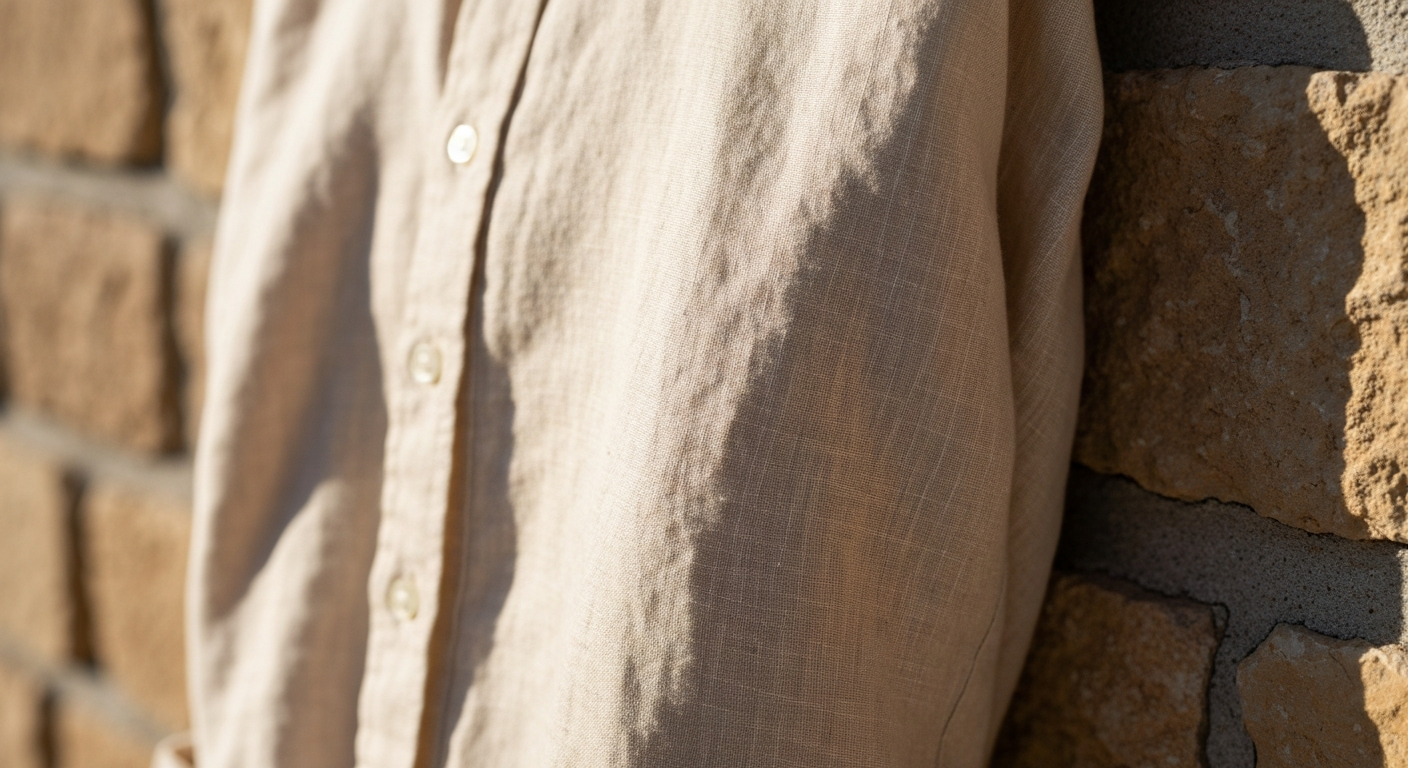
Linen's hollow fiber core makes it cool against the skin and translucent in direct sun or humidity. The shirt that was fully opaque at nine in the morning reads through by noon in Mediterranean light. Silicone covers allow the linen to sit over bare skin with nothing the sun can find.
The short answer: matte silicone covers. Linen turns translucent in daylight, and a bra in any colour prints through the weave. Covers disappear where even nude bras shadow. The longer answer below: why linen behaves this way, and what works under it by colour and cut.
The oldest linen in the world is Egyptian. Fragments of it were found wrapped around mummies, preserved for four thousand years because linen does not rot the way wool or silk do. It is resistant to decay in dry conditions, which sounds like a material virtue until you understand the mechanism: flax fiber, which is what linen is, has a hollow core. A microscopic channel running the length of each strand. That channel is why linen survives time. It is also why linen, in summer heat, behaves the way it does against a body.
Heat enters the channel. Moisture wicks through it. The fiber conducts heat away from the skin roughly thirty percent faster than cotton does. This is why a linen shirt worn on an August afternoon on the Amalfi coast, or in the Alfama, or on the ferry from Athens to Hydra, feels cool while it is dry. The physics is real, not marketing. The hollow core pulls warmth away before it has a chance to accumulate.
But the same structure that makes linen cool also makes it honest. When body heat builds, when the humidity rises, when a sleeve brushes against a wall and absorbs even a faint trace of moisture, the weave shifts. The fibers swell slightly, the weave loosens, and what was fully opaque at nine in the morning becomes translucent by noon. Light-colored linen, loosely woven, can become effectively sheer in direct sunlight or against a bright interior. This is not a flaw. It is the nature of the material. The question is whether what lies beneath it belongs to the picture.
Why Linen Has Always Been a Mediterranean Problem
In Italy, the relationship between linen and the body is understood differently than in northern Europe. The women in Positano in July, at a lunch table overlooking the Tyrrhenian Sea, are not wearing anything under their linen shirts that changes the silhouette of the shirt. There is no visible strap, no bra band at the mid-back, no line cutting across a shoulder blade. The shirt falls as the shirt was cut to fall. The person inside it is present without the underwear being present.
This is not negligence. In the Capri of the 1960s, where Jacqueline Kennedy photographed on the beach at La Canzone del Mare, the aesthetic instruction was always the same: the garment and the body, nothing in between that announces itself. The modern version of this sensibility is the same principle in a different decade.
Portuguese linen, much of it woven and dyed in the mills of Guimaraes before it reaches the workshops on the outskirts of Lisbon, is among the finest produced in Europe. It is typically medium-weight, with a thread count high enough to maintain opacity in most conditions. But even good linen, Italian or Portuguese, becomes semi-transparent under the right light. The question of what to wear underneath it is a question of weave weight, of the color of the shirt, and of where you will be when the light changes.
The Engineering Problem
A linen shirt has a different architecture than a linen dress or linen trousers. The shirt closes at the front. It has a collar structure that holds it slightly away from the chest. It is typically cut with enough ease to allow air circulation, which also means enough ease for light to pass through when the fabric is backlit by the sun coming off the water.
The problem is concentrated in the chest and the neckline. A bra with a visible band, worn under a partially unbuttoned linen shirt, creates a break in the line of the garment that the eye catches before anything else. A bra with colored fabric, even nude fabric that is not precisely matched to your skin tone, reads differently against linen than against a thicker jersey. Linen's slightly irregular, textured weave does not absorb or diffuse what lies beneath it. It transmits.
For a relaxed summer shirt that buttons to the neck, the problem is one thing. For the same shirt worn open to the third button, in the way that a shirt is worn at a harbor restaurant in late afternoon light, the problem is another. The open neckline creates a visual frame. What is visible or almost-visible inside that frame is part of the composition, whether you intend it to be or not.
The same article of clothing behaves differently in different conditions. A loose white linen shirt that looks completely opaque in a dim restaurant interior will backlight to near-transparency when you step outside into direct Mediterranean sun. This is not a surprise if you understand the material. It is a reason to make a considered choice about what goes under it before you leave the house.
What Does Not Work
A structured bra with molded cups will alter the fall of a linen shirt in the chest area, creating a rounded silhouette where the shirt was designed to hang flat. This is not a failure of the bra. It is a fundamental incompatibility between molded foam construction and woven natural fabric. The shirt fights the structure beneath it and loses.
A bandeau or strapless bra with any visible edging creates a horizontal line across the chest. Against linen, which is slightly translucent in strong light, this line is not invisible. It is simply horizontal and unwanted.
A camisole or tank underneath a partially unbuttoned shirt adds a layer that is immediately visible at the neckline and changes the weight and drape of the garment. The shirt no longer falls freely. It catches on the camisole at the shoulders, pulls slightly differently across the back. The linen reads as covered rather than as worn.
What Does Work
The solution the shirt requires is one that has no presence of its own. Medical-grade silicone covers from Korea, ultra-thin at the edge, the width of a human hair, apply directly to the skin and disappear under the fabric. There is no band, no edge, no structural presence. The shirt falls the way the shirt was cut to fall. The opacity question is answered without altering anything about how the garment hangs or moves.
This is not a new approach to old linen. The women in Positano in 1965 had their own methods. What has changed is the technology: an adhesive that releases cleanly without residue, a silicone formulation thin enough that the edge does not create a ridge line even under a fine weave, coverage designed to last the length of a day rather than the length of a morning. Good for fifteen or more wears, stored in the original case, unchanged. The fabric can breathe. The channel in the flax fiber can do its work. Nothing underneath the shirt competes with the shirt.
The same logic applies across the full range of semi-transparent summer fabrics. Sheer blouses and backless dresses present related problems from different angles. The material changes; the underlying question stays the same: what disappears cleanly, and what does not.
The Question of White
White linen is the test case. Every other color has some degree of additional opacity built into it by the dye. White linen, especially loosely woven or medium-weight white linen worn in direct sunlight, is essentially transparent in certain conditions. This is not unique to linen: white cotton voile, white silk habotai, white gauze, all behave similarly. What is specific to linen is how quickly the transparency threshold is crossed. The hollow core heats and the weave opens faster than you expect.
White linen worn on a boat, or on a terrace with a sea view, or walking through a city in August where the stone reflects heat upward from the ground, will reach the transparency threshold within an hour. This is not a catastrophe. It is a fact about the material that allows you to prepare for it.
Ivory and ecru linen, which are the most common tones in Italian and Portuguese summer collections, are marginally more forgiving than pure white because the natural flax pigment remains in the fiber. They still require consideration. They reward it.
How Linen Actually Wrinkles
Part of the specific knowledge required to dress in linen is accepting that linen wrinkles, and that the wrinkles are structural rather than cosmetic. The same hollow core that makes linen breathable creates a fiber with limited elastic recovery. When compressed, which happens every time you sit down, the flax strand bends and holds the bend rather than springing back. A linen shirt worn for three hours in a car or at a desk will look different from a linen shirt put on fresh. This is not a problem to be solved. It is a condition to be dressed around.
The wrinkle follows the movement of the body. It accumulates at the elbows, across the lap, at the small of the back. A well-cut linen shirt in a medium weight, around 180 to 210 GSM, will wrinkle in a way that reads as lived-in rather than neglected. A lighter linen, the kind used in summer suiting, will wrinkle more dramatically and require more deliberate care. This is a matter of fit: a shirt that is too tight across the chest or back will wrinkle irregularly and unflattering. One that has sufficient ease will crease in the expected places and hold its general line.
The wrinkle problem and the transparency problem are related. A heavily creased shirt scatters light differently than a smooth one. The folds catch shadow and light alternately, which paradoxically makes the garment appear more opaque than when it is flat. This is why a linen shirt fresh from the hanger is more revealing than one worn through a long afternoon. The morning opacity is the dangerous one.
The Full Picture
The point of linen, the reason it has survived as the dominant fabric of Mediterranean summers for four thousand years, is not that it solves every problem perfectly. It is that it solves the problem of heat in a way no synthetic fabric ever fully replicates. The hollow flax core, the irregular weave, the way it softens and lightens over repeated washing: these are features of a material that was engineered by the slow pressure of agricultural necessity across centuries of hot summers around a particular body of water.
Dressing well in linen means understanding what the fabric does and what it does not do, and making choices accordingly. The shirt you choose for an outdoor lunch in July, where the light will be direct and the temperature will rise through the afternoon, requires different consideration than the same shirt worn for a morning meeting indoors. Understanding the material means you can trust it. Linen trusted, on the right day, in the right light, with nothing underneath it that announces itself, is one of the better things you can wear.
The hollow core, the wrinkle, the afternoon transparency: these are all the same property working at different scales. A fiber that breathes fully, that moves freely, that accepts the heat of a Mediterranean day and passes it through rather than holding it. The rest is a matter of preparation. Dress around the material, and the material works with you.
Frequently asked questions
What should you wear under a linen shirt?
Matte silicone covers. Linen turns translucent in daylight and a bra in any colour, even nude, prints through the weave and casts a shadow. Covers applied directly to the skin disappear because they have no band or structural edge for the fabric to pick up and reveal.
Why does a white linen shirt become see-through?
Linen's flax fibre has a hollow core that wicks heat and moisture. As body heat builds, the weave loosens, and fabric that was opaque in the morning can turn translucent by noon. White or loosely woven linen crosses that threshold fastest, sometimes within an hour in direct sun.
Can you wear a regular bra under a linen shirt?
Not well. A structured bra with molded cups creates a rounded silhouette where the shirt is meant to hang flat, and a bandeau or strapless bra's edging shows as an unwanted horizontal line. A camisole underneath adds visible bulk at the neckline and changes how the shirt drapes and moves.
What's a good alternative to a camisole under a sheer linen shirt?
Medical-grade silicone covers applied directly to the skin, with no band or structural presence to disturb the shirt's drape. Ultra-thin at the edge, the width of a human hair, so no ridge line shows, and good for fifteen or more wears when stored in the original case between uses.
The dress decides what shows. The covers decide what does not.

Matte and invisible under sheer.
€29,90€5,98 a pair
Korean silicone · 15+ wears per pair
“I carry them with me everywhere.”
Carol M.

